

From Arafat to Muzdalifah, 1.6m Hajj pilgrims continue their sacred journey

1 / 3
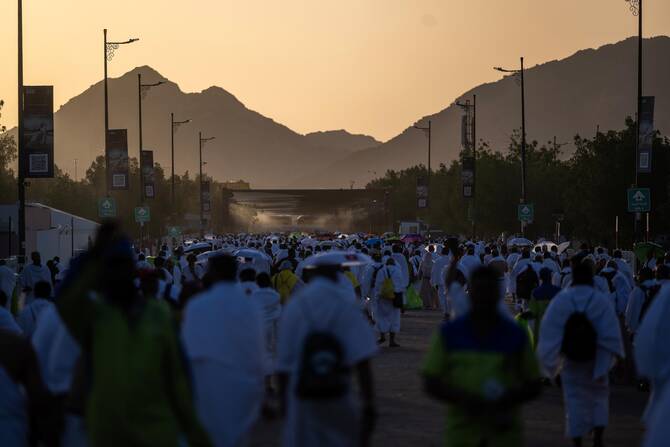
As the sun set over Mount Arafat, signaling the end of the day’s rituals, pilgrims began leaving en masse for Muzdalifah, a holy site nestled between Arafat and Mina. (SPA)
2 / 3
As the sun set over Mount Arafat, signaling the end of the day’s rituals, pilgrims began leaving en masse for Muzdalifah, a holy site nestled between Arafat and Mina. (SPA)
3 / 3
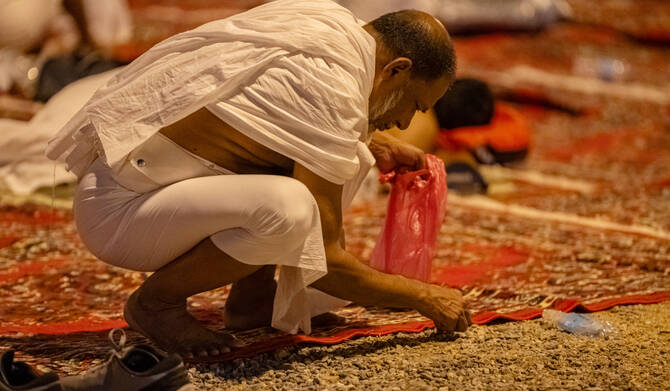
In Muzdalifah, the pilgrims collect pebbles for the stoning of the devil ritual at the Jamarat area in Mina. (AN photo by Huda Bashattah)
Short Url
Updated 05 June 2025
Follow

From Arafat to Muzdalifah, 1.6m Hajj pilgrims continue their sacred journey

  • As the sun set over Mount Arafat, signaling the end of the day’s rituals, pilgrims began leaving en masse for Muzdalifah, a holy site nestled between Arafat and Mina
  • Travel from Arafat to Muzdalifah was achieved by using a vast fleet of buses operating on a phased schedule

RIYADH: On Thursday, corresponding to Dul Hijjah 9, more than 1.67 million pilgrims gathered on the plain of Arafat, marking the spiritual apex of the Hajj pilgrimage.

From early morning, the atmosphere in Arafat was one of intense devotion, with worshippers praying, reciting the Qur’an, and raising their hands in supplication.

The Day of Arafat, considered the most sacred in the Islamic calendar, is the heart of the Hajj journey.


In Muzdalifah, the pilgrims collect pebbles for the stoning of the devil ritual at the Jamarat area in Mina. (AN photo by Huda Bashattah)

As the sun set over Mount Arafat, signaling the end of the day’s rituals, pilgrims began leaving en masse for Muzdalifah, a holy site nestled between Arafat and Mina.

The move to Muzdalifah is an integral part of Hajj, combining logistical coordination with spiritual significance.

This leg of the journey is tightly choreographed by Saudi authorities to ensure safe and efficient travel despite the enormous scale of the operation.

According to the General Authority for Statistics, 1,673,230 pilgrims are performing Hajj this year, with 1,506,576 of them from outside the Kingdom.

The number of domestic pilgrims is 166,654, including citizens and residents.

Managing the movement of such large numbers requires seamless coordination between several agencies, including the Ministry of Hajj and Umrah, the Ministry of Interior, and the Transport General Authority.

Travel from Arafat to Muzdalifah was achieved by using a vast fleet of buses operating on a phased schedule. Additionally, the Al-Mashaaer Al-Mugaddassah Metro, a railway system built exclusively for Hajj, played a major role in easing congestion.

The nine-station metro can transport up to 72,000 pilgrims an hour in one direction, operating on a circular loop connecting Arafat, Muzdalifah, and Mina.

Authorities also used smart surveillance systems, drones, and real-time data to monitor crowd movement and prevent bottlenecks.

Volunteers and security personnel were stationed at checkpoints to guide pilgrims and ensure safety during this critical transition.

Upon arrival in Muzdalifah, pilgrims performed the Maghrib and Isha prayers — traditionally shortened and combined — before beginning another key ritual: collecting 49 pebbles for the symbolic stoning of the devil at the Jamarat site in Mina.

Many pilgrims chose to rest or sleep under the open sky, emulating Prophet Muhammad’s practice during his farewell pilgrimage. Although logistically smaller than other holy sites, Muzdalifah was fully equipped with ample lighting, shaded rest areas, water stations, and mobile medical units.

The Ministry of Health deployed more than 120 ambulances and several field hospitals at Arafat and Muzdalifah, supported by thousands of medical staff to respond to heat stress, dehydration, or urgent health issues.

Mobile clinics were also stationed at key points to assist elderly and vulnerable pilgrims.

These logistical and health measures reflect Saudi Arabia’s long-term commitment to improving the Hajj experience under Vision 2030.

Through a blend of faith, planning, and technology, this year’s Hajj continues to evolve into a model of safety, efficiency, and spiritual focus for millions of Muslims worldwide.


Experimental farm in Al-Lith looks into future of Saudi Arabian agriculture

Updated 02 February 2026
Follow

Experimental farm in Al-Lith looks into future of Saudi Arabian agriculture

  • Research initiative reflects strategic transformation

JEDDAH: An experimental farm in Saudi Arabia’s Al-Lith Governorate is one of the research initiatives reflecting the strategic transformation taking place in the Kingdom’s agricultural sector.

The farm uses highly efficient, sustainable production models that combine scientific research with commercial application, contributing to strengthening the country’s food security system and the sustainability of water resources.

Located in the Ghumaiqa Center on an area of about 10 hectares, the cutting-edge farm is a testing platform for modern agricultural technologies that tackle the challenge of water scarcity.

The farm includes developed open fields and modern greenhouses, supported by smart irrigation encompassing drip and sprinkler irrigation alongside surface and subsurface technologies.

All the systems operate via smart controls that enable the monitoring of water consumption and ensure improved efficiency, thereby achieving a balance between agricultural production and water conservation.

The farm also uses treated and diluted low-salinity seawater.

It aims to diversify agricultural water sources, reduce reliance on freshwater, and open new horizons for agriculture in coastal and semi-arid environments.

A view of the experimental farm in Al-Lith. (SPA)

The project represents a promising investment opportunity in the field of smart agriculture, enabling the development of commercially scalable production models, particularly for high-value vegetables and fruits, while reducing operational costs associated with water and energy, enhancing the economic feasibility of future agricultural projects.

In addition, the project contributes to transferring and localizing agricultural expertise, supporting local food supply chains, and creating an attractive environment for agricultural investment.

This aligns with Sustainable Development Goals and enhances the efficiency of the private sector in adopting innovative agricultural solutions.

Yahya bin Abdulrahman Al-Mahabi, the director of the Ministry of Environment, Water and Agriculture office in Al-Lith Governorate, told the Saudi Press Agency that the project represented the future of agriculture in the Kingdom.

He explained that the vision was based on investing in technology, enhancing the return on water per unit, and integrating scientific research with investment opportunities.

Al-Mahabi spoke of the experimental farm as a modern, scalable and replicable model applicable in several regions of the Kingdom, particularly in coastal environments.

Al-Mahabi highlighted the Ministry of Environment, Water and Agriculture’s commitment to supporting distinctive projects that contributed to achieving food security while developing rural areas and enhancing agricultural production efficiency, in line with the objectives of the Kingdom’s Vision 2030.