Pakistan steps up local vaccine manufacturing push with Saudi cooperation

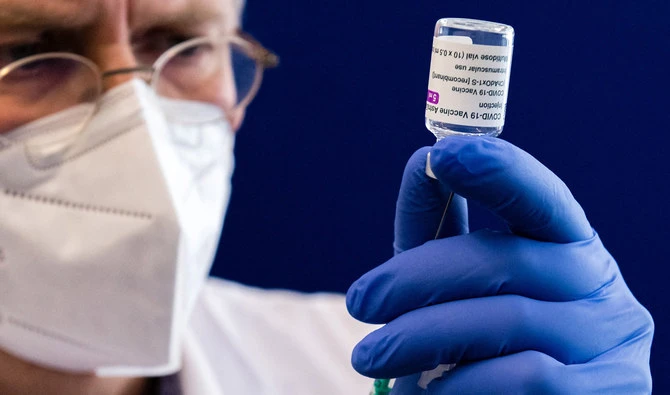
A healthcare worker fills a syringe with the AstraZeneca Covid-19 vaccine at the university hospital in Halle/Saale, eastern Germany, on February 12, 2021. (AFP/File)
Short Url
Updated 02 February 2026
Follow

Pakistan steps up local vaccine manufacturing push with Saudi cooperation

  • Talks with Saudi delegation aim to support domestic production for national immunization needs, ministry says
  • Pakistan currently imports all vaccines, which ramps up foreign exchange and procurement pressures

ISLAMABAD: A high-level Saudi delegation is arriving in Pakistan today, Monday, to give practical shape to local vaccine manufacturing in Pakistan, the health ministry said in a statement amid Islamabad’s push to meet its national immunization needs. 

The eleven-member Saudi delegation’s visit marks a “critical milestone” in strengthening bilateral cooperation between Pakistan and Saudi Arabia in health, pharmaceutical manufacturing and industrial collaboration, the ministry said. 

It added that the development takes place after Pakistan Health Minister Syed Mustafa Kamal held three meetings with his Saudi counterpart over the past seven months in which both sides discussed local vaccine manufacturing, investment opportunities and technical cooperation. Kamal also met Saudi Arabia’s minister of industry to discuss the same. Both sides designated focal persons to ensure effective coordination and follow-up after the meetings. 

“The visit of the high-level Saudi delegation is expected to prove a decisive step toward giving practical shape to the process of local vaccine manufacturing in Pakistan,” Kamal was quoted as saying by the health ministry. 

The Pakistani health minister reaffirmed Islamabad’s commitment to establishing local vaccine production facilities, stating that domestic manufacturing will not only meet Pakistan’s national immunization needs but will also enable surplus production for export. 

This, he said, would contribute to Pakistan’s economic growth and national stability.

“Ensuring the availability of safe, high-quality vaccines for the public remains the government’s top priority, ” the minister said. 

Since Pakistan does not produce vaccines locally, it has to import them from other countries. Producing vaccines will help the South Asian country save valuable foreign exchange and avoid longer procurement delays as it seeks to inoculate its population against various diseases. 

Pakistan, a country of over 240 million people, regularly holds national immunization campaigns against diseases such as polio, measles, rubella and hepatitis. 


Pakistan reviews austerity measures amid Middle East crisis, urges strict nationwide implementation

Updated 11 March 2026
Follow

Pakistan reviews austerity measures amid Middle East crisis, urges strict nationwide implementation

  • Deputy Prime Minister Ishaq Dar chairs review meeting of austerity steps
  • Officials briefed on salary cuts, school closures, four‑day week, petrol conservation

ISLAMABAD: Pakistan’s government on Wednesday assessed progress on a sweeping set of austerity measures introduced to mitigate the country’s economic strain from sharply rising global oil prices and supply disruptions linked to the ongoing war in the Middle East.

Prime Minister Shehbaz Sharif this week announced a series of austerity steps, including a four‑day work week for government offices, requiring 50  percent of staff to work from home, cutting fuel allowances for official vehicles by half, grounding up to 60  percent of the government fleet and closing all schools for two weeks to conserve fuel amid the global oil crisis.

The measures were unveiled in response to global oil market volatility triggered by the conflict involving the United States, Israel and Iran, which has disrupted supply routes such as the Strait of Hormuz and pushed crude prices sharply higher, straining Pakistan’s heavily import‑dependent energy sector.

“The meeting stressed the importance of strict and transparent adherence to the austerity measures, promoting fiscal responsibility and prudent use of public resources,” Deputy Prime Minister and Foreign Minister Senator Mohammad Ishaq Dar said in a statement.

He was chairing a meeting of the Committee for Monitoring and Implementation of Conservation and Additional Austerity Measures, constituted under the directions of the PM, bringing together federal and provincial officials to review execution of the broad cost‑cutting plan. 

Dar emphasized the government’s commitment to enforcing the PM’s austerity steps nationwide. The committee’s review also covered reductions in departmental expenditure, deductions from salaries of senior officials earning over Rs. 300,000 ($1,120), and coordination with provincial administrations to ensure uniform implementation of the plan.

Participants at the meeting reiterated that all ministries and divisions must continue strict monitoring and reporting, with transparent oversight mechanisms, as Pakistan navigates the economic pressures from the prolonged Middle East crisis and its fallout on global energy and trade markets.