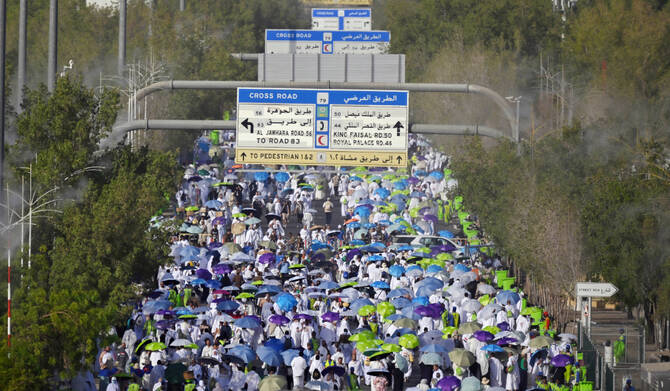
Tough security ensures safe, smooth Hajj

The Ministry of Interior has repeatedly said that individuals caught attempting to perform Hajj with no valid Hajj permit will face a fine of SR20,000 with enforcement in effect from April 29 to June 10. (AN photo by Basheer Saleh)
Short Url
Updated 05 June 2025
Follow

Tough security ensures safe, smooth Hajj

  • The Ministry of Interior outlined a comprehensive security and organizational plan to ensure a safe and smooth 2025 Hajj season

ARAFAT: Saudi Arabia has intensified the enforcement of Hajj permit regulations this year, barring individuals without official permits from entering Makkah to ensure that authorized pilgrims can fully benefit from the Kingdom’s services and facilities.

The Ministry of Interior confirmed that security forces had been deployed across all key access points to Makkah to prevent unauthorized individuals from entering the city in the days leading up to Hajj. The intensified measures come in response to longstanding concerns over the strain placed on infrastructure and essential services by unauthorized pilgrims.


The Ministry of Interior has repeatedly said that individuals caught attempting to perform Hajj with no valid Hajj permit will face a fine of SR20,000 with enforcement in effect from April 29 to June 10. (AN photo by Basheer Saleh)

The Ministry of Interior outlined a comprehensive security and organizational plan to ensure a safe and smooth 2025 Hajj season.

By ensuring that only authorized individuals enter Makkah during the Hajj season, the Kingdom aims to maintain public health, optimize crowd control and uphold the spiritual integrity of the pilgrimage.


Pilgrims have voiced their support for the tightened rules. (AN photo by  Abdulrahman bin Shalhoub)

In a recent press conference, held ahead of Hajj, the Kingdom detailed preparations aligned with the directives of Interior Minister Prince Abdulaziz bin Saud. The strategy covers public safety, crowd and traffic control, and emergency responses throughout the pilgrims’ journey.

Authorities reported the dismantling of 252 fake Hajj campaigns, the arrest of 1,239 illegal transporters, and the return of 269,678 non-residents of Makkah, 75,943 unauthorized pilgrims and 109,632 vehicles. An additional 11,610 individuals were found violating residency, labor and border laws.


The Ministry of Interior has repeatedly said that individuals caught attempting to perform Hajj with no valid Hajj permit will face a fine of SR20,000 with enforcement in effect from April 29 to June 10. (AN photo by Basheer Saleh)

The move is part of a broader effort by authorities to safeguard the sanctity of the pilgrimage and ensure the safety and comfort of registered pilgrims.

The MoI has repeatedly said that individuals caught attempting to perform Hajj with no valid Hajj permit will face a fine of SR20,000 (more than $5,300), with enforcement in effect from April 29 to June 10.


The Ministry of Interior outlined a comprehensive security and organizational plan to ensure a safe and smooth 2025 Hajj season. (AN photo by  Abdulrahman bin Shalhoub)

The ministry warned that foreign nationals found in violation would, in addition to the financial penalty, be deported to their home countries and barred from re-entering the Kingdom for ten years.

The ministry also confirmed that a financial penalty of up to SR100,000 would be imposed on anyone who transported holders of visit visas or attempted to transport them with the intent of bringing them to the city of Makkah or the holy sites during the same period.

The ministry added it would request the competent court to confiscate any land transport vehicle proven to have been used for this purpose if owned by the transporter, an accomplice or any party found to be involved.

In previous years, emergency rooms in Makkah hospitals were often overwhelmed with medical cases involving individuals who entered the city without valid Hajj permits. Many lacked access to official accommodation and transportation, resulting in overcrowding not only in emergency facilities but also in the Grand Mosque and the holy sites of Mina, Muzdalifah and Arafat — areas whose capacity is topographically constrained.

Pilgrims have voiced their support for the tightened rules. In previous seasons, illegal pilgrims strained logistical operations, including food distribution, transportation schedules and accommodation management.

Indian couple Altaf Hussein and his wife Farhana told Arab News that they were pleased with the running of this year’s Hajj.

“I am happy with their management,” Hussein said. Farhana added that it was her first time performing Hajj and that it was unlike what she had heard about.

“From day one in Makkah, I am so happy and thankful to Allah the Almighty, and may Allah keep the two holy mosques’ management prosper,” she said.

Marwa Al-Said, an Egyptian pilgrim, said that this year’s Hajj felt “especially exceptional” with unauthorized pilgrims barred from entering Makkah.

“I would like to thank you all. The arrangements you are applying this year are truly different,” she said. “I feel comfortable — there is no hardship, no fear and none of the worries we usually hear about during Hajj. It is, seriously speaking, real security.”

According to an official at Jabal Al-Rahma Hospital in Arafat, the one-day facility — which in previous years typically received hundreds of patients during the Hajj season — had recorded only two emergency cases as of 3:00 p.m. on Thursday.


The secret keepers of desert balance in Saudi Arabia

Updated 11 sec ago
Follow

The secret keepers of desert balance in Saudi Arabia

  • How the Kingdom’s wildcats control pests, protect public health, and sustain the ecosystem

Did you know:

Sand cats are the only cat species with hair on the soles of their feet, allowing them to walk on hot sand without sinking.

Caracals, locally known as Al-Washaq, are native and endangered, capable of jumping 3 to 4 meters in a single leap.

Pure populations of the Arabian wildcat are at risk due to hybridization with domestic cats.

Haifa Alshammari

RIYADH: During the summer of 2024, two desert lynx kittens were born in Taif as part of Saudi Arabia’s efforts to protect and increase the population of caracals in the country.

Although caracals are critically endangered, wildcats in general play a significant ecological role in the Kingdom. They act as natural pest control, and Saudi Arabia is committed to conserving these species while increasing their populations to support a thriving ecosystem.

Despite the Kingdom’s harsh, arid climate, conditions are suitable for wildcats not only to survive but also to flourish. Among the terrestrial species inhabiting Saudi Arabia are sand cats, Arabian wildcats, and the desert lynx.

Felis margarita, or sand cats, are small — around 40-60 cm — with pale sandy fur that allows them to blend into the desert. They have a broad head, large ears, and long hair on the bottom of their feet to walk on hot sand.

“It is small in size and does not mate with other cats. It is the only cat species in the world with hair on the soles of its feet instead of skin to prevent it from sinking into the sand,” said Obaid Alouni, a Saudi environmentalist.

Alouni explained that one defensive technique sand cats use is to lie flat on the ground to avoid detection.
“It lies flat on the ground when it senses danger to avoid being noticed by other animals.”

These cats primarily feed on rodents and small reptiles, occasionally large insects, obtaining their water from their prey. Sand cats are native to West Asia and help regulate rodent and insect populations, preventing outbreaks and reducing disease spread.

Interestingly, raising sand cats as domestic pets is becoming more popular, Alouni said. But he emphasized that adoption is easier when they are kittens, as they remain wild animals. Although widely distributed across the Kingdom, exact population numbers are difficult to determine due to their elusive nature. They are currently listed as “least concern” by the International Union for Conservation of Nature.

Similar to sand cats, Arabian wildcats (Felis lybica) are found across the Arabian Peninsula and play a vital role in environmental health.

“They are wild cats that live independently without human intervention,” Alouni told Arab News.

Arabian wildcats resemble domestic cats but have thicker, sandy to grey-brown coats with faint stripes or spots and ringed tails with blunt tips. Like sand cats, they feed on rodents, birds, reptiles, and insects and are listed as “least concern” by the IUCN.

However, Alouni warned that pure populations of Arabian wildcats in Saudi Arabia could be threatened by hybridization with domestic cats.

“Currently, wild cats face the problem of interbreeding with domestic cats. This weakens their immune systems and makes them more susceptible to diseases from other cats,” he said.

“This contributes to the extinction of the purebred lineage and, consequently, the disappearance of their wild instincts,” he added.

While both species are desert dwellers, sand cats are harder to spot as they avoid heavily trafficked areas. They are mainly found in the Ad Dahna desert and the Empty Quarter, where sand dunes dominate the landscape. Arabian wildcats, however, inhabit rocky or mountainous areas such as the Tuwaiq Mountains, valleys, and farms with abundant small prey.

“Wild cats come around towns and villages, and unfortunately, begin mating with domesticated cats that people release outside,” Alouni explained. He stressed the importance of keeping domestic cats away from wildcat habitats, including deserts and camping sites.

The third wildcat species native to Saudi Arabia, the caracal or desert lynx, is critically endangered. “The lynx is classified in size between large and small, and is distinguished by its jump, which can reach 3 meters or even 4 meters in the sky,” Alouni described.

Locally known as Al-Washaq, desert lynx have reddish-tan coats, long legs, and black-tufted ears. They feed on birds, rodents, and sometimes small antelopes. Thankfully, these cats are protected under Saudi law due to their critically endangered status.

Hunting any sand cats, Arabian wildcats, or desert lynx can result in fines of approximately $20,000, according to the Saudi Ministry of Environment, Water, and Agriculture.
“There is a very severe financial penalty in Saudi Arabia for anyone who hunts it,” Alouni added.

The Kingdom has strict regulations to protect endangered animals, criminalizing not only hunting or killing but also trade. Violators could face penalties of up to $8 million, up to 10 years in prison, or both.

Overall, sand cats, Al-Washaq, and Arabian wildcats are essential to maintaining a healthy environment in Saudi Arabia. By controlling rodent populations, they help prevent outbreaks that could threaten agriculture and public health.