


“Giant-killing” in sport is often associated with cup competitions in soccer, when a team from a lower division beats one placed in a higher division.
A recent example was when Plymouth Argyle, near the foot of the Championship — effectively, the second tier of English football — beat the leaders of the Premier League, Liverpool, in the fourth round of the FA Cup on Feb. 9, 2025. There have been many other legendary examples of giant-killing in soccer. Use of the term to describe similar feats in other sports does not appear to be commonplace.
Perhaps it reflects the different structure of other sports. At its apex, cricket is not structured by divisions. Only 12 teams play Test cricket against each other. In one-day international cricket (ODIs) and T20 international cricket, the International Cricket Council rates teams according to performance. The Test-playing teams occupy the highest-rated positions in the shorter formats by virtue of their greater strength. Outside of World Cup tournaments they rarely play teams rated in the 20 places below them. Therefore, the opportunities for giant-killing would appear to be restricted.
This is not to say that upsets and surprises do not happen. They are part of the natural rhythm of sport. Identifying when they may happen is a challenging task. In Liverpool’s case, the manager selected a team consisting of a number of players who were not normally first choice for league matches. Last week I referred to Zimbabwe’s defeat of Australia in the group stage of the 1983 World Cup at Nottingham. Two members of the Zimbabwean team met several of the Australian team the evening before the match at the hotel where both teams were staying.
The Zimbabweans were surprised to learn of the level of disharmony within the Australian camp and the openness with which it was revealed. This revelation gave them hope and confidence, but it was not until the closing stages of the match that they realised a shock win was possible against an aging Australian team. The part-time players of Zimbabwe triumphed by 13 runs. Afterwards, the Australian captain admitted that “We knew nothing about them at all. There was no video analysis. We said, ‘We’ll find out what they’re like when we get out there on the park’.”
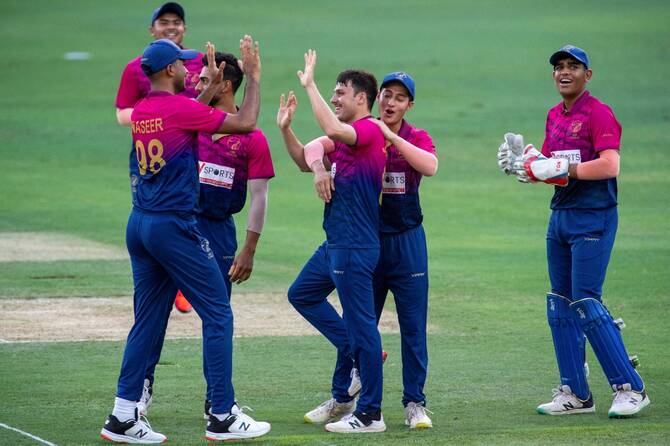
A vastly different environment exists today in which technical analysis of players’ performances in different circumstances are forensically assessed, with plans drawn up to promote, expose and counter them. It is not clear if these have led to upsets of smaller nations beating more powerful ones. At first sight, the UAE men’s team beating Bangladesh in a three-match T20 series between May 17 and 21 might appear to be an upset. On closer examination, this would be a disservice to the UAE in this format.
Prior to the series, Bangladesh were rated ninth in the ICC T20 rankings, compared with 15th for the UAE. The ratings are the result of dividing the total number of points earned by the number of games played. Bangladesh had a rating of 225 prior to the series compared with 181 for the UAE. Although there were only six places separating Bangladesh and the UAE, the reality is that, given the points system of two points for a win and minus two points for a loss, it would take a significant time for the UAE and teams with similar ratings to bridge the gap.
This puts the UAE’s series win into greater perspective. Bangladesh won the first match by 27 runs, the UAE losing its last seven wickets for 33 runs. In the second match, Bangladesh posted 205 for 5 wickets which the UAE chased down with only one delivery remaining for the loss of eight wickets. Muhammad Waseem top scored with 82. The crucial difference in that match was that the UAE’s lower order did not collapse. In the third match, the UAE chased down 163 for the loss of only three wickets, with five deliveries remaining. Alishan Sharafu scored an undefeated 68, assisted by 41 not out from Asif Khan. Earlier, Haider Ali had claimed three wickets for only seven runs.
After the series, Litton Das, Bangladesh’s captain, noted that his team bowled and fielded in the second half of all three matches, the UAE having won the toss and elected to field. He said that dew was a factor in making the ball more difficult to grip and field cleanly, adding that his team’s batting, including his own, had not been consistent enough. This pattern continued in Bangladesh’s next series against Pakistan, which the latter won 3-0. As a result, Bangladesh have dropped one rating place to 10th.
Although the UAE’s rating remained unchanged, the UAE team and their management were understandably delighted with the outcome. Emirates Cricket Board Chairman Nahayan Mabarak Al-Nahayan congratulated the team on their historic series win, saying that “the team had played brilliantly in the whole series, while the support staff put in the hard yards to make the victory possible, another glorious chapter in our cricketing history.” He added that the board will “continue to provide the best possible facilities and exposure to our immensely talented players.”
The UAE have previously beaten Test-playing countries Ireland, New Zealand and Afghanistan, the last two in 2023. Victory over Bangladesh should, as the chairman remarked, “give immense confidence and self-belief to our players and make them take on bigger and more established opponents.” It is in this context that giant-killing acts in cricket may be judged — the defeat of a Test-playing, ICC full member being defeated by an associate nation.
It was certainly a shock when the Netherlands beat South Africa in the group stages of the 2023 World Cup at Dharamsala by 38 runs. In the same competition, Afghanistan beat England by 69 runs. A year later, the US, as joint host nation of the 2024 T20 World Cup, beat Pakistan in a super over, bowled because the match scores were tied. One of the greatest upsets was achieved by Ireland in the 2011 ODI World Cup in Bengaluru. England scored 327 and, in reply, Ireland slumped to 111 for five. Kevin O’Brien then hammered 100 off 50 deliveries to propel Ireland to a sensational three-wicket victory.
Finding a common denominator to explain or forecast upsets remains elusive. In three of the above examples, the defeated full members either looked out of sorts on the day or had broader issues, which affected their performances.
In the case of Ireland, O’Brien produced an innings of brilliance, which occasionally and unexpectedly occurs. In more normal patterns it is possible that, as associate nations improve over time with appropriate developmental support from their national boards, the propensity for giant-killing may increase. This is a possibility for the UAE in T20 cricket rather than ODIs, in which their recent performances have put the team in jeopardy of losing its ODI status.


