


On May 23, a one-off, four-day Test match began at Trent Bridge, Nottingham, between England and Zimbabwe. It was the first match in any format between the countries since 2007 and only the seventh Test match played between them. The last meeting was in 2003 when England hosted two Tests, winning both by an innings.
Overall, England has won four of the seven Tests, with three drawn. Two of these were in December 1996, the first time England toured Zimbabwe, which was granted full membership of the International Cricket Council in 1992.
Zimbabwe’s playing performances over the last three decades have fluctuated drastically. In the first 30 Test matches, only one was won, at home to Pakistan in early 1995. This prompted discussion that the granting of Test status had been premature. However, a talented group of players emerged to provide the basis for a Test team that became one of the hardest to beat in the late 1990s. It won a one-off Test against India in October 1998, following up on this by beating Pakistan 1-0 in a three-match Test series in November and December 1998. The one-day international team qualified for the 1999 World Cup, narrowly missing out to New Zealand on a semi-final place because of an inferior net run-rate.
These golden years were ended by political turmoil. The 2003 World Cup was jointly hosted by Zimbabwe, Kenya and South Africa. Concerns over security of players caused England to forfeit a match scheduld to be played in Harare. A desperate shortage of food, a deteriorating economic situation and violent clashes between rival factions led two Zimbabwean players, Andy Flower and Henry Olonga, to stage a protest. In a long statement they said that they could not “ignore the fact that millions of our compatriots are starving, unemployed and oppressed … that thousands of Zimbabweans are routinely denied their right to freedom of expression.” They wore black armbands, “mourning the death of democracy.”
Unsurprisingly, the government was embarrassed, both players were dismissed from the team and felt compelled to leave Zimbabwe. Team harmony, already affected by government involvement in selection, was further disrupted, with a succession of players deciding to end their international careers prematurely. In 2004, the team captain, Heath Streak, was sacked by the Zimbabwe Cricket Union, prompting 14 other players to walk out.
Despite attempts at rapprochement, results failed to improve in an environment of mistrust. Another bout of player resignations led the cricket board to voluntarily suspend the team from Test cricket in late 2005. After a six-year exile, Test cricket returned to Zimbabwe in August 2011 when Bangladesh was beaten in a one-off match in Harare. In subsequent years, off-the-field issues continued to dominate, whilest performances on the field were patchy and disappointing.
In July 2019, the ICC voluntarily suspended Zimbabwe Cricket from ICC tournaments because it had failed to ensure that it was free from government interference. This meant that ICC funding was frozen and that neither men’s nor women’s teams could compete in T20 World Cup preliminaries and qualifiers, despite a lifting of the suspension three months later.
It is only recently that greater optimism for the future of cricket in Zimbabwe has emerged. Control over finances seems to have been established, ICC funding of $13.5 million being used to support a five -team domestic structure, national sides and the expensive business of hosting Test matches. Since 1992, the men’s Test team has played 124 Test matches, winning only 14, drawing 30 and losing 80. It would be easy for ZC to downplay Test cricket at a time when its relevance is being questioned.
The stance of ZC’s chair, Tavengwa Mukhulani, is diametrically opposite. He wants to see all Full Member teams play each other on a home and away basis, believing that the way for Zimbabwean cricketers to improve is by playing the stronger teams. Consequently, Mukuhlani is not in favor of a two-tier Test system. It is also an issue for him that Zimbabwe is not part of the World Test Championship, for reasons which are not clear to him. Zimbabwe’s commitment to Test cricket is clear. In 2025, it will play 11 Tests, joint highest with Australia.
The issues for Zimbabwe at Test level were illustrated at Trent Bridge. England was invited to bat first and raced to score almost 500 runs on Day 1, against bowling that betrayed a lack of knowledge of how to perform on an English pitch. In reply to England’s 565 for six, declared, Zimbabwe’s batters attacked, none more so than Brian Bennett, 21. He wrote himself into the history books by scoring the fastest Test century for Zimbabwe. Although England ultimately won by an innings and 45 runs, it was clear that Zimbabwe has talent to nurture.
Some of this nurturing will fall to experienced team members. One of them, Sikandar Rasa, has played for Zimbabwe since 2013. Prior to the Test at Nottingham, he was playing in the Pakistan Super League for Lahore Qalandars. Once the Test, in which he bowled 25 overs and batted for 20 overs, had finished a day early, he flew back to Lahore via Birmingham, Dubai and Abu Dhabi, arriving minutes before play started. Lahore was set 202 to win. When Rasa went out to bat, 57 runs were needed from 3.2 overs. He immediately hit a four and six and, in the final over, repeated the feat to secure victory with one delivery remaining.
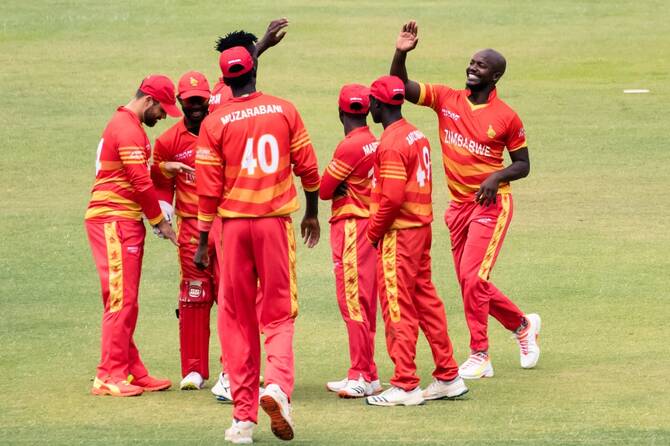
Zimbabwean cricket has suffered tough times over the past 20 years. Superhuman feats such as Rasa’s and the individual performances witnessed at Nottingham, where the team enjoyed colourful and musical support, provide hope for a brighter future. In Zimbabwe's first World Cup match at Trent Bridge in June 1983, when Australia was dramatically beaten by 13 runs, a bright future was suggested. Then, the team consisted almost entirely of white players, Ali Shah being the exception. Fifteen years later, nine of the team were white. At Trent Bridge last week, seven of the team were black, including the 6 foot, eight inches tall fast bowler, Blessing Muzarabani, who had claimed 26 Test wickets in 2025 prior to Nottingham.
Robert Mugabe, who ruled Zimbabwe between 1980 and 2017, is attributed with saying that “Cricket civilises people and creates good gentlemen. I want everyone to play cricket in Zimbabwe. I want ours to be a nation of gentlemen.” Noticeably, there was no mention of women.
Zimbabwe’s women’s team made its international debut in 2006 at the ICC Africa Regional Qualifier for the Women’s Cricket World Cup. The team has yet to reach the final stages of a World Cup although it did win a gold medal at the Africa Games in 2023. Currently, the team consists entirely of black players.
In the past two decades, a transformation has taken place that has turned the men’s national cricket team into one that more closely represents Zimbabwe’s demographics, in which white Zimbawean’s make up less than 1 percent of the 17 million population. The women’s team is totally reflective of that fact. Zimbabwean cricket needs an era of stability and support to allow its new generation of cricketers to mature.


