


ISLAMABAD: Pakistan on Wednesday condemned Washington’s decision to veto a United Nations Security Council resolution demanding an immediate ceasefire in Gaza, describing it as tacit approval for the “continued annihilation” of Palestinians, while also denouncing the storming of Jerusalem’s Al-Aqsa Mosque by Israeli settlers this week.
The US blocked a draft resolution tabled by the 10 elected members of the Security Council, which called for an “immediate, unconditional and permanent ceasefire” between Israeli forces and Hamas, along with unhindered humanitarian access across the war-battered enclave.
The United States said it would not support any measure that did not include provisions for Hamas to disarm and withdraw from Gaza.
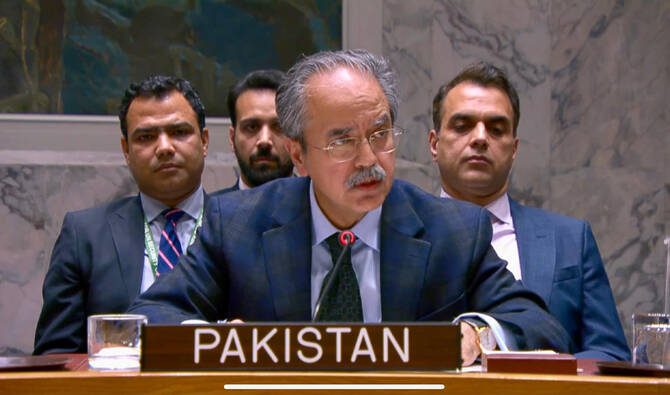
Reacting to the US decision, Pakistan’s Permanent Representative to the UN, Ambassador Asim Iftikhar Ahmad, regretted the council’s failure to adopt the resolution tabled by its ten elected members “to address one of the most grave and sustained humanitarian catastrophes of our time.”
“Let us be clear: this failure will not go down in records as a mere procedural footnote,” he told the council. “It will be remembered as complicity, a green light for continued annihilation, a moment where the entire world was expecting action, but yet again, this Council was blocked and prevented by one member from carrying out its responsibility.”
Calling the humanitarian situation in Gaza a collapse of both international law and moral responsibility, Ahmad cited figures of over 54,000 civilian deaths, including 28,000 women and girls and 18,000 children, with nearly 100 Palestinians reported killed in the last 24 hours alone.
He said the enclave had been “decimated,” with famine, disease and displacement spreading faster than aid could arrive.
The ambassador rejected arguments that called for delaying action to allow negotiations to proceed, questioning how much more “space filled with rubble, graves and the anguished cries of children” would be needed before meaningful intervention took place.
He reiterated Pakistan’s support for a ceasefire, unimpeded humanitarian access to Gaza and a negotiated two-state solution based on pre-1967 borders with East Jerusalem as the capital of a sovereign Palestinian state.
Ahmed said the international community had spoken clearly through the General Assembly and the International Court of Justice, while the Security Council remained “muzzled.”
AL-AQSA MOSQUE STORMING
In a separate statement issued in Islamabad, Pakistan’s foreign ministry condemned the storming of the Al-Aqsa Mosque compound in East Jerusalem by Israeli settlers this week, calling it a “direct assault” on the sanctity and legal status of one of Islam’s holiest sites.
According to media reports, dozens of Israeli settlers entered the mosque compound and performed Talmudic rituals, prompting condemnation from several Muslim-majority countries.
“These reprehensible acts, including violations at multiple entrances of the Mosque, are a direct assault on the sanctity, historical character, and legal status of the revered Muslim holy site,” the foreign ministry said, warning that such actions could ignite further unrest in an already volatile region.
The ministry also expressed concern over the continued targeting of civilians in Gaza, saying that nearly 100 Palestinians had been killed in the span of a single day, including people waiting at food distribution points.
It noted that Israeli forces were operating with impunity and called for their international accountability.
Reaffirming Pakistan’s position on the conflict, the ministry called for immediate steps to halt the violence, ensure access to humanitarian assistance and revive efforts toward a political resolution to the conflict.


