



Saudi interior minister inspects Hajj preparedness at holy sites

1 / 4
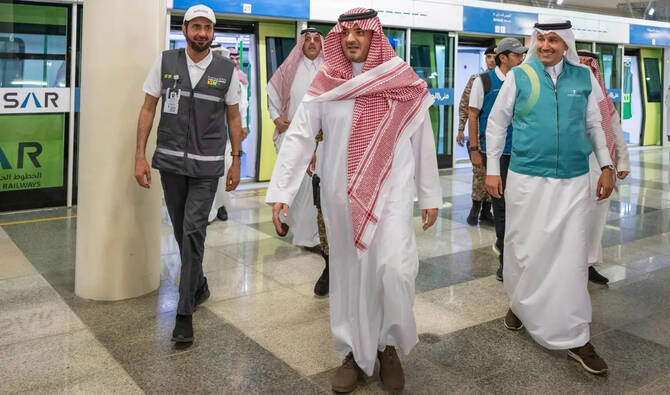
Saudi interior minister conducted a field tour on Wednesday to inspect the readiness of the Al-Mashaaer Al-Mugaddassah (Holy Sites) Metro Line as pilgrims move to the holy site of Arafat. (SPA)
2 / 4
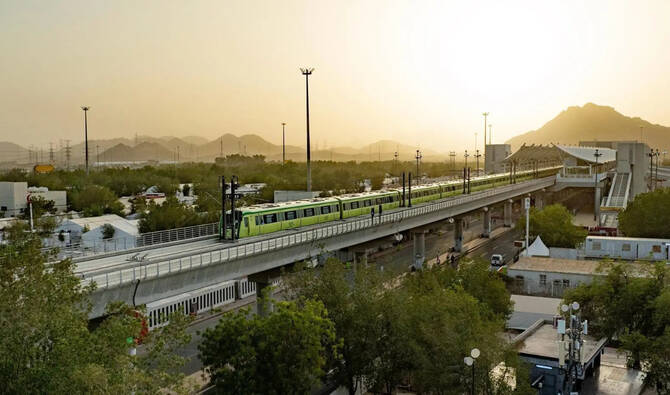
Saudi interior minister conducted a field tour on Wednesday to inspect the readiness of the Al-Mashaaer Al-Mugaddassah (Holy Sites) Metro Line as pilgrims move to the holy site of Arafat. (SPA)
3 / 4
Saudi interior minister conducted a field tour on Wednesday to inspect the readiness of the Al-Mashaaer Al-Mugaddassah (Holy Sites) Metro Line as pilgrims move to the holy site of Arafat. (SPA)
4 / 4
Saudi interior minister conducted a field tour on Wednesday to inspect the readiness of the Al-Mashaaer Al-Mugaddassah (Holy Sites) Metro Line as pilgrims move to the holy site of Arafat. (SPA)
Short Url
Updated 05 June 2025
Follow

Saudi interior minister inspects Hajj preparedness at holy sites

RIYADH: Saudi interior minister conducted a field tour on Wednesday to inspect the readiness of the Al-Mashaaer Al-Mugaddassah (Holy Sites) Metro Line as pilgrims move to the holy site of Arafat.

Prince Abdulaziz bin Saud, who also heads the Supreme Hajj Committee, was briefed on the mechanisms of dispatching and scheduling train trips, in full integration with the relevant security and regulatory authorities, ensuring smooth operations and the safety of pilgrims the Saudi Press Agency said.

The minister boarded a train ride to the Mina 3 (Jamarat) Station, where he inspected the station’s readiness and facilities to receive pilgrims. 

The metro line is a high-capacity rail system in Makkah that operates for only seven days a year, during Hajj, as a shuttle service to take pilgrims to and from holy sites. It has a capacity of up to 72,000 passengers per hour. 

Prince Abdulaziz also visited the Facilities Security Forces, who regulate pedestrian movement and crowd management in the areas surrounding the metro stations, and was briefed on the forces’ plans and role in supporting and assisting the Hajj Security Forces. 


Saudi Arabia’s Sharaan and Wadi Nakhlah nature reserves win Dark Sky recognition

Updated 25 December 2025
Follow

Saudi Arabia’s Sharaan and Wadi Nakhlah nature reserves win Dark Sky recognition

  • The two reserves in AlUla join more than 250 locations worldwide that are protected from light pollution
  • AlUla Manara and AlGharameel Nature Reserve, also both in AlUla, received Dark Sky Park designations last year

ALULA: Two more nature reserves in Saudi Arabia’s AlUla have won recognition as Dark Sky Places, joining more than 250 locations worldwide that are protected from light pollution.

The official accreditation of Sharaan National Park and Wadi Nakhlah reserves from the DarkSky International builds on AlUla’s 2024 achievement, when AlUla Manara and AlGharameel Nature Reserve became the first sites in the Kingdom and the Gulf region to receive Dark Sky Park designations.

The latest recognition further strengthens AlUla’s position as a leading global destination for night sky protection and astronomical tourism, said the Royal Commission for AlUla (RCU) in a statement carried by the Saudi Press Agency (SPA).

Dark Sky International also announced the recognition in an earlier report, noting that the Sharaan and Wadi Nakhlah’s combined area of 6,146 square kilometers reflects the “expanded scope of environmental protection efforts aimed at preserving AlUla’s pristine night skies and reducing light pollution across a vast geographical area.”

DarkSky International works to reduce light pollution in both urban and rural areas and to raise global awareness of the importance of protecting the night sky.

AlUla’s natural isolation from urban light sources, combined with ideal atmospheric conditions, makes it a world-class destination for stargazing, astronomy education, and immersive dark-sky experiences.  (SPA)


AlUla’s protected areas are located in the heart of northwest Arabia, near the ancient oasis city of AlUla in Madinah Province.

“Towering sandstone cliffs, labyrinthine canyons, tranquil basins, and volcanic formations create a dramatic setting where geological diversity, cultural heritage, and thriving biodiversity converge beneath exceptionally dark, open skies,” Dark Sky said.

Scientists have noted that AlUla’s natural isolation from urban light sources, combined with ideal atmospheric conditions, makes it a world-class destination for stargazing, astronomy education, and immersive dark-sky experiences. 

With the phased development of its reserves, AlUla is now ranked 3rd globally in the Dark Sky Park category, solidifying its status as one of the world’s premier destinations for astronomical discovery.

The RCU reaffirmed its commitment to protecting the natural environment, preserving the night sky, and promoting sustainable tourism, further positioning AlUla as a leading global destination for astronomy, scientific research, and advanced environmental experiences, in line with AlUla Vision and the Kingdom’s Vision 2030.