

Strict permit checks, heat safety rules in focus ahead of Hajj

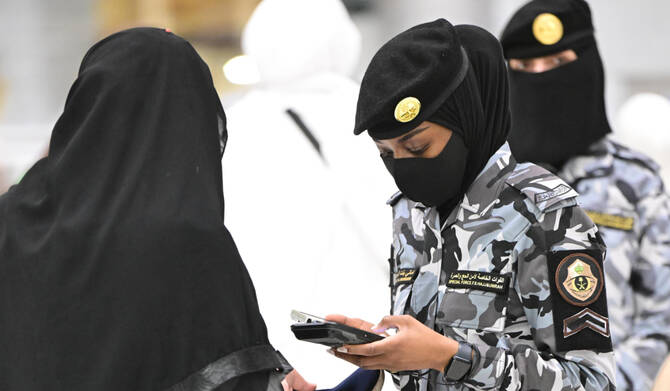
The Nusuk card, issued by the Ministry of Hajj and Umrah, is a mandatory ID and entry pass for pilgrims and workers at the holy sites. (SPA)
Short Url
Updated 03 June 2025
Follow

Strict permit checks, heat safety rules in focus ahead of Hajj

  • The Day of Arafah, the most significant day of Hajj, falls on Thursday, June 5 this year

MAKKAH: Pilgrims without a Nusuk card will not be granted access to the Grand Mosque, the holy sites or transportation services during this year’s Hajj, Saudi authorities have said.

Speaking at a meeting with heads of official Hajj missions during the 49th Grand Hajj Symposium in Jeddah, Minister of Hajj and Umrah Tawfiq Al-Rabiah highlighted the importance of adhering to movement regulations to protect pilgrims and enhance their spiritual experience.

He described the Nusuk card as a “fundamental regulatory tool to ensure orderly performance of the pilgrimage and prevent violations,” according to the Saudi Press Agency.

Addressing concerns about extreme weather, the minister advised pilgrims to remain in their tents on the Day of Arafah from 10 a.m. to 4 p.m. to avoid heat-related illnesses.

He warned that uncoordinated group movements compromise safety and disrupt the flow of pilgrims.

The Day of Arafah, the most significant day of Hajj, falls on Thursday, June 5 this year.

Al-Rabiah added that pilgrims must not walk from Arafat to Muzdalifah and should use designated transport systems instead.

He said that effective crowd management and transportation plans are essential for safety and require collective compliance.

Al-Rabiah added that this Hajj season will see stricter enforcement of permit regulations, in line with the Kingdom’s commitment to a safe, organized and spiritually fulfilling pilgrimage.

The Nusuk card, issued by the Ministry of Hajj and Umrah, is a mandatory ID and entry pass for pilgrims and workers at the holy sites.

In addition to identification, it aids logistics, facilitates communication with Hajj missions, grants access to schedules and services, and allows pilgrims to submit feedback.

It also helps authorities monitor crowd movement and send alerts to ensure a safe and organized pilgrimage. Pilgrims receive the card through their service provider, which is responsible for its distribution.

A digital version is available via the official Nusuk app, but it does not replace the printed card, which must be carried at all times.

According to the ministry, the card expires at the end of the Hajj season, with all data erased. However, pilgrims may keep the physical card as a souvenir and proof of completing Hajj.


Saudi Arabia’s Sharaan and Wadi Nakhlah nature reserves win Dark Sky recognition

Updated 58 min 30 sec ago
Follow

Saudi Arabia’s Sharaan and Wadi Nakhlah nature reserves win Dark Sky recognition

  • The two reserves in AlUla join more than 250 locations worldwide that are protected from light pollution
  • AlUla Manara and AlGharameel Nature Reserve, also both in AlUla, received Dark Sky Park designations last year

ALULA: Two more nature reserves in Saudi Arabia’s AlUla have won recognition as Dark Sky Places, joining more than 250 locations worldwide that are protected from light pollution.

The official accreditation of Sharaan National Park and Wadi Nakhlah reserves from the DarkSky International builds on AlUla’s 2024 achievement, when AlUla Manara and AlGharameel Nature Reserve became the first sites in the Kingdom and the Gulf region to receive Dark Sky Park designations.

The latest recognition further strengthens AlUla’s position as a leading global destination for night sky protection and astronomical tourism, said the Royal Commission for AlUla (RCU) in a statement carried by the Saudi Press Agency (SPA).

Dark Sky International also announced the recognition in an earlier report, noting that the Sharaan and Wadi Nakhlah’s combined area of 6,146 square kilometers reflects the “expanded scope of environmental protection efforts aimed at preserving AlUla’s pristine night skies and reducing light pollution across a vast geographical area.”

DarkSky International works to reduce light pollution in both urban and rural areas and to raise global awareness of the importance of protecting the night sky.

AlUla’s natural isolation from urban light sources, combined with ideal atmospheric conditions, makes it a world-class destination for stargazing, astronomy education, and immersive dark-sky experiences.  (SPA)


AlUla’s protected areas are located in the heart of northwest Arabia, near the ancient oasis city of AlUla in Madinah Province.

“Towering sandstone cliffs, labyrinthine canyons, tranquil basins, and volcanic formations create a dramatic setting where geological diversity, cultural heritage, and thriving biodiversity converge beneath exceptionally dark, open skies,” Dark Sky said.

Scientists have noted that AlUla’s natural isolation from urban light sources, combined with ideal atmospheric conditions, makes it a world-class destination for stargazing, astronomy education, and immersive dark-sky experiences. 

With the phased development of its reserves, AlUla is now ranked 3rd globally in the Dark Sky Park category, solidifying its status as one of the world’s premier destinations for astronomical discovery.

The RCU reaffirmed its commitment to protecting the natural environment, preserving the night sky, and promoting sustainable tourism, further positioning AlUla as a leading global destination for astronomy, scientific research, and advanced environmental experiences, in line with AlUla Vision and the Kingdom’s Vision 2030.