


RIYADH: Saudi Arabia's Ministry of Interior outlined a comprehensive security and organizational strategy to ensure an incident-free 2025 Hajj season.
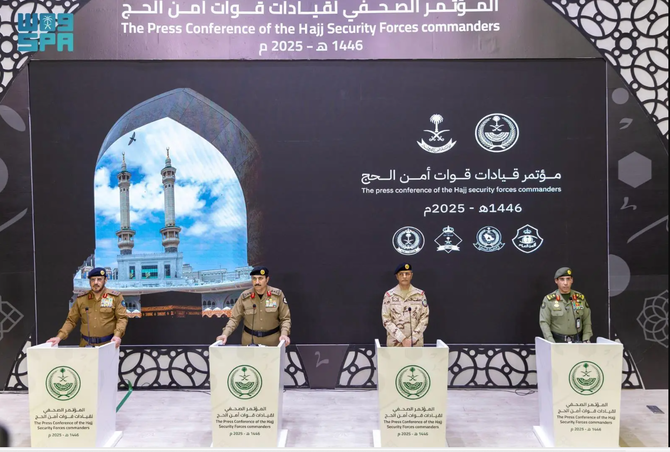
The ministry held a press conference with Hajj security force commanders on Sunday at the Unified Security Operations Center. Briefing attendees included key officials such as Lt. Gen. Mohammed Al-Bassami, the director of public security, Maj. Gen. Mohammed Al-Omari, commander of special emergency forces at the presidency of state security, Maj. Gen. Hamoud Al-Faraj, director-general of civil defense, and Maj. Gen. Saleh Al-Marba, the acting director-general of the general directorate of passports.
Al-Bassami affirmed Saudi Arabia’s commitment to prepare a safe, secure, and organized environment for pilgrims.
He said the efforts aligned with the directives of the minister of interior and chairman of the Supreme Hajj Committee, Prince Abdulaziz bin Saud bin Naif, who has endorsed extensive security and organizational plans for the 2025 Hajj season.
These plans, he said, encompass all facets of security, public order, crowd management, traffic flow, and emergency response, implemented through an integrated framework that spans the pilgrims’ entire journey, from arrival to departure.
Al-Bassami said that any attempts to disrupt security or violate regulations would be met with strict and uncompromising action.
He further emphasized the readiness of the Grand Mosque and the holy sites to manage large crowds, aiming to alleviate congestion and maintain safe capacities on all roads and holy sites.
Seasonal traffic management plans are also in effect for routes leading to Makkah and Madinah, as well as central area entrances, to ensure the smooth movement of pilgrims.
The General Directorate of Public Security reported significant enforcement actions.
Authorities seized 252 fake Hajj campaigns and apprehended 1,239 transporters violating Hajj regulations.
Additionally, 109,632 unauthorized vehicles were turned back, as were 269,678 people not residing in Makkah, 75,943 people without Hajj permits, and 11,610 people who disobeyed residency, labor and border security regulations.
Furthermore, the number of visit visa holders who arrived for the purpose of Hajj reached 205,713.
Al-Omari reiterated the forces' commitment to ensuring protection and maintaining order during the Hajj season.
He detailed the implementation of precise field plans, focusing on preventing infiltrators and unauthorized individuals from accessing the holy sites.
The plans include managing and organizing crowd movement at the Jamarat stoning facility and the southern courtyard of the Grand Mosque to ensure smooth flow and pilgrim safety.
In a notable development, Al-Faraj announced the first use of the Falcon drone for firefighting and rescue operations, a new addition to the General Directorate of Civil Defense’s Hajj operations this year.
He emphasized the sector's readiness to implement its approved plan in service of the pilgrims.
Al-Marba outlined the directorate’s integrated plan within the Ministry of Interior’s security framework.
This plan is built upon four pillars: ensuring full readiness to receive pilgrims at air, land, and sea ports, including those under the Makkah Route Initiative; enforcing regulations against illegal pilgrim transporters through seasonal administrative committees at Makkah’s entrances; providing support to security and service agencies in the holy sites through field presence; and organizing and overseeing the departure of pilgrims post-Hajj.


