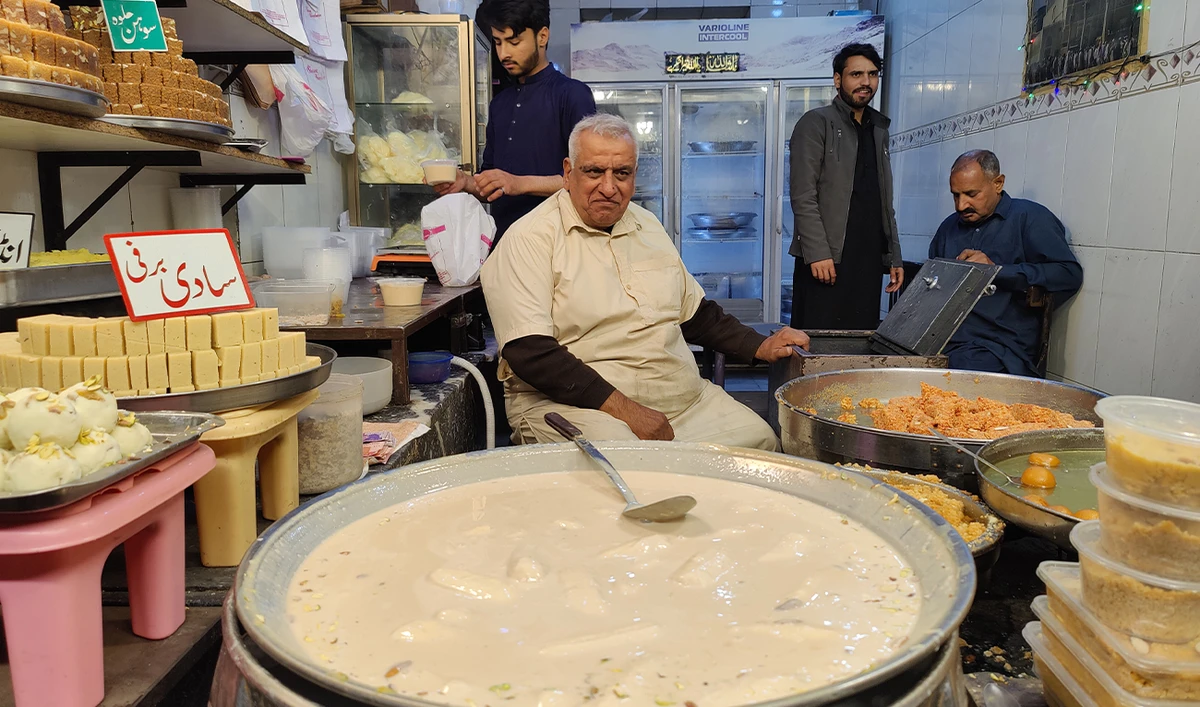
- Founded in 1947, Inayat Sweets draws devotees from across Pakistan and abroad for a dessert steeped in tradition
- Customers and shop owners say decades-old methods, pure ingredients have kept taste unchanged across generations
SIALKOT: In the narrow streets of Pakistan’s eastern city of Sialkot — best known globally for footballs stitched by hand and precision surgical instruments — a modest sweet shop has quietly built a reputation that stretches far beyond the city.
For nearly eight decades, Inayat Sweets has drawn crowds for a single dessert: ras malai, a soft, milk-based delicacy that occupies a special place in South Asian food culture.
Ras malai, traditionally made from fresh cheese patties gently simmered and soaked in lightly sweetened milk, is prized for its delicate texture and subtle richness. It is often reserved for celebrations, family gatherings and moments of indulgence. At Inayat Sweets, customers say, it has become something closer to ritual.
The shop’s story began in 1947, the year British colonial rule ended and the Indian subcontinent was partitioned, when its founder migrated from India and set up a small business selling milk and yogurt in the newly formed Pakistan.
Today, the legacy is carried forward by Abdul Rashid, who runs the shop much as his grandfather once did.
“My grandfather opened this shop in 1947 when he migrated from India. It was a very small business. Basically, we were selling milk and yogurt,” Rashid told Arab News.
Over time, the offerings expanded, but one item emerged as the shop’s defining identity.
“Our most famous item is ras malai, ” Rashid said. “Then we have winter halwas [confection] like carrot halwa, pumpkin halwa, egg halwa, beans halwa etc.”
Rashid says the secret behind the shop’s longevity lies less in innovation than in discipline, and a refusal to compromise on ingredients.
“All sweets have the same sugar and ghee, but we do everything with honesty. Most important is everything here is made of pure organic ghee, milk is 100 percent pure.”
That emphasis on quality has turned Inayat Sweets into a destination rather than a neighborhood stop, with customers traveling specifically for its ras malai.
“God has been so kind on me that not only in Pakistan but from whole world people want the ras malai of Inayat Sweets,” he said, adding that family support remains central to the business. “I have big support of my wife.”
For many customers, the relationship stretches back decades.
“The ras malai here is the best. We are coming here for last 25, 26 years and by the grace of God no one has made such ras malai. Neither someone has made such halwas,” said customer Shahbaz Ishaq.
Others say they have searched widely, without success, for the same flavor elsewhere.
“This taste is nowhere in Sialkot and I have gone outside Sialkot and tried it in other cities. This ras malai can be found only in this shop. I am coming here since I was 10-year-old,” said Yaseen Chohan.
For some, the distinction lies in the shop’s use of khoya, or reduced milk solids, a labor-intensive ingredient that many modern producers avoid.
“This is good! Specially khoya is used in every product,” said Altaf Hussain. “It’s very tasty and high quality.”