

Chile president to ramp up decarbonization, pressure on Israel as term winds down

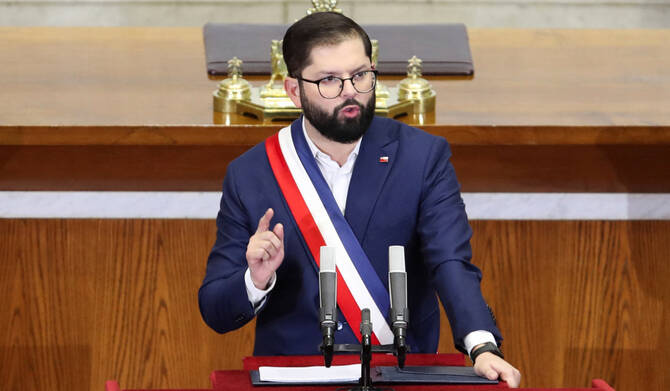
Chile's President Gabriel Boric speaks during his annual address at the National Congress building in Valparaiso, Chile June 1, 2025. (REUTERS)
Short Url
Updated 01 June 2025
Follow

Chile president to ramp up decarbonization, pressure on Israel as term winds down

  • Boric, an outspoken critic of Israel, had recently recalled military personnel from Chile’s embassy in the country and summoned the ambassador for questioning

VALPARAISO, Chile: Chile’s President Gabriel Boric said on Sunday that he will accelerate renewable energy efforts and step up pressure against Israel over its war in Gaza among other initiatives during his government’s last nine months in office.
In a wide-ranging three-hour speech from Congress in the coastal city of Valparaiso that marked his last annual address, Boric also discussed crime, infrastructure, the economy and abortion rights.
In comments that sparked the largest amount of cheers and jeers from opposite sides of Congress, Boric said he will introduce a law to ban imports from what he called “illegally occupied territories” and back efforts by Spain for an arms embargo against Israel.
Boric, an outspoken critic of Israel, had recently recalled military personnel from Chile’s embassy in the country and summoned the ambassador for questioning.
Chile’s government will also introduce an “accelerated decarbonization” bill that aims to boost investment in renewable energy sources, help end coal-powered thermoelectric plants and move the country’s 2040 goal to decarbonize the electric grid up to 2035.
Boric added that a bill to speed up the permitting process for new projects was weeks away from being approved, a long-awaited request by miners, renewable energy companies and other investors. Its goal is to cut permitting times by 30 percent to 70 percent, Boric said.
“Investment projects won’t develop to their full potential if we don’t modernize and speed up permitting,” Boric said, while also touting his plan to expand lithium mining, led by state copper giant Codelco.
Critics have rebuked Boric for not making major reforms he promised as a candidate, and for failing to see through a rewrite of the dictatorship-era constitution that was knocked back twice by voters.
Boric appeared to recognize the complaints, while defending his record.
“Have we achieved everything we wanted, with the depth we wanted? No, but we have made progress in that direction, with the conditions under which we had to govern,” he said.


Sanchez hails Spain’s immigration approach as a model for EU

Updated 4 sec ago
Follow

Sanchez hails Spain’s immigration approach as a model for EU

  • Prime minister rejects critics who argue Spain’s stance fuels illegal migration to the country

MADRID: Prime Minister Pedro Sanchez has hailed Spain’s openness to immigration as a model for Europe, saying it has benefited the economy and bolstered state coffers.

While other European nations have tightened their borders against newcomers under pressure from right-wing parties, Spain has championed legal immigration.

The country has opened up paths for migrants to live and work in the country legally, even as it has pushed to police its borders and block irregular migration.

Migration accounts for 80 percent of Spain’s economic growth over the past six years, and accounts for 10 percent of the country’s social security revenues, Sanchez said.

“Spain will continue to defend a migration model that works, one that works for Spain and could also help awaken an aging Europe,” the Socialist premier told a gathering of Spanish ambassadors in Madrid.

“Our model works. There is no so-called ‘pull effect,’” Sanchez added, rejecting critics who argue Spain’s pro-immigration stance fuels illegal migration to the country.

Irregular migrant arrivals to Spain fell by 42.6 percent in 2025 from the previous year to 36,775, largely due to a sharp drop in arrivals along the Atlantic route to the Canary Islands, according to Interior Ministry figures.

Spain has reached cooperation agreements with several African nations that are key sources of irregular migration to bolster the fight against smuggling networks.

Spain, the EU’s fourth-largest economy, has outperformed its peers since 2021, supported by tourism, low energy costs, domestic consumption, and foreign investment.

The government forecasts the economy will expand by 2.9 percent in 2025, more than twice the euro zone average.