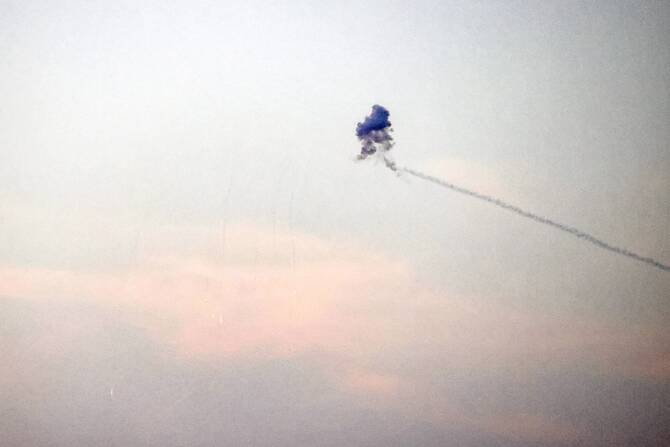
Israel army intercepts Yemen missile after air raid sirens sound

Israel's Iron Dome missile defence system intercepts a projectile. (File/AFP)
Short Url
Updated 02 June 2025
Follow

Israel army intercepts Yemen missile after air raid sirens sound

  • Yemen’s Houthi insurgents later claimed to have fired a 'ballistic missile' at Israel’s Ben Gurion airport

JERUSALEM: The Israeli army said it had intercepted a missile fired from Yemen on Sunday after air raid sirens sounded in Jerusalem and other cities.
“Following the sirens that sounded a short while ago in several areas in Israel, a missile launched from Yemen was intercepted,” the army said in a statement.
Yemen’s Houthi insurgents later claimed to have fired a “ballistic missile” at Israel’s Ben Gurion airport.
The group’s military spokesman Yehya Saree said three drones were also launched at Israel.
The Iran-backed group has repeatedly launched missiles and drones at Israel since the Gaza war broke out in October 2023 with Palestinian militant group Hamas’s attack on Israel.
Almost all of the projectiles have been intercepted.
Sunday’s interception followed another reported attack on Thursday claimed by the Yemeni militants.
The Houthis, who say they are acting in solidarity with Palestinians, paused their attacks during a two-month Gaza ceasefire that ended in March, but began again after Israel resumed its military campaign in the territory.
While most of the projectiles have been intercepted, one missile fired in early May hit inside the perimeter of Ben Gurion airport for the first time.
Israel has carried out several strikes in Yemen in retaliation for the attacks, including on ports and the airport in the capital Sanaa.


UN chief visits Iraq to mark end of assistance mission set up after 2003 invasion

Updated 13 December 2025
Follow

UN chief visits Iraq to mark end of assistance mission set up after 2003 invasion

  • Sudani said his country “highly values” the mission’s work in a region “that has suffered for decades from dictatorship, wars, and terrorism”
  • Guterres praised “the courage, fortitude and determination of the Iraqi people”

BAGHDAD: United National Secretary-General Antonio Guterres was in Baghdad on Saturday to mark the end of the political mission set up in 2003 following the US-led invasion of Iraq that toppled Saddam Hussein.
The UN Security Council, at Iraq’s request, voted last year to wind down the mandate of the United Nations Assistance Mission in Iraq (UNAMI), by the end of 2025. The mission was set up to coordinate post-conflict humanitarian and reconstruction efforts and help restore a representative government in the country.
Iraqi caretaker Prime Minister Mohammed Shia Al-Sudani said his country “highly values” the mission’s work in a region “that has suffered for decades from dictatorship, wars, and terrorism.” He said its conclusion showed Iraq had reached a stage of “full self-reliance.”
“Iraq emerged victorious thanks to the sacrifices and courage of its people,” he said in a joint statement with Guterres.
The ending of UNAMI’s mandate “does not signify the end of the partnership between Iraq and the UN,” Sudani said, adding that it represents the beginning of a new chapter of cooperation focused on development and inclusive economic growth.
The prime minister said a street in Baghdad would be named “United Nations Street” in honor of the UN’s work and in recognition of 22 UN staff who were killed in an Aug. 19, 2003, truck bomb attack on the Canal Hotel in Baghdad, which housed the UN headquarters.
Guterres praised “the courage, fortitude and determination of the Iraqi people” and the country’s efforts to restore security and order after years of sectarian violence and the rise of extremist groups, including the Daesh group, in the years after the 2003 invasion.
“Iraqis have worked to overcome decades of violence, oppression, war, terrorism, sectarianism and foreign interference,” the secretary-general said. “And today’s Iraq is unrecognizable from those times.”
Iraq “is now a normal country, and relations between the UN and Iraq will become normal relations with the end of UNAMI,” Guterres added. He also expressed appreciation for Iraq’s commitment to returning its citizens from the Al-Hol camp, a sprawling tent camp in northeastern Syria housing thousands of people — mostly women and children — with alleged ties to the IS.
Guterres recently recommended former Iraqi President Barham Salih to become the next head of the UN refugee agency, the first nomination from the Middle East in half a century.
Salih’s presidential term, from 2018 to 2022, came in the immediate aftermath of the Daesh group’s rampage across Iraq and the battle to take back the territory seized by the extremist group, including the key northern city of Mosul.
At least 2.2 million Iraqis were displaced as they fled the IS offensive. Many, particularly members of the Yazidi minority from the northern Sinjar district, remain in displacement camps today.