

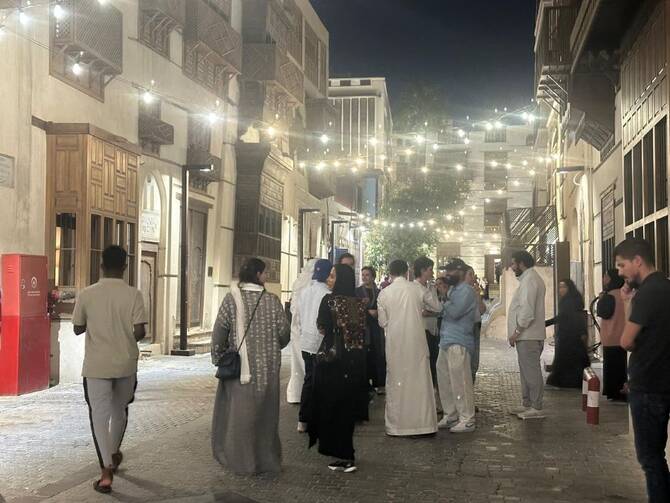
Balad Al-Fann brings Saudi art to life

1 / 7
Safeya Binzagr’s exhibition titled For Us to Remember. (AN Photo/Nada Hameed)
2 / 7
Safeya Binzagr’s exhibition titled For Us to Remember. (AN Photo/Nada Hameed)
3 / 7
Effat Fadag, curator of Safeya Binzagr’s exhibition titled For Us to Remember. (AN Photo/Nada Hameed)
4 / 7
The Balad Al-Fann art program opened in Jeddah’s historic district on Wednesday, running until June 15. (AN Photo/Nada Hameed)
5 / 7
The Balad Al-Fann art program opened in Jeddah’s historic district on Wednesday, running until June 15. (AN Photo/Nada Hameed)
6 / 7
The Balad Al-Fann art program opened in Jeddah’s historic district on Wednesday, running until June 15. (AN Photo/Nada Hameed)
7 / 7
The Balad Al-Fann art program opened in Jeddah’s historic district on Wednesday, running until June 15. (AN Photo/Nada Hameed)
Short Url
Updated 29 May 2025
Follow

Balad Al-Fann brings Saudi art to life

  • Exhibition blends art and memories through archival materials, selected artworks, personal possessions and rare voice recordings

JEDDAH: The second edition of the Balad Al-Fann art program has opened in Jeddah Historic District and runs until June 15.

The initiative this time presents a captivating series of art exhibitions, held under the theme “Our Storied Walls,” which celebrate memory, culture and place.

It boasts a renewed focus on local narratives with each exhibition looking at the tangible and human heritage of the city.

Held at Nassif Boutique, the exhibition is a tribute to the late artist Hisham Binjabi, a foundational figure in Saudi Arabia’s modern art movement.

Curated by Ayman Yossri Daydban, a former student of Binjabi, the exhibition blends art and memories through archival materials, selected artworks, personal possessions and rare voice recordings.

Arab News spoke to Daydban, who is one of the most prominent contemporary artists in Saudi Arabia, with his works featuring in major museums and biennials.

He said: “This is a personal exhibition. My journey with Hisham Binjabi began over 35 years ago when he discovered my work, admired it, and encouraged me.

“For a whole year his name echoed in my mind, until I held my first solo exhibition in 1991. It was his encouragement and appreciation of my boldness — he said I thought outside the box — that pushed me forward. I found myself naturally drawn to contemporary art.”

Daydban’s art is conceptual, and rooted in ideas and meaning. Binjabi, on the other hand, remained faithful to classical and realist styles.

Daydban said: “For years we observed each other’s work from afar, and every time we met I felt like a student reuniting with his mentor.

“But Hisham was more than an artist — he was a social figure, a cultural activist who managed and promoted art within the community, bringing art into social and human contexts.

“His greatest influence was not just in his paintings, but in his presence, personality, and wisdom.”

The exhibition does not merely display Binjabi’s artworks — it narrates his life story through them.

His wife played a part by telling their story through her lens and, for the first time, her works are featured in a dedicated section alongside audio recordings of her and their daughters, reflecting on their lives together as a creative family.

An audio room on the upper floor features testimonials from contemporary artists who were his students or peers, and more recordings are added daily.

The exhibition unfolds across three levels: a deeply emotional audiovisual experience, a debut showcase of his wife’s personal works, and a collective sonic space for shared memory and reflection.

Daydban added: “Hisham was, above all, a socially engaged artist, and this exhibit is aimed primarily at the community of Al-Balad, where he lived and left his mark.”

The program also honors the late Safeya Binzagr, one of the first female visual artists in the Kingdom.

Curated by Effat Fadag, the exhibition weaves together the visual and literary in a journey filled with nostalgia, history and cultural memory.

The exhibition presents rare paintings, handwritten letters, and personal belongings that reflect Binzagr’s unique lens on Hejazi life. Her deeply human portrayals of women, homes, attire and rituals offer not only artistic beauty but also historic insight.

Titled “Revealing What Was Hidden,” the exhibition shows how Binzagr used her art to bring the past to life. Her work helps keep Saudi culture and history alive.

The event honors her role as an artist and historian, and Fadag said: “I asked myself: What can I say that hasn’t already been said? I wanted to highlight aspects of her journey that aren’t widely known.”

Binzagr was the first woman to publicly showcase her family and community life, giving a voice to the private lives of Saudi women — a society that was largely hidden at the time.

Fadag said: “I tried to reflect this (voice) through the layout of the exhibition, using the historic Nassif House, starting from the main building to the external annex, with three symbolic doors that narrate her story.”

This journey begins with Binzagr’s birth and upbringing, moves through her education, the exhibitions she held, and finally her artistic projects on Saudi traditional attire, which are featured on the second floor.

Fadag said: “In the clothing room you see very personal images — she even modeled for her work so she could better understand and express the exact details she wanted to paint. She knew exactly how to translate her vision.”

The final section focuses on giving back to the community, and how Binzagr impacted learning, the broader culture and society at large.

The initiative also puts the spotlight on a curated selection of winning works from a national photography competition, while Balad Al-Fann also hosts a competition showcasing traditional calligraphy, ceramics, ornamentation, and engraving.


‘The Wild Within’ sees artists breathe new life into Mideast buildings

Updated 16 December 2025
Follow

‘The Wild Within’ sees artists breathe new life into Mideast buildings

DUBAI: Lens-based artist Ryan Koopmans and digital artist Alice Wexell are staging a showcase at Dubai’s Leila Heller Gallery that breathes new life into regional buildings.

The series of digital artworks is part of the exhibition “The Wild Within,” featuring images of old structures in Beirut, Istanbul, and Abu Dhabi filled with wild flowers.

Two of the largest works, “Heartbeats” and “The Wish,” are displayed using Ventana, a microLED architectural display surface created by visual technology company Megapixel.

'Around Us' by Ryan Koopmans and Alice Wexell. (Supplied) 

The former artwork depicts the entrance hall of Qasr Al-Watan, the UAE’s presidential palace in Abu Dhabi, while the latter reimagines the upper floors of the Emirates Palace Mandarin Oriental in Abu Dhabi.

“Each building we work with comes to us through a combination of research, travel, and intuition,” the artists told Arab News in a joint statement.

'Constellations' by Ryan Koopmans and Alice Wexell. (Supplied) 

“We are drawn to structures that carry both emotional and historical resonance, often buildings that once embodied human ambition and now exist in a state of quiet transformation.”

Koopans and Wexell made sure to research the context of each building they choose to recreate, saying “an old villa in Jeddah or a former school in Sharjah each hold their own cultural memory, influencing everything from the lighting and atmosphere to the plants and flowers that we digitally sculpt and implement into the photographs.”

'Heart of Sharjah' by Ryan Koopmans and Alice Wexell. (Supplied) 

The hypnotic works depict the interior of buildings in the region, with digitally rendered flowers carpeting the floor in a bid to “(reimage) these spaces (and) explore the relationship between nature, place, and time, while celebrating each site as a unique work of architecture with its own spirit and story,” the artists said.

Koopmans is of dual Canadian and Dutch heritage, while Wexell is Swedish and based in Stockholm, so it is noteworthy that both artists chose to explore the Middle East for their latest project.

'Blossom of the Ancestors' by Ryan Koopmans and Alice Wexell. (Supplied) 

“In the Middle East especially, the architecture reflects a layered past that merges different styles and eras, while also expressing a sense of renewal and forward-looking energy, particularly in the region’s fantastic contemporary buildings. We are drawn to the symmetry, geometry and patterns that are found not only in nature itself, but in the architectural language of the region both past and present,” they said.

The series — featuring works such as “Adore You,” “Between Worlds,” and “Blossom of the Ancestors” — explores contrasts between the natural world and human-made forms, as well as the traditional and contemporary worlds.

“We are interested in how these elements coexist and merge into one another, creating a sense of hyperrealism that feels both familiar and imaginary. By merging photography with digital sculpture, the artworks question where the boundary lies between documentation and invention, and how technology can extend rather than replace our sense of the natural world.”

'Under the Rain of Light' by Ryan Koopmans and Alice Wexell. (Supplied) 

Although the scale of the artworks ensures they leave the viewer entranced, it did pose challenges, according to the artists.

“Presented at a large scale, every texture in these artworks becomes visible, which can be demanding but is also incredibly rewarding. The magnified detail allows the visceral and atmospheric layers of the pieces to come through with greater impact,” they said, adding that each piece took “many months” to create.

“Ultimately, we want our collectors to experience a sense of wonder and contemplation, as if they are standing inside a dream that feels both entirely real yet unreal.”

The exhibition runs until Jan. 15, 2026.