

Islamabad steps up vehicle checks to boost security as 166,000 cars get electronic tags

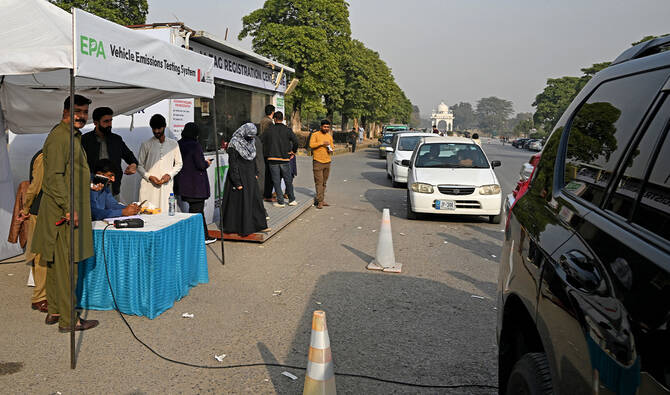
This picture taken on December 10, 2025, shows residents examining their cars at an emission testing point in Islamabad. (AFP)
Short Url
Updated 18 January 2026
Follow

Islamabad steps up vehicle checks to boost security as 166,000 cars get electronic tags

  • Authorities say over 3,000 vehicles registered in past 24 hours as enforcement intensifies
  • Extended service hours introduced to push full compliance with digital monitoring system

ISLAMABAD: Authorities in the Pakistani capital have intensified enforcement against vehicles without mandatory electronic tags with more than 166,000 cars now registered, according to data released on Sunday evening, as Islamabad moves to strengthen security and digital monitoring at key entry and exit points.

The Islamabad Capital Territory (ICT) administration introduced the electronic tagging system late last year as part of a broader effort to regulate traffic, improve record-keeping and enhance surveillance in a city that hosts the country’s main government institutions, foreign missions and diplomatic enclaves.

Under the system, vehicles are fitted with electronic tags that can be read automatically by scanners installed at checkpoints across the capital, allowing authorities to identify unregistered vehicles without manual inspections. Vehicles already equipped with a motorway tag, or m-tag, are exempt from the requirement.

“A total of 166,888 vehicles have successfully been issued M-Tags so far, including 3,130 vehicles in the last 24 hours,” the ICT administration said, according to the Excise Department.

Officials said readers installed at checkpoints across Islamabad are fully operational and are being used to stop vehicles still without tags, as enforcement teams carry out checks across the city.

To facilitate compliance, authorities have expanded installation facilities and extended operating hours. The Excise Department said m-tag installation is currently available at 17 booth locations, while select centers have begun operating beyond normal working hours.

According to Director General Excise Irfan Memon, m-tag centers at 26 Number Chungi and 18 Meel are providing services round the clock, while counters at Kachnar Park and F-9 Park remain open until midnight to accommodate motorists unable to visit during daytime hours.

Officials said the combination of enforcement and facilitation was aimed at achieving full compliance with minimal disruption, adding that operations would continue until all vehicles operating in the capital are brought into the system.

The enforcement drive builds on a wider push by the federal government to integrate traffic management, emergency response and security monitoring through technology-driven “safe city” initiatives. Last month, Interior Minister Mohsin Naqvi reviewed Islamabad’s surveillance infrastructure and said reforms in monitoring systems and the effective use of technology were the “need of the hour.”

Authorities have urged motorists to obtain electronic tags promptly to avoid delays and penalties at checkpoints as enforcement continues across the capital.


Pakistan awaits mandate clarity before committing troops to Gaza stabilization force, FO says

Updated 9 sec ago
Follow

Pakistan awaits mandate clarity before committing troops to Gaza stabilization force, FO says

  • Foreign office says Islamabad cannot commit to contributing troops unless it obtains clarity on the force’s mandate
  • Says Pakistan can be part of peacekeeping force but not of any disarming or de-militarization mandates

ISLAMABAD: Foreign office spokesperson Tahir Andrabi said on Thursday that Pakistan has identified its “red lines” on contributing to the International Stabilization Force (ISF) in Gaza, adding that Islamabad would be unable to take a decision on the matter without clarity about the force’s mandate. 

Andrabi’s comments come as Prime Minister Shehbaz Sharif gears up to attend the inaugural Board of Peace meeting to be chaired by US President Donald Trump in Washington today, Thursday. 

Trump’s 20-point peace plan for Gaza calls for ‌a multi-nation force to oversee a ‌transition period for reconstruction and economic recovery in the Palestinian territory. Pakistan has previously said it is willing to contribute troops for the peace force but would not be part of any move to disarm Hamas. 

“On the international security assistance force, we understand that a decision is awaited on the contours of the mandate of the Board of Peace, on the mandate of the International Stabilization Force,” Andrabi said during a weekly briefing to reporters. 

“And till such time, we would obviously not be in a position to take any decision on this matter. We have identified our red lines quite explicitly.”

Andrabi quoted a previous statement of Deputy Prime Minister Ishaq Dar by saying: “Pakistan can be part of the peacekeeping mandate, but we would obviously not be part of any disarming, de-militarization mandates.”

He said discussion on the international force might take place in Washington today.

The foreign office spokesperson said Pakistan has joined the Board of Peace with a particular focus of aiding in the reconstruction of Gaza and for the long-term settlement of issues faced by Palestinians.

Andrabi said Israel’s recent move to register lands in the West Bank will also come up in the Board of Peace meeting today. 

“That is how Israel is violating international law, UN resolutions on wider occupied Palestinian territories, not just Gaza,” he said.

“So, I think the board of peace meeting affords an opportunity to discuss this important development.”

SAUDI MEDIATION FOR PAKISTANI DETAINEES
To a question about the release of three Pakistani detainees by Afghanistan this week on Saudi Arabia’s mediation, Andrabi welcomed the role played by the Kingdom and “other brotherly Muslim countries.”

 Afghanistan government spokesperson Zabihullah Mujahid announced on Tuesday that it had released three Pakistani soldiers captured during border clashes between the two countries in October after mediation from Saudi Arabia. Mujahid said the detainees were handed over to a visiting Saudi delegation in Kabul.

“Pakistan values the positive role of our brotherly countries, our important OIC Islamic countries, in basically messaging Taliban leadership, reminding them of their obligations under international law, to ensure that their territory is not used for terrorism in Pakistan,” the spokesperson said.

“I think such an exchange also took place between Riyadh and Kabul.”

However, he said Saudi Arabia was not part of any “structured mediation talks” between Pakistan and Afghanistan.

“I am not aware of that role and I would strongly urge you not to speculate into it,” he said. 

To a question about Pakistan’s response if India violates the Indus Waters Treaty, Andrabi said Islamabad will not compromise on its water rights.

“We will not let India weaponize water. We will not compromise on even a single drop of water that this treaty allows us to have a share of, and we will not compromise on the water rights of the people of Pakistan,” he added.