

Russia says no response from Ukraine on Istanbul talks

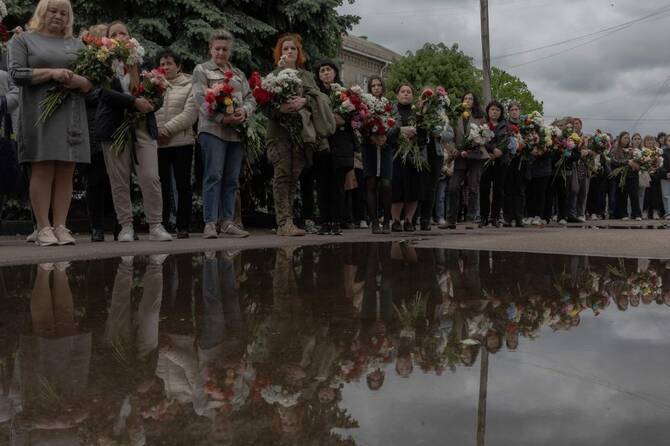
Attendees stand with flowers during the funeral ceremony of 17-year-old Roman Martyniuk, his 11-year-old sister Tamara Martyniuk and 8-year-old brother Stanislav Martyniuk, who were killed by a Russian missile strike, at a town hall in Korostyshiv, Zhytomyr region, on May 28, 2025. (AFP)
Short Url
Updated 29 May 2025
Follow

Russia says no response from Ukraine on Istanbul talks

  • Moscow has shown no signs of easing its bombardment of Ukraine while rebuffing calls for an immediate ceasefire
  • “We need to wait for a response from the Ukrainian side,” Peskov said

MOSCOW: Russia on Thursday said it was still waiting for Ukraine to say whether it would attend peace talks in Istanbul on Monday, after Kyiv demanded Moscow send its peace terms before agreeing to the meeting.

Diplomatic efforts to end the three-year conflict have gained pace in recent months, but Moscow has shown no signs of easing its bombardment of Ukraine while rebuffing calls for an immediate ceasefire.

Moscow has offered to hold a second round of direct talks with Ukraine in Istanbul on June 2, where it wants to present a so-called “memorandum” outlining its conditions for a long-term peace settlement.

But Ukraine said the meeting would not yield results unless it saw a copy of the memorandum in advance, a proposal that the Kremlin dismissed.

“As far as I know, no response has been received yet... we need to wait for a response from the Ukrainian side,” Kremlin spokesman Dmitry Peskov said, calling Kyiv’s demand that Russia provide peace conditions up front as “non-constructive.”

Ukraine said it had already submitted its peace terms to Russia and demanded Moscow do the same.

Turkiye’s President Recep Tayyip Erdogan called on Russia and Ukraine not to “shut the door” on dialogue ahead of the anticipated meeting in Istanbul.

The warring sides previously met in Istanbul on May 16, their first direct talks in over three years.

Those talks failed to yield a breakthrough, but the two sides did agree to trade 1,000 prisoners each — their biggest POW swap since the beginning of the conflict.

Erdogan’s foreign minister, Hakan Fidan, who met Russian leader Vladimir Putin in Moscow on Monday, was expected to travel to Kyiv on Thursday to meet Ukrainian President Volodymyr Zelensky.

US President Donald Trump, who has been pushing for a peace deal, has become increasingly frustrated with Moscow’s apparent stalling and warned Wednesday he would determine within “about two weeks” whether Putin was serious about ending the fighting.

Moscow’s offensive, launched in February 2022, has resulted in tens of thousands of deaths and the destruction of large parts of eastern and southern Ukraine.

Ukraine on Thursday criticized Russia’s refusal to provide the memorandum.

“The Russians’ fear of sending their memorandum to Ukraine suggests that it is likely filled with unrealistic ultimatums,” foreign ministry spokesman Georgiy Tykhy said.

The Kremlin has been grinding forward on the battlefield for over a year while pushing its demands for peace, which include Ukraine abandoning its NATO ambitions and ceding territory it already controls.

Local authorities in Ukraine said Thursday that Russia had fired 90 drones overnight, killing at
least five people across the country.

In southern Ukraine, a drone strike killed two civilians in the Kherson region, while a ballistic missile attack claimed the life of a farm worker in the Mykolaiv region.

In the eastern Donetsk region, shelling killed one civilian, according to a 24-hour tally from the National Police.

A 68-year-old man was killed by a drone strike on his home in the northeastern Sumy region, which borders Russia.

In his comments on Wednesday, Trump told reporters he was “very disappointed” at Russia’s deadly bombardment during the negotiating process, but rebuffed calls to impose more sanctions on Moscow.

Kyiv has accused Russia of deliberately stalling the peace process to pursue its offensive.

Zelensky said Russia was “amassing” more than 50,000 troops on the front line around Sumy, where Moscow’s army has captured a number of settlements as it seeks to establish what Putin has called a “buffer zone” inside Ukrainian territory.

On Thursday, the Russian army said it captured three villages in the Donetsk and Kharkiv regions and had repelled 48 Ukrainian drones, including three over the Moscow region.

A retired Russian commander who led air strikes on the Ukrainian port city of Mariupol died in a blast early Thursday in Stavropol in southern Russia, authorities said, adding that they did not rule out Ukrainian involvement.


‘Peace and stability are ultimate prerequisites for growth and prosperity,’ Indonesia’s president tells WEF

Updated 9 sec ago
Follow

‘Peace and stability are ultimate prerequisites for growth and prosperity,’ Indonesia’s president tells WEF

  • While world faces tightening financial conditions, trade tensions, political uncertainty, ‘Indonesia continues to grow,’ says Prabowo Subianto
  • He says country does not fear economic integration

BEIRUT: History teaches us that “peace and stability are our most valuable assets” and the “ultimate prerequisites for growth and prosperity” as there will be no prosperity without peace, Indonesia’s president said on Thursday.
Prabowo Subianto, in his special address before the World Economic Forum, said: “We gather here in Davos at a time of great uncertainty; a time when wars continue to break out … a time when trust between nations, between institutions, between peoples is fragile.”
According to Subianto, the International Monetary Fund recently described Indonesia as “a global bright spot with strong economic growth amid a challenging external environment.”
While the world faced tightening financial conditions, trade tensions and political uncertainty, “Indonesia continues to grow,” Subianto said, adding that his country’s economy had grown by more than 5 percent every year over the last decade.
“I am confident that this year our growth will be higher,” he said, noting that inflation remained at about 2 percent, while the government deficit had been kept below 3 percent of gross domestic product.
He said that international institutions did not praise Indonesia because of unfounded optimism, but because of evidence. “They recognized that Indonesia’s economy is resilient,” he said, emphasizing that “peace and stability in Indonesia over the years” did not happen by chance.
He added that his country had always chosen unity over fragmentation, and friendship and collaboration over confrontation. He stressed “friendship over enmity.”
Subianto explained that his country had never defaulted on paying its debts and “succeeding regimes always pay the debts of the preceding regime.”
Regarding the economy, the Indonesian president said his country did not fear economic integration, adding: “We have been a trading nation for hundreds of years, and we now conclude trade agreements, not because it is fashionable but we consider it necessary.
“We believe in the concept of win-win. Last year we signed free trade agreements and comprehensive economic partnership agreements with Europe, the EU, Canada (and) Peru, and I have just visited the UK to sign our new strategic partnership and also an economic growth agreement.” He hopes that by 2027 Indonesia has in place a comprehensive economic partnership agreement with the UK.
Its policy is part of the country’s strategy to deepen productivity, reduce barriers and unlock private sector growth for Indonesia, ASEAN (the Association of Southeast Asian Nations) and the Global South, he said.
Subianto added in a session chaired by Borge Brende, WEF’s president and CEO: “We believe that trade integration, when done fairly, is not a threat to sovereignty. We believe trade is a tool for prosperity.
“Indonesia has a clear vision, as we are determined to become a modern country integrated with the global economy (while) providing (a) good quality of life for its citizens, living free of poverty and hunger.”
He further highlighted the importance of political and economic stability as a prerequisite for investments.
Toward the end of his address, the Indonesian president reiterated that “peace and stability is a long and arduous program.”
He added: “Indonesia chooses peace versus chaos. We want to be a friend to all, and an enemy to none. We want to be a good neighbor and a good, responsible citizen of the world, protecting the environment and protecting nature. We must not destroy nature, and live with it.
“Let us build the world we want to live in together. Let us continue the journey to improve the quality of life for all to live in peace, freedom, friendship, tolerance, coexistence, and (with) cooperation for all races, ethnicities, and religions.
“Let us continue our pursuit of justice for all, and security and freedom for all.”