


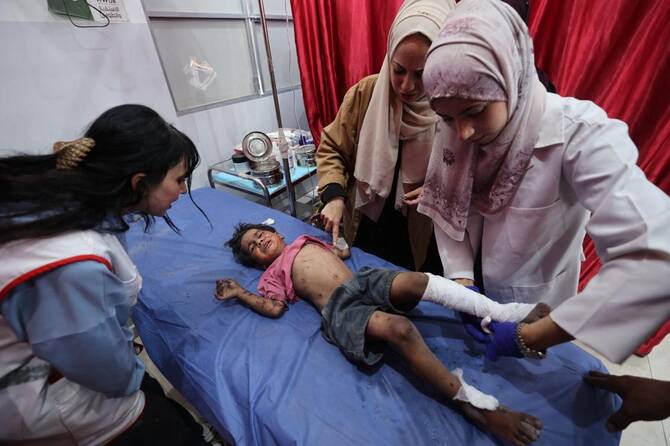

GAZA CITY: At least 44 people were killed in Israeli attacks across the Gaza Strip on Thursday, rescuers said, a day after a World Food Programme warehouse in the center of the territory was looted by desperate Palestinians.
After a more than two-month blockade, aid has finally begun to trickle back into Gaza, but the humanitarian situation remains dire after 18 months of devastating war. Food security experts say starvation is looming for one in five people.
The Israeli military has also recently stepped up its offensive in the territory in what it says is a renewed push to destroy Hamas, whose October 7, 2023 attack triggered the war.
Gaza civil defense official Mohammad Al-Mughayyir told AFP “44 people have been killed in Israeli raids,” including 23 in a strike on home in Al-Bureij.
“Two people were killed and several injured by Israeli forces’ gunfire this morning near the American aid center in the Morag axis, southern Gaza Strip,” he added.

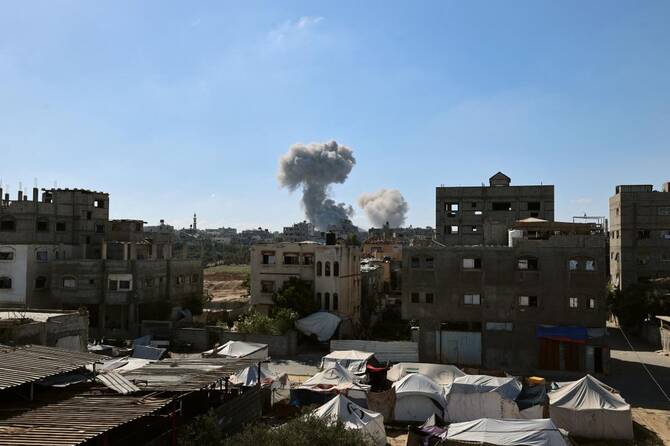
Smoke billows in the background during an Israeli strike, as pictured from the Nuseirat refugee camp in the central Gaza Strip, on Thursday. (AFP)
The center, run by the US-backed Gaza Humanitarian Foundation (GHF), is part of a new system for distributing aid that Israel says is meant to keep supplies out of the hands of Hamas, but which has drawn criticism from the United Nations and the European Union.
“What is happening to us is degrading. The crowding is humiliating us,” said Gazan Sobhi Areef, who visited a GHF center on Thursday.
“We go there and risk our lives just to get a bag of flour to feed our children.”
The Israeli military said it was looking into the reported deaths in Al-Bureij and near the aid center.
Separately, it said in a statement that its forces had struck “dozens of terror targets throughout the Gaza Strip” over the past day.
In a telephone call Thursday with EU foreign policy chief Kaja Kallas, Jordanian Foreign Minister Ayman Safadi said Israel’s “systematic starvation tactics have crossed all moral and legal boundaries.”
On Wednesday, thousands of desperate Palestinians stormed a World Food Programme (WFP) warehouse in central Gaza, with Israel and the UN trading blame over the deepening hunger crisis.
AFP footage showed crowds of Palestinians breaking into the WFP facility in Deir Al-Balah and taking bags of emergency food supplies as gunshots rang out.
“Hordes of hungry people broke into WFP’s Al-Ghafari warehouse in Deir Al-Balah, central Gaza, in search of food supplies that were pre-positioned for distribution,” the UN agency said in a statement.
The issue of aid has come sharply into focus amid starvation fears and intense criticism of the GHF, which has bypassed the longstanding UN-led system in the territory.
Israel’s ambassador to the United Nations Danny Danon told the Security Council that aid was entering Gaza by truck — under limited authorization by Israel at the Kerem Shalom crossing — and accused the UN of “trying to block” GHF’s work through “threats, intimidation and retaliation against NGOs that choose to participate.”
The UN has said it is doing its utmost to facilitate distribution of the limited assistance allowed by Israel’s authorities.
Opinion
This section contains relevant reference points, placed in (Opinion field)
The world body said 47 people were wounded Tuesday when crowds of Palestinians rushed a GHF site. A Palestinian medical source reported at least one death.
GHF, however, alleged in a statement that there had been “several inaccuracies” circulating about its operations, adding “there are many parties who wish to see GHF fail.”
But 60-year-old Abu Fawzi Faroukh, who visited a GHF center Thursday, said the situation there was “so chaotic.”
“The young men are the ones who have received aid first, yesterday and today, because they are young and can carry loads, but the old people and women cannot enter due to the crowding,” he told AFP.
Negotiations on a ceasefire, meanwhile, have continued, with US envoy Steve Witkoff expressing optimism and saying he expected to propose a plan soon.
But Gazans remained pessimistic.
“Six hundred days have passed and nothing has changed. Death continues, and Israeli bombing does not stop,” said Bassam Daloul, 40.
The Gaza war was sparked by Hamas’s October 2023 attack on Israel that killed 1,218 people, mostly civilians, according to an AFP tally based on official figures.
Out of 251 hostages seized during the attack, 57 remain in Gaza including 34 the Israeli military says are dead.
The health ministry in Hamas-run Gaza said Thursday that at least 3,986 people had been killed in the territory since Israel ended the ceasefire on March 18, taking the war’s overall toll to 54,249, mostly civilians.


