

EU condemns Israel over Gaza civilian deaths

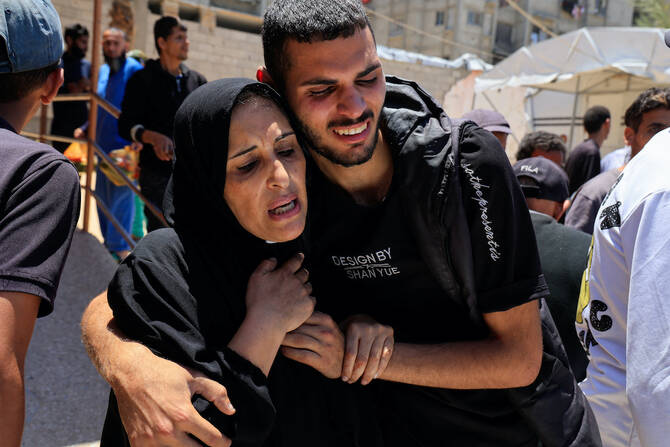
Mourners attend the funeral of Palestinians killed in Israeli strikes, in Khan Younis, in the southern Gaza Strip on Wednesday. (Reuters)
Short Url
Updated 28 May 2025
Follow

EU condemns Israel over Gaza civilian deaths

  • Foreign policy chief Kaja Kallas says humanitarian aid must never be politicized after Israel seizes control of distribution in Gaza
  • Strongly-worded criticism comes amid groundswell of European political backlash in against Netanyahu government 

LONDON: EU foreign policy chief Kaja Kallas condemned Israel on Wednesday over the number of civilian deaths in Gaza and restrictions on humanitarian aid.

Her comments come as political pressure grows in Europe against Israel’s military campaign in the territory, which has killed almost 54,000 Palestinians since October 2023.

“Israel’s military operation in Gaza, the disproportionate use of force and the deaths of civilians cannot be tolerated,” Kallas said. “The continued targeting of civilian infrastructure is unacceptable.”

She called for a return to the ceasefire that broke down in March after less than two months, the release of all hostages and the permanent end to the conflict through negotiations.

Since ending the ceasefire, Israel has ramped up its operations, killing almost 4,000 people. Benjamin Netanyahu’s government this month ordered the military to take full control of the territory as it attempts to wipe out Hamas.

Israel has also taken over aid distribution after blockading supplies to Gaza for more than two months, leading to fears of a famine among the impoverished population.


EU High Representative and Vice-President for Foreign Affairs Kaja Kallas said Israel's targeting of civilian infrastructure is unacceptable. (AFP)

A new aid distribution system that bypasses the UN has been set up in southern Gaza and is being run in conjunction with a new American organization. The system started to operate this week but has been heavily criticized by Arab and European governments, along with aid agencies.

“Humanitarian aid must never be politicized or militarized,” Kallas said. “The EU reiterates its urgent call for the immediate, unimpeded and sustained resumption of aid at scale, according to the needs of the civilian population in Gaza.”

She called for the UN to resume its role in distributing humanitarian assistance.

While much of the focus has been on the decimation of Gaza, Israel has also ramped up operations in the occupied West Bank and has been accused of encouraging settler attacks on Palestinians.

Kallas said intimidation campaigns, attacks, and the destruction of Palestinian homes by settlers have displaced entire communities.

“Israel must immediately take decisive steps to address this issue and ensure that the perpetrators of these crimes are held accountable,” she said.

Her strong comments followed a rebuke of Israel on Tuesday from German Chancellor Friedrich Merz, in what has been seen as a shift in Berlin’s support for Israel.

“What the Israeli Army is doing in the Gaza Strip, I no longer understand the goal,” he said. “To harm the civilian population in such a way, as has increasingly been the case in recent days, can no longer be justified as a fight against terrorism.”

Last week, the UK, France and Canada issued a joint statement demanding Israel halt its military actions and threatened “concrete actions” if the slaughter continued. 

On Wednesday, Italy’s right-wing government also demanded an end to Israel’s assault saying it had become “unacceptable.” Foreign Minister Antonio Tajani warned against any attempt to forcibly remove the Palestinian population from Gaza — something Palestinians fear is underway after Netanyahu said he would offer “voluntary emigration” to other states for the territory’s population.

Netanyahu said last week that criticism from Western countries was “emboldening” Hamas, which led the October 2023 attack on Israel that killed 1,200 people and captured dozens of hostages.

The UK has suspended talks on a free-trade agreement with Israel and the EU has launched a review of its association agreement with the country. 

Kallas said on Wednesday that she aims to present options for the bloc’s next steps on June 23.

Opinion

This section contains relevant reference points, placed in (Opinion field)


Syrian Alawites protest in coastal heartland after mosque bombing

Updated 5 sec ago
Follow

Syrian Alawites protest in coastal heartland after mosque bombing

  • Syrian Alawites took to the streets on Sunday in the coastal city of Latakia to protest after a mosque bombing that killed eight people in Homs two days before
LATAKIA: Syrian Alawites took to the streets on Sunday in the coastal city of Latakia to protest after a mosque bombing that killed eight people in Homs two days before.
The attack, which took place in an Alawite area of Homs city, was the latest against the religious minority, which has been the target of several episodes of violence since the December 2024 fall of longtime ruler Bashar Assad, himself an Alawite.
Security forces were deployed in the area, and intervened to break up clashes between demonstrators and counter-protesters, an AFP correspondent witnessed.
“Why the killing? Why the assassination? Why the kidnapping? Why these random actions without any deterrent, accountability or oversight?” said protester Numeir Ramadan, a 48-year-old trader.
“Assad is gone, and we do not support Assad... Why this killing?“
Sunday’s demonstration came after calls from prominent spiritual leader Ghazal Ghazal, head of the Islamic Alawite Council in Syria and Abroad, who on Saturday urged people to “show the world that the Alawite community cannot be humiliated or marginalized.”
“We do not want a civil war, we want political federalism. We do not want your terrorism. We want to determine our own destiny,” he said in a video message on Facebook.
Protesters carried pictures of Ghazal along with banners expressing support for him, while chanting calls for decentralized government authority and a degree of regional autonomy.
“Our first demand is federalism to stop the bloodshed, because Alawite blood is not cheap, and Syrian blood in general is not cheap. We are being killed because we are Alawites,” Hadil Salha, a 40-year-old housewife said.
Most Syrians are Sunni Muslim, and the city of Homs — where Friday’s bombing took place — is home to a Sunni majority but also has several areas that are predominantly Alawite, a community whose faith stems from Shiite Islam.
The community is otherwise mostly present across their coastal heartland in Latakia and Tartus provinces.
Since Assad’s fall, the Syrian Observatory for Human Rights monitor and Homs province residents have reported kidnappings and killings targeting members of the minority community.

- Alawite massacres -

The country has also seen several bloody flare-ups of sectarian violence.
Syria’s coastal areas saw the massacre of Alawite civilians in March, with authorities accusing armed Assad supporters of sparking the violence by attacking security forces.
A national commission of inquiry said at least 1,426 members of the minority were killed, while the Syrian Observatory for Human Rights monitor put the toll at more than 1,700.
Late last month, thousands of people demonstrated on the coast to protest fresh attacks targeting Alawites in Homs and other regions.
Before and after the March bloodshed, authorities carried out a massive arrest campaign in predominantly Alawite areas, which are also former Assad strongholds.
Protesters on Sunday also demanded the release of detainees.
On Friday, Syrian state television reported the release of 70 detainees in Latakia “after it was proven that they were not involved in war crimes,” saying more releases would follow.
Despite assurances from Damascus that all Syria’s communities will be protected, the country’s minorities remain wary of their future under the new Islamist authorities, who have so far rejected calls for federalism.