


ALULA: Qurh, an ancient city in Saudi Arabia’s AlUla governorate, served for centuries as a vital hub for pilgrims and traders, according to the Saudi Press Agency.
Located about 20 km south of AlUla’s old town, near the village of Mughayra, Qurh is one of the Royal Commission for AlUla’s archaeological sites. AlUla’s other main heritage sites are Dadan, Hegra and the Old Town.
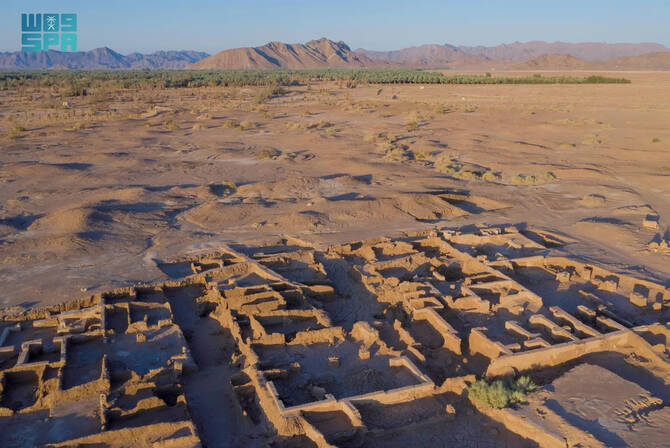
Qurh’s ruins spread across an expansive plain surrounded by medium-height mountains. The ruins include remnants of architectural structures, marketplaces, streets, and palaces, all of which highlight the city’s once-thriving economic and urban life.
Architectural features dating back to the early Islamic periods also suggest that settlement and cultural growth continued after the advent of Islam.

The ruins include remnants of architectural structures, marketplaces, streets, and palaces, all of which highlight the city's once-thriving economic and urban life. (SPA)
Qurh was the capital of Wadi Al-Qura and a center for Arab markets, as described by the historian Hisham bin Al-Kalbi, who identified it as a commercial and cultural center and a cradle of the arts.
The city was located on the route of the historic Incense Road, a trade artery used to transport precious goods from the southern Arabian Peninsula to the north, passing through Wadi Al-Qura.

The ruins include remnants of architectural structures, marketplaces, streets, and palaces, all of which highlight the city's once-thriving economic and urban life. (SPA)
According to Abdulrahman Alsuhaibani, the RCA’s vice president for culture, the excavations in Qurh have so far proved “that there was some interaction with China at the beginning of the Islamic period.”
“Evidence exists of interactions and trade extending as far as China,” he said in an interview produced by FT Longitude in partnership with the RCA.
“With China, for example, (there were) merchants who brought porcelain, medicines and silk to Arabia with incense for sure, ivory, while other valuables travelled in the opposite directions.”
AlUla, part of Saudi Arabia’s western province of Madinah, has been home to the ancient Dadanites, Lihyanites, Nabataeans, Sabaeans, Minoans, Egyptian, Romans and Arabs, he said.


