

Sudan cholera outbreak kills 172 in one week: health ministry

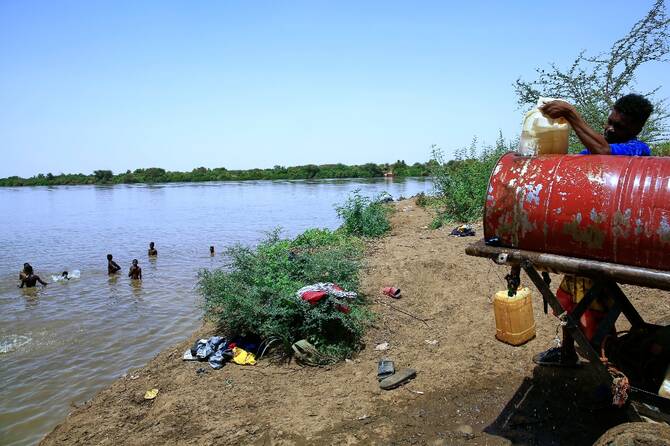
Children swim in the Nile River as a man fills a water container due to water outages in Khartoum, Sudan. (AP)
Short Url
Updated 27 May 2025
Follow

Sudan cholera outbreak kills 172 in one week: health ministry

  • Doctors Without Border coordinator Joyce Bakker calls for a united response, including water, sanitation and hygiene programs and more treatment facilities as cholera cases surge in Sudan

PORT SUDAN: Sudan’s health ministry reported Tuesday a sharp uptick in cholera cases in the war-torn country, which recorded 2,700 infections and 172 deaths in one week.

In a statement, the health ministry said 90 percent of cases were reported in Khartoum state, where water and electricity supply have been severely disrupted in recent weeks by drone strikes attributed to the paramilitary Rapid Support Forces (RSF), at war with the army since April 2023.

Meanwhile, a leading medical group warned on Tuesday of a rising number of cholera cases in war-torn Sudan as a new outbreak of the waterborne disease grips the country, and said its teams have treated hundreds of patients in the region of the capital, Khartoum.

Joyce Bakker, the Sudan coordinator for Doctors Without Borders — also known as Médecins Sans Frontières or MSF — said that the alarming spike began in mid-May, with Khartoum’s twin city, Omdurman, as the epicenter.

She said MSF treated almost 2,000 suspected cholera cases in the past week alone. There were no immediate official figures of fatalities from cholera in this latest outbreak, though an aid worker said he was told on Monday of 12 people dying of cholera.

In March, MSF said that 92 people had died of cholera in Sudan’s White Nile State, where 2,700 people had contracted the disease since late February.

Sudan plunged into war more than two years ago, when tensions between the Sudanese army and its rival paramilitary Rapid Support Forces group, or RSF, exploded with battles in Khartoum and across the country.

Since then, at least 20,000 people have been tallied as being killed, though the number is likely far higher, and the African nation has been engulfed by what the United Nations says is the world’s largest humanitarian crisis.

More than 14 million people have been displaced and forced from their homes and disease outbreaks, famine and atrocities have mounted as the country entered its third year of war.

Sudan’s Health Minister Haitham Ibrahim said on Saturday that the recent increase in cholera cases is estimated to average 600 to 700 per week, over the past four weeks.

He attributed the surge to the return of many Sudanese to the Khartoum region — people who had fled their homes to escape the fighting and who are now coming back. Their returns have strained the city’s dwindling water resources, he said.

Last week, the Sudanese military said it had regained control of the Greater Khartoum area from the paramilitary forces.

On Monday, Mohanad Elbalal, co-founder of the Khartoum Aid Kitchen, said he was told that 12 people had died of cholera in Omdurman, including a relative of one of his kitchen staff.

Bakker, the MSF coordinator, said Tuesday that the group’s treatment centers in Omdurman are overwhelmed and that the “scenes are disturbing.”

“Many patients are arriving too late to be saved,” she said. “We don’t know the true scale of the outbreak, and our teams can only see a fraction of the full picture.”

She called for a united response, including water, sanitation and hygiene programs and more treatment facilities.


Security, economic and political partnerships in the spotlight at first Jordan-EU Summit

Updated 11 sec ago
Follow

Security, economic and political partnerships in the spotlight at first Jordan-EU Summit

  • Event reflects international confidence in Jordan as a reliable partner in efforts to address security threats, advance peace initiatives, and expand cooperation, analysts say
  • Timing is significant, expert says, given the region faces overlapping crises and threats that place security and defense cooperation at the heart of Jordanian-European relations

AMMAN: The inaugural Jordan-EU Summit underlined the depth of the country’s strategic partnership with Europe, officials and experts said, and confirmed the pivotal role Jordan plays in regional security, political stability and economic cooperation.

Analysts told the Jordan News Agency that Thursday’s summit took place at a sensitive moment for the region, but reflected international confidence in Jordan as a reliable partner in efforts to address cross-border security threats, advance peace initiatives, and expand cooperation in trade, investment and development.

Bashir Al-Dajeh, an expert in security and strategy, said the timing of the summit was significant, given the region is facing overlapping crises and transnational threats that place security and defense cooperation at the heart of Jordanian-European relations.

Jordan’s strategic location positions it on the front lines of efforts to tackle illegal migration, organized crime, drug and arms smuggling and cross-border terrorism, he added. The country has hosted more than 3.5 million refugees over the past decade without compromising its security infrastructure, he noted.

Jordan’s effective border controls were helping to curb irregular migration to Europe and disrupting the plans of extremist groups and trafficking networks, Al-Dajeh said, which was directly benefiting regional and European security.

Khaled Abu Hassan, a member of the Jordanian parliament, said the country’s foreign policy under King Abdullah had reinforced its influence, in the region and internationally, particularly its firm stance in support of the Palestinian cause and a two-state solution to the conflict with Israel.

He said the summit reaffirmed Jordan’s political influence in the shaping of regional balances and advancement of efforts to achieve a just and comprehensive peace. The timing of the meeting also demonstrated the resilience of the nation in managing multiple regional and domestic challenges.

Abu Hassan also highlighted the economic aspects of the summit, including the announcement of a Jordan-EU economic conference in April, as a sign of the international recognition of Jordan’s political and economic role.

Economist Mufleh Aql said the high-level summit reflected a shared desire for a broadening of cooperation to encompass politics, trade, security and renewable energy, and Jordan was well-placed to benefit from access to the EU’s large markets, technology and investment opportunities.

The country could benefit from increased exports, technology transfers and financing for major infrastructure projects in sectors such as water, transport and energy, he added, and in return offer the EU skilled human capital amid labor shortages in Europe.

EU support for Jordan’s positions on issues such as Jerusalem, regional stability, energy and migration further strengthens the partnership, Aql said. Jordan also already benefits from EU grants, concessional loans and exports of agricultural, pharmaceutical and chemical products to European markets, he noted.