

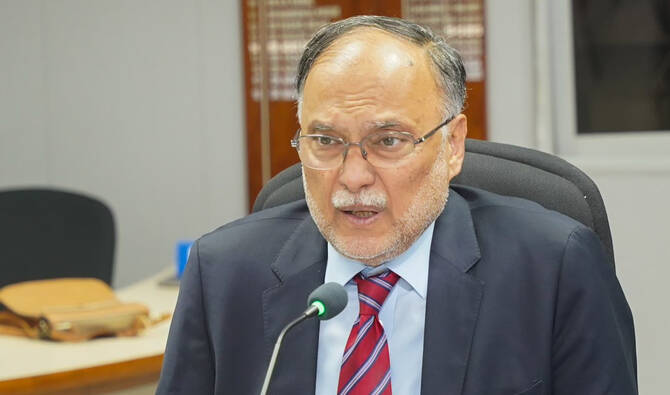

KARACHI: Planning Minister Ahsan Iqbal hinted this week there could be an increase in Pakistan’s defense allocation in the budget for the fiscal year 2025-26, due to be announced next month, weeks after a military standoff with India that alarmed the world.
Pakistan and India attacked each other with missiles, drones and artillery earlier this month after tensions surged over an attack in April on tourists in Indian-administered Kashmir that New Delhi blamed on Pakistan. Islamabad has denied the charge.
“We want to try and put the least burden on the common man but right now I believe it is our national duty that in this budget we give our armed forces the resources they need to strengthen our defense capabilities so that our defense can be safe even in the future,” Iqbal said in remarks to reporters when asked about reports of an increase in the defense allocation for the new fiscal year.
The conflict with New Delhi escalated on May 7 after India first hit Pakistan and Azad Kashmir with missiles, and Pakistan retaliated, saying it had downed six Indian fighter jets.
Fighting between the two nations continuing for four days, with missile and drone strikes on each other’s military facilities and airfields as well as increased gunfire exchanges on the de facto LoC border. A ceasefire was reached on May 10.
“This has been established that our neighbor is a dangerous enemy, who once again attempted to attack us in the dark of night, but we punished them by fully responding to this offense and it [India] will definitely think a hundred times before committing such an aggression next time,” Iqbal added.
“However, our duty is to stay alert and prepared all the time so that if someone commits such a mistake in future, then it could be responded to more effectively.”
Two days after the ceasefire, Indian Prime Minister Narendra Modi warned Pakistan New Delhi would target “terrorist hideouts” across the border again if there were new attacks on India and would not be deterred by what he called Islamabad’s “nuclear blackmail.”
“In the coming days, we will measure every step of Pakistan... what kind of attitude Pakistan will adopt,” Modi said, adding that India had only “paused” strikes.
In a report published on Saturday, Tola Associates, a major tax advisory and consultancy firm, proposed raising the defense budget to Rs2.8 trillion, a 32 percent increase compared to the last fiscal year, owing to a “war-like situation” with India.
“The budgeted defense expenditure stood at Rs2,122 billion for FY25 while the actual expenditure till March 2025 was Rs1,424 billion. [However], due to the ongoing war situation with the neighboring country, defense spending may increase by up to 50 percent in the Q4FY25,” the report said.
“Given the current regional tensions and the need to ensure Pakistan’s defense preparedness, we estimate total defense spending to reach Rs2.4 trillion by June 2025.”
Pakistan’s historically large defense budget is attributed to a complex interplay of factors, primarily driven by regional security concerns and internal challenges. These include the perceived security threat from India as well as internal instability and security threats like terrorism. Additionally, debt servicing and the allocation of resources toward military interests have also played a role in shaping the budget.


