

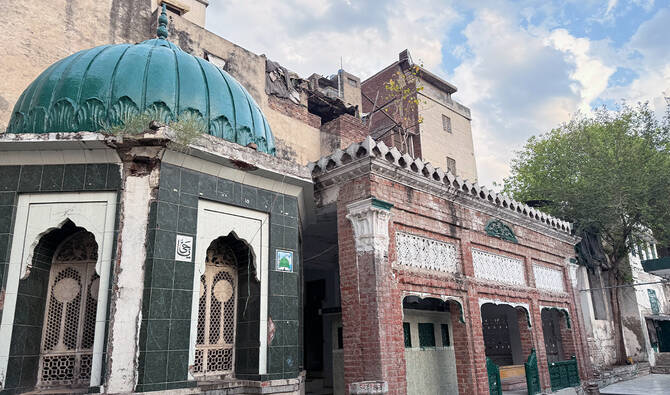
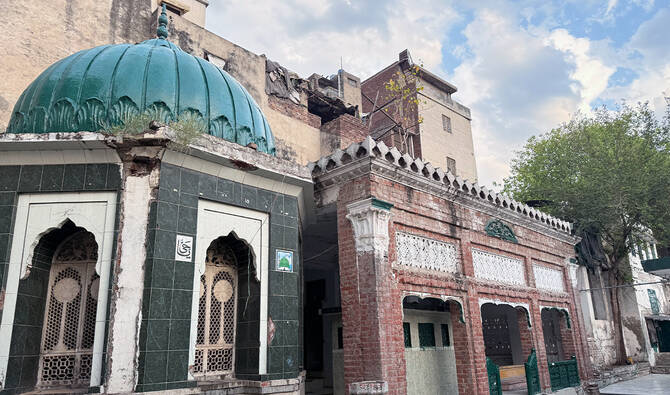
LAHORE: Tucked within the dense, winding lanes of Lahore’s Walled City, the Begum Zamani Mosque rises quietly near Masti Gate, its fading frescoes and low domes bearing witness to centuries of history — and to a time when the city’s sacred spaces stood side by side.
Commissioned in the early 17th century during the reign of Mughal emperor Jahangir and named after his mother, Mariam-uz-Zamani, the mosque is widely regarded as the oldest surviving Mughal mosque in Lahore. Built between 1611 and 1614, it predates the grand Badshahi Mosque by several decades and reflects an earlier phase of Mughal architectural expression in the region.
Renowned for its intricate stucco work, floral frescoes and kashikari tile decoration, the mosque stands across from what was once ‘Mai Ka Mandir,’ a Hindu temple that has since been absorbed into the commercial sprawl of the area, its physical presence largely erased but its memory still alive among locals.
“The mosque stands in an area of the Walled City commonly known as Masti Darwaza… Unlike many other historic gates of Lahore, this neighborhood historically hosted mixed religious communities before the Partition,” said Saad Zahid, a cultural heritage expert.
“The mosque itself represents Muslim architecture and is widely believed to have been built by the Mughal emperor Jahangir, named after his mother,” he said.
“Together, these sites reflect how this gate of the Walled City once symbolized a remarkable landscape of interfaith coexistence in Lahore.”
QUIETER MUGHAL MOMENT
Unlike later Mughal mosques, which emphasized monumental scale and visibility, Begum Zamani Mosque is notably restrained in its form. It has no towering minarets, a feature that sets it apart from iconic structures such as the Badshahi Mosque.
Local caretakers attribute this to the presence of the temple that once stood opposite.
“There is a mandir located directly in front of the mosque, and that temple existed before the mosque was built,” said Hafiz Maqsood Ahmed, who has served as the mosque’s prayer leader for the past 30 years.
“When Jodha Bai, later known as Mariam Zamani, commissioned the construction of the mosque, she intentionally chose not to include minarets in its design… The mosque has small domes but no minarets, because she did not want the mosque to overshadow the magnificence of the temple that stood opposite it.”
While historians generally describe early Mughal mosques as architecturally modest compared to later imperial constructions, such local accounts continue to shape how communities interpret the site’s past.
The mosque features five domes, with the central dome rising to nearly twice the height of the others. Its double-layered structure, caretakers say, was designed both to manage the building’s weight and to protect its elaborate decorative work.
“This design was created because of the heavy structural weight of the building. Secondly, the mosque contains extensive kashikari… so the double dome was constructed to help protect this intricate artwork,” Ahmed said.
“The kashikari work in this mosque is considered unparalleled, not only among mosques but even when compared to temples across Pakistan.”
CHANGING LANDSCAPE
Over time, the mosque’s surroundings have transformed dramatically. What was once a relatively open, mixed-use neighborhood has evolved into one of Lahore’s busiest commercial zones, with shoe markets, warehouses and dense encroachments crowding the historic site.
The temple that once stood across from the mosque no longer functions as a place of worship and has been converted into a storage facility.
“There are estimated 384 shops across the entire site, including Rim Market, Shoe Market, and properties attached to the Maryam Zamani Mosque,” said Azeem DadKhan, Director Conservation and Planning at the Walled City of Lahore Authority.
“The area falls within the buffer zone of Lahore Fort, adjacent to the Akbari Gate of the fort. The study is being conducted to assess business losses and structural measurements, and is being carried out by consultant,” he added.
For Noor Muhammad, 80, who has been giving the call to prayer at the mosque for six decades, the changes are deeply personal.
“It is said that Mariam Zamani used to offer prayers in the basement of this mosque, which is why the mosque also came to be known as Masjid Begum Shahi,” he said.
“At one time, this entire area was largely empty, but over the years people have illegally occupied the surroundings.”
FADING CROWDS, ENDURING FAITH
As Ramadan draws to a close and Eid approaches, the mosque sees a brief revival of activity, a reminder of the role it once played at the heart of community life.
Caretakers say that more than a decade ago, the mosque would fill to capacity during major religious occasions. Today, attendance remains modest, with most worshippers coming for daily prayers rather than congregational gatherings.
“For the past 30 years, we have continuously raised our voices for proper maintenance and preservation of this historic mosque,” Ahmed said, noting that restoration work carried out in 2019–2020 had already begun to deteriorate.
“The older craftsmanship was strong and durable, whereas the recent repairs have already deteriorated within three to four years.”
Despite the commercial bustle surrounding it, the mosque continues to anchor a sense of continuity for those who live and work nearby.
“This mosque is very old, it existed even before I was born,” said Muhammad Shahzad, a 36-year-old shopkeeper. “My children also come to this mosque to offer their prayers.”


