


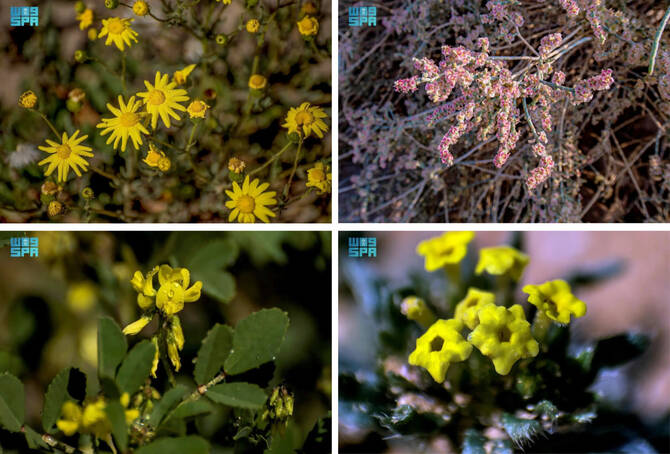

JEDDAH: Saudi Arabia’s landscapes are brightened each year by a dazzling array of wildflowers that bring bursts of color and life to its deserts and valleys.
Among the most iconic are Bassia eriophora, Senecio glaucus (locally known as Zamlouq), and Tribulus omanense (commonly called Zahrah). These species are celebrated not only for their natural beauty but also for their ecological, historical, and cultural significance.

In the Northern Borders Province, the desert is seasonally transformed into a living canvas by the arrival of Zamlouq, one of the region’s most striking wildflowers. Once near extinction, this annual herbaceous plant is now enjoying a revival.
Also known as Nowair or Yellow Arabian, Zamlouq germinates rapidly after rainfall and can grow up to 20 centimeters tall. It is easily recognized by its elongated, strap-like leaves and bright yellow, daisy-like flowers that enrich the desert with vibrant color.
Zamlouq emits a distinctive, aromatic fragrance that attracts bees and butterflies, playing a vital role in pollination and supporting ecological balance.

Zamlouq, also known as Nowair or Yellow Arabian, not only provides valuable forage for livestock and wildlife but also helps stabilize the soil and prevent erosion. (SPA)
It typically blooms from late winter into spring, carpeting the desert floor with natural ground cover that boosts soil fertility and provides valuable forage for livestock and wildlife. It also helps stabilize the soil and prevent erosion — especially in open desert areas.
“This annual herb thrives in sandy plains and open rangelands, blooming in spring,” Ghalia Aljeddani, associate professor of plant ecology at the University of Jeddah’s Department of Environmental Sciences, told Arab News.
“It serves as valuable forage for livestock and contributes to soil stabilization and ecological beautification.”
Opinion
This section contains relevant reference points, placed in (Opinion field)
Another native species creating a breathtaking spectacle during the blooming season is the Ramth shrub (Haloxylon salicornicum), particularly in the valleys of the Northern Borders, such as Wadi Arar and its tributaries. Recent thunderstorms and rainfall have triggered renewed floral activity in these regions.
Ramth is a perennial, evergreen shrub known for both its ecological and pastoral value. Conservation efforts, including the establishment of nature reserves, have helped restore this once-declining species and expand Saudi Arabia’s green cover.

Ramth (Haloxylon salicornicum), a perennial desert shrub, thrives across the Arabian Peninsula under harsh desert conditions. (SPA photo)
Highly valued by herders as a key “Hamad” (palatable pasture shrub), Ramth typically grows to around 1 meter tall and can spread across several square meters. Its scale-like, tubular leaves retain moisture, allowing it to thrive in extreme desert conditions.
When protected from grazing, Ramth demonstrates a remarkable capacity to regenerate. In mid-summer, its foliage produces tiny granules of pure white sugar — a unique feature in its ecological profile.
Ramth is “commonly used as camel forage and firewood,” said Aljeddani.
“It is also a natural source of salt for camels and has uses in cleaning products and some medicinal applications. Its ability to thrive in saline and arid environments makes it a promising solution for combating desertification.”
DID YOU KNOW?
• More than 800 types of wildflowers have been recorded across the Arabian Peninsula.
• After rainfall, the deserts, rocky mountains and gravel plains burst into life with greenery.
• Despite their relatively small sizes, wildflowers in Saudi Arabia are remarkably resilient.
• Bedouin have long used wild plants to treat infections and for health-boosting properties.
Among the diverse Tribulus species found across the Arabian Peninsula, Tribulus omanense — locally known as Zahrah — stands out with its large, vivid yellow flowers and soft, feathery foliage.
This trailing plant thrives in loose sands and high desert dunes and can grow up to 80 centimeters tall, adding a dramatic splash of color to otherwise barren terrain. Belonging to the Zygophyllaceae family, Zahrah is distinguished by its star-shaped flowers with five delicate petals and its spiny seed capsules.

Tribulus omanense — locally known as Zahrah — is a creeping annual plant from the (Zygophyllaceae) family, distinguished by clover-like compound leaves and bright yellow flowers. (SPA photo)

Tribulus omanense stands out with its large, vivid yellow flowers and soft, feathery foliage. (SPA photo)
Its deep green, pinnate leaves and sprawling stems enhance its ornamental appeal, while its winter bloom transforms the desert into a radiant sea of yellow. Zahrah serves as an important food source for desert ungulates like gazelles and oryx, as well as for domesticated animals.
Native to the Arabian Peninsula, Zahrah is exceptionally adapted to harsh conditions, tolerating extreme heat, drought, and sandy soils. Its water-saving mechanisms make it indispensable to desert ecosystems.
Beyond its ecological value, Tribulus omanense is revered as a symbol of endurance and vitality — mirroring the resilience of the desert and the spirit of the people who call it home.

The Arnebia decumbens plant, a seasonal wildflower that flourishes in the Kingdom's Northern Borders region during spring, serves as a vital food source for wildlife and livestock and contributes to ecological balance and soil stabilization in sandy areas. (SPA)
Yet environmental pressures such as climate change, overgrazing, and urban expansion threaten the resurgence of these plants. Authorities are working to raise public awareness about the importance of conserving native vegetation to preserve biodiversity and protect the Kingdom’s natural heritage.
These measures will help maintain ecological balance without excessive strain on water resources, enhance natural resistance to drought and desertification, and support the development of resilient and sustainable ecosystems.
“These wildflowers are not merely natural adornments of the land,” said Aljeddani. “They play vital environmental, cultural, and economic roles and significantly contribute to national initiatives aimed at achieving sustainability.”


