Thai ex-PM Yingluck ordered to pay $305 million in damages over rice scheme

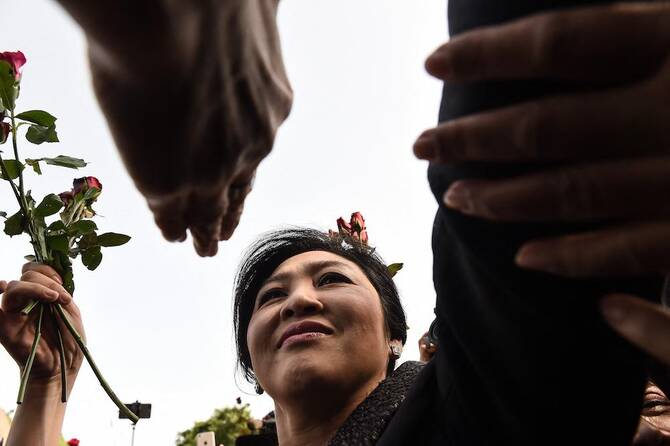
Self-exiled former premier Yingluck Shinawatra came to power in 2011 after a landslide election victory and resigned just days before her government was ousted in a coup in 2014. (AFP)
Short Url
Updated 22 May 2025
Follow

Thai ex-PM Yingluck ordered to pay $305 million in damages over rice scheme

  • Yingluck is one of four members of the billionaire Shinawatra family to have served as prime minister
  • She has been living overseas to avoid jail for failing to prevent corruption in the rice scheme

BANGKOK: A Thai court on Thursday ordered self-exiled former premier Yingluck Shinawatra to pay 10 billion baht ($305 million) in damages over a botched rice pledging scheme that saw her sentenced in 2017 to five years in prison for negligence. Yingluck, one of four members of the billionaire Shinawatra family to have served as prime minister, has been living overseas to avoid jail for failing to prevent corruption in the rice scheme, which paid farmers up to 50 percent above market prices and caused massive losses to the state.
The program, a flagship policy of her populist Pheu Thai party, cost the state billions of dollars and led to millions of tons of rice going unsold. Thailand is the world’s second-largest rice exporter.
Thursday’s ruling was on Yingluck’s appeal against a previous order to pay 35 billion baht ($1.07 billion) in damages to the finance ministry.
“The accused performed duties with gross negligence that caused damage to the state and therefore must pay compensation,” the Supreme Administrative Court said, adding the previous order exceeded the legal threshold of her responsibility and was unlawful. Yingluck 57, came to power in 2011 after a landslide election victory and resigned just days before her government was ousted in a coup in 2014. She is the aunt of current Prime Minister Paetongtarn Shinawatra and younger sister of former premier and political heavyweight Thaksin Shinawatra. Thursday’s verdict comes less than two years after her family’s Pheu Thai party returned to power after a decade in the political wilderness, coinciding with influential brother Thaksin coming home after 15 years in self-exile to avoid jail.
The Shinawatras have consistently denied wrongdoing and have long maintained they have been victims of political vendettas by powerful figures in the conservative establishment and royalist military.
Yingluck on Thursday said the order to pay 10 billion baht was excessive.
“Even if I repaid it my entire life, it would never be enough,” she said on social media. “I will continue to demand and fight for justice.”


Blacklisted naphtha tanker from Russia enters Venezuelan waters while another diverts, ship data shows

Updated 4 sec ago
Follow

Blacklisted naphtha tanker from Russia enters Venezuelan waters while another diverts, ship data shows

  • Under U.S. sanctions related to Russia, the ship has a different sanctions profile than Skipper, the tanker that was seized by the U.S. on December 10

HOUSTON: A tanker subject to U.S. sanctions carrying some 300,000 barrels of naphtha from Russia entered Venezuelan waters late ​on Thursday, while another began redirecting course in the Atlantic Ocean, ship tracking data showed, a reflection of diverging last-minute decisions by ship owners after President Donald Trump ordered a "blockade" of oil tankers under sanctions bound for the OPEC country earlier this week.
The move ramped up pressure on Venezuelan president Nicolas Maduro by targeting the country's main source of income and followed the seizure by the U.S. of an oil tanker off the coast of Venezuela earlier in December.
Vessels that were not subject to sanctions began setting sail on Wednesday from Venezuelan waters after a week's pause, helping drain the country's mounting crude stocks.
Gambia-flagged medium tanker Hyperion docked on Friday at Amuay ‌Bay on Venezuela's ‌western coast, according to LSEG ship tracking data. It loaded near ‌Murmansk ⁠in ​Russia in ‌late November.
Under U.S. sanctions related to Russia, the ship has a different sanctions profile than Skipper, the tanker that was seized by the U.S. on December 10.
The U.S. can only seize vessels outside of its jurisdiction, or vessels that aren't heading to or from the country, if Washington has placed them under sanctions for links to groups it designates as terrorist, said David Tannenbaum, a director at consulting firm Blackstone Compliance Services that specializes in sanctions and anti-money laundering compliance.
Skipper, formerly called the Adisa, was under sanctions for what the U.S. says was involvement in Iranian oil trading that generated ⁠revenue for Iranian groups it has designated as foreign terrorist organizations.
With the Hyperion, though, sanctions were imposed to reduce Russian revenues from energy because of ‌its war with Ukraine.
"The Hyperion doesn't have known ties to ‍terrorism, and therefore unless they can prove it's subject ‍to the jurisdiction of the U.S., Washington can't grab it extraterritorially," said Tannenbaum, who previously worked with the ‍U.S. Treasury's Office of Foreign Assets Control that administers and enforces economic and trade sanctions.

REDIRECTS AND U-TURNS
The Angola-flagged Agate, another medium tanker under sanctions that loaded in Russia and had been sailing toward the Caribbean, was seen redirecting on Friday, according to LSEG ship tracking. The vessel was pointing towards Africa, but had not yet signaled a new destination.
Oman-flagged Garnet, also under sanctions ​and loaded in Russia, continued on its track, signaling the Caribbean as its destination on Friday.
Benin-flagged tanker Boltaris, under sanctions and carrying some 300,000 barrels of Russian naphtha bound for Venezuela, made ⁠a U-turn earlier this month and was heading for Europe without having discharged, according to LSEG vessel monitoring data.
Two very large crude carriers not subject to sanctions set sail for China on Thursday from Venezuela, according to sources familiar with Venezuela's oil export operations, marking only the second and third tankers unrelated to Chevron to depart the country since the U.S. seized Skipper.
The American oil major, which has continued to ship Venezuelan crude under a U.S. authorization, exported a crude cargo on Thursday bound for the U.S., LSEG data showed.
Secretary of State Marco Rubio on Friday said the U.S. was not concerned about the four vessels that sailed from Venezuela on Thursday, as those were not ships under sanctions.
"Sanctioned boats, we have the capabilities necessary to enforce our laws. We'll have a judicial order, we'll execute on those orders and there's nothing that will impede us from being able to do that," Rubio said.
Venezuela's government ‌called Trump's blockade a "grotesque threat" in a statement on Tuesday, saying it violates international law, free commerce and the right of free navigation.