

Gaza student evacuated to UK with her family after government climbdown

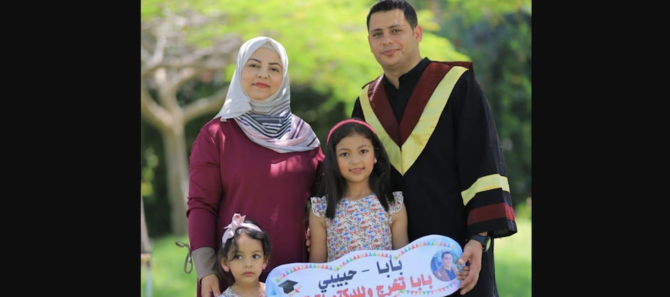
Manar Al-Houbi, a student from Gaza granted permission to live and study in the UK, has been evacuated from the Palestinian territory, with her family, by the British government. (Supplied)
Short Url
Updated 19 December 2025
Follow

Gaza student evacuated to UK with her family after government climbdown

  • Manar Al-Houbi was initially denied permission to bring her husband and children after changes to UK rules on foreign scholarship recipients
  • Several students still stranded in Gaza as relocation deadline looms, after refusing to abandon family members

LONDON: A student from Gaza granted permission to live and study in the UK has been evacuated from the Palestinian territory, with her family, by the British government.

Manar Al-Houbi won a full scholarship to study for a doctorate at the University of Glasgow. It also allowed her to bring her husband and children with her, and they applied for the required visas. But shortly before her studies were due to start, UK authorities told her the rules for international students and their dependents had changed and her family could no longer accompany her.

Shortly after her story was reported in October, however, the government backed down as said it would consider evacuation of international students’ dependents on a “case-by-case basis.”

Al-Houbi and her family are now in Jordan, on their way to the UK, The Guardian newspaper reported on Friday. The British scheme for the evacuation of students from Gaza is due to expire on Dec. 31. People who have attempted to use it have described it as being riddled with issues, as a result of which some students with scholarships have been left stranded in the Palestinian territory.

Several told the Guardian they had decided not to travel to the UK because they had felt pressured into leaving loved ones behind, including children.

Wahhaj Mohammed, 32, said he was told by the Foreign, Commonwealth and Development Office to travel to the UK alone, and his wife and children would be allowed to join him later. Two months after he arrived in Glasgow, his family are still in Gaza with no time frame for them to follow him.

“The uncertainty affects every aspect of my life here,” he told The Guardian. “It’s difficult to settle, to feel present or to engage academically when the people you love most remain living under constant threat.”

The Guardian said UK officials were “hopeful” his family would be evacuated in 2026 but could offer no guarantee about when this might happen.

Another student, Amany Shaher, said she refused to leave her family behind in Gaza and as a result was denied permission to travel to the UK this week. She does not know whether she will be permitted to defer her scholarship to study at the University of Bristol.

The 34-year-old, who has three children, said: “How can I even consider leaving my children behind in Gaza? Nowhere else in the world would a mother be expected to part so easily from her children. It’s dehumanizing. We have a right to stick together as a family and not be forced to separate — that should not be too much to ask.

“None of us know if the UK’s student evacuation scheme will be extended or not. We haven’t been given any clear guidance or timelines and have no idea what 2026 will bring.”

Mohammed Aldalou also refused to leave behind his family, including his 5-year-old autistic and non-verbal son, to take up a scholarship for postgraduate studies at the London School of Economics.

He said the Foreign Office had suggested to him he travel separately from them, as they did with Mohammed.

“They should ask themselves what they would do if they were in my shoes,” he said. “It’s heartbreaking that after everything we’ve been through, we’re being asked to make this impossible decision.”

Sources told The Guardian it was unlikely the Foreign Office would extend the scheme to allow students to travel from Gaza to the UK later, but that a meeting took place last week with the Department for Education to discuss whether students could begin their studies online.


Blacklisted naphtha tanker from Russia enters Venezuelan waters while another diverts, ship data shows

Updated 56 min 28 sec ago
Follow

Blacklisted naphtha tanker from Russia enters Venezuelan waters while another diverts, ship data shows

  • Under U.S. sanctions related to Russia, the ship has a different sanctions profile than Skipper, the tanker that was seized by the U.S. on December 10

HOUSTON: A tanker subject to U.S. sanctions carrying some 300,000 barrels of naphtha from Russia entered Venezuelan waters late ​on Thursday, while another began redirecting course in the Atlantic Ocean, ship tracking data showed, a reflection of diverging last-minute decisions by ship owners after President Donald Trump ordered a "blockade" of oil tankers under sanctions bound for the OPEC country earlier this week.
The move ramped up pressure on Venezuelan president Nicolas Maduro by targeting the country's main source of income and followed the seizure by the U.S. of an oil tanker off the coast of Venezuela earlier in December.
Vessels that were not subject to sanctions began setting sail on Wednesday from Venezuelan waters after a week's pause, helping drain the country's mounting crude stocks.

HIGHLIGHTS

• Trump's 'blockade' aims to halt sanctioned oil tankers to Venezuela

• Hyperion's sanctions profile differs from seized Skipper tanker

• Venezuela condemns US actions as violating international law

Gambia-flagged medium tanker Hyperion docked on Friday at Amuay ‌Bay on Venezuela's ‌western coast, according to LSEG ship tracking data. It loaded near ‌Murmansk ⁠in ​Russia in ‌late November.
Under U.S. sanctions related to Russia, the ship has a different sanctions profile than Skipper, the tanker that was seized by the U.S. on December 10.
The U.S. can only seize vessels outside of its jurisdiction, or vessels that aren't heading to or from the country, if Washington has placed them under sanctions for links to groups it designates as terrorist, said David Tannenbaum, a director at consulting firm Blackstone Compliance Services that specializes in sanctions and anti-money laundering compliance.
Skipper, formerly called the Adisa, was under sanctions for what the U.S. says was involvement in Iranian oil trading that generated ⁠revenue for Iranian groups it has designated as foreign terrorist organizations.
With the Hyperion, though, sanctions were imposed to reduce Russian revenues from energy because of ‌its war with Ukraine.
"The Hyperion doesn't have known ties to ‍terrorism, and therefore unless they can prove it's subject ‍to the jurisdiction of the U.S., Washington can't grab it extraterritorially," said Tannenbaum, who previously worked with the ‍U.S. Treasury's Office of Foreign Assets Control that administers and enforces economic and trade sanctions.

REDIRECTS AND U-TURNS
The Angola-flagged Agate, another medium tanker under sanctions that loaded in Russia and had been sailing toward the Caribbean, was seen redirecting on Friday, according to LSEG ship tracking. The vessel was pointing towards Africa, but had not yet signaled a new destination.
Oman-flagged Garnet, also under sanctions ​and loaded in Russia, continued on its track, signaling the Caribbean as its destination on Friday.
Benin-flagged tanker Boltaris, under sanctions and carrying some 300,000 barrels of Russian naphtha bound for Venezuela, made ⁠a U-turn earlier this month and was heading for Europe without having discharged, according to LSEG vessel monitoring data.
Two very large crude carriers not subject to sanctions set sail for China on Thursday from Venezuela, according to sources familiar with Venezuela's oil export operations, marking only the second and third tankers unrelated to Chevron to depart the country since the U.S. seized Skipper.
The American oil major, which has continued to ship Venezuelan crude under a U.S. authorization, exported a crude cargo on Thursday bound for the U.S., LSEG data showed.
Secretary of State Marco Rubio on Friday said the U.S. was not concerned about the four vessels that sailed from Venezuela on Thursday, as those were not ships under sanctions.
"Sanctioned boats, we have the capabilities necessary to enforce our laws. We'll have a judicial order, we'll execute on those orders and there's nothing that will impede us from being able to do that," Rubio said.
Venezuela's government ‌called Trump's blockade a "grotesque threat" in a statement on Tuesday, saying it violates international law, free commerce and the right of free navigation.