

The enduring legend of Virat Kohli

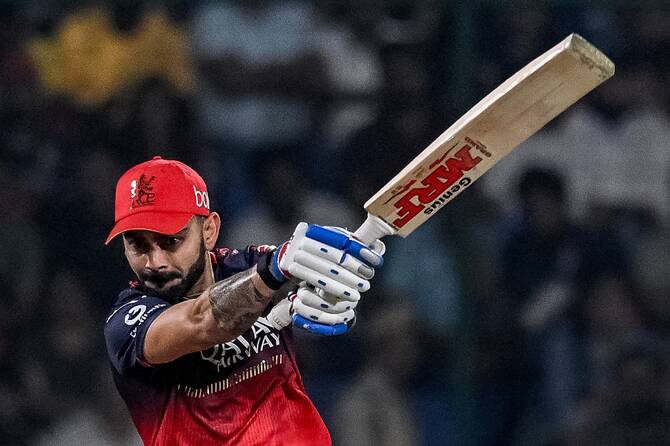
Kohli scored 9,230 runs in 123 Tests to stand fourth in India’s all-time list of Test run-scorers after Tendulkar, Dravid and Gavaskar. (FILE/AFP)
Short Url
Updated 24 May 2025
Follow

The enduring legend of Virat Kohli

  • Kohli’s cricketing persona has been one of aggressiveness and intensity, always eager to join the fray and whip up his team to greater heights, more in the manner of soccer than cricket

Some cricketers possess an unmistakable presence when they walk out to bat. Vivian Richards of the West Indies was one. He swaggered, smiled, oozed confidence and menace, chewed gum and eschewed a helmet in favor of a cap. His style of entrance may have set a precedent for others to build their own individual brands as cricketers in an era of universal television coverage. 

Chris Gayle, another West Indian, the self-styled “Universe Boss,” was one who did that across all formats. An imposing presence as soon as he stepped onto the cricket field, Gayle took to the T20 format very quickly, establishing himself as a free-scoring, aggressive batter to be feared. He also proved himself at Test level, capable of batting at length. In 2010, he batted almost 10 hours in scoring 333 against Sri Lanka, becoming only the fourth batsman to score two Test triples. Both Gayle and Richards now live out of the limelight, their cricketing reputations intact.

In previous eras, the great and charismatic players of the time did not have the media exposure that is available to current players. In the immediate years after 1945, Denis Compton of England and Keith Miller of Australia were two players who excited crowds with their charisma, becoming icons at a time of national recovery from war. Compton was one of the first cricketers to be used in consumer advertising, as the face of Brylcreem, a hair cream. 

It is now commonplace for cricketers to endorse consumer products, other than cricket equipment. A number of them have developed their own brand values. An outstanding example of this is Virat Kohli, who has transcended his ability as a cricketer to become an international icon. His decision to retire from Test cricket, announced on Instagram on May 12 to 271 million followers, has sparked a deluge of tributes. These have focussed on his place in the game and his contribution to it, especially to Test cricket, for which he has been an outspoken champion. 

In this respect, it is a disappointment to many that Kohli will not be a part of the Indian team that will play five Tests in England between June 20 and Aug. 4. Neither will his successor as captain, Rohit Sharma, who also announced his retirement from Test cricket on May 7. Both players retired from international T20 cricket after India won the T20 World Cup in June 2024, under Sharma’s captaincy. The two were different in both batting and leadership styles but have been instrumental in guiding India to recent trophy success.

Sharma retires with 4,301 runs in 67 Test matches, averaging 40.57. His recent form has been poor, having made only one 50 in 15 innings since his last Test hundred against England in Dharamsala in March 2024. Sharma was captain in 2024, when India was surprisingly beaten 3-0 at home by New Zealand and 3-1 away by Australia, where he sat out the decisive fifth Test in Sydney. In the same series, Kohli, although scoring a hundred in the first Test, endured a dip in form. His frustrations at what appeared to be waning abilities surfaced in an unseemly incident during the fourth Test at Melbourne. 

At the end of the tenth over of Australia’s innings, 19-year-old debutant, Sam Konstas, walked toward his opening partner at the non-striker’s end. He was looking at his gloves, when Kohli, who was walking in the opposite direction from his fielding position, made shoulder contact with Konstas. Commentators remarked that Kohli had walked one whole pitch over to his right and appeared to have instigated the confrontation.

Kohli was sanctioned for a breach of conduct and fined 20 percent of his match fees, which he accepted. Perhaps the act was that of an aging lion attempting to curb a rising cub, of whose talent he was envious. Kohli’s cricketing persona has been one of aggressiveness, intensity, always eager to join the fray and whip up his team to greater heights, more in the manner of soccer than cricket.

This has not endeared him to opposition supporters. I have witnessed and heard comments by English supporters that have been uncomplimentary — not that Kohli has been afraid to take on opposition supporters with words and provocative gestures. There has always been a sense that he has escaped censure for transgressions and acts for which others would have received punishment.

On the field, whether fielding, captaining or batting, Kohli’s presence and actions were ones that demanded attention. His passion for Test cricket shone through, as evidenced in his retirement statement in which he said, “I’ve given it everything I had, and it’s given me back so much more than I could’ve hoped for. I’ll always look back at my Test career with a smile.”

In it, Kohli scored 9,230 runs in 123 Tests to stand fourth in India’s all-time list of Test run-scorers after Tendulkar, Dravid and Gavaskar. He also captained India in 68 of his Tests, winning 40 of them, which makes him the country’s most successful leader in the format. Such a record is a reflection not only of his hunger for runs, but his desire to win and for those around him to strive for excellence. His own commitment to physical fitness has become legendary and aspirational for young Indians, who seek to emulate his appearance.

It is not clear if there was any single reason for Kohli’s decision to retire. One consideration is form. The Test hundred in Australia last November was his first in 15 innings in the previous 16 months. In Australia, he scored 190 runs in nine innings, averaging just 23.75, which compares with a final Test average of 46.85. Since January 2020, he has averaged 30.72, scoring only three centuries in 39 Tests. Another consideration was the curbing, by the national board, of the size and composition of the support groups for players while on tour. One factor that does not seem to have been widely discussed is the impact of Sharma’s retirement.

Of course, Kohli has not slipped into the shadows. In IPL 2025, he has scored more than 500 runs and he still wishes to play ODI cricket for India. His retirement appears to be a carefully managed process. Off the field, his brand value and product endorsement strategy has been carefully curated to mirror his fitness-oriented lifestyle, fashion sense, family orientation and appeal across the whole Indian demographic. Kohli has also invested in a number of start-up ventures to ensure exposure outside of mainstream advertising. Unlike other famous cricketers, he will not be living quietly in retirement. 

There is little doubt that Virat Kohli has an aura about him on and off the pitch. He leaves a huge gap in the Test arena and there is a worry that his advocacy of it may not be continued by his successors. Kohli has said that, “There’s something deeply personal about playing in whites. The quiet grind, the long days, the small moments that no-one sees but that stay with you forever.” Self-reflection is not a characteristic that springs immediately to mind about Kohli, who admits that the journey has “tested me, shaped me and taught me lessons I’ll carry for life.” He leaves an indelible mark on both Indian and global cricket in which his stature was invariably imperial, not just when going out to bat.       


A new UAE-based player arrives on cricket’s media field

Updated 25 December 2025
Follow

A new UAE-based player arrives on cricket’s media field

  • ‘Mr Cricket UAE,’ Anis Sajan, has launched a Dubai based cricket-focused digital media house under the aegis of the Mr. Cricket UAE Media Group.

A former Australian international cricketer, Michael Hussey, who retired in 2013, was known as “Mr Cricket.” It has always appeared to me to be a strange nickname. Even with my passion for the game and its quirks, it has been difficult to fathom its origins, to the point of deciding to delve no deeper. I was jolted out of this inertia by an introduction to “Mr. Cricket UAE,” Anis Sajan. As detailed in Arab News on Dec. 18, he has launched a Dubai-based cricket-focused digital media house, under the aegis of the Mr. Cricket UAE Media Group.
Sajan is a rags-to-riches person, from the chawls of Mumbai to the heights of the Danube Group, of which he is vice-chairman. He told me of his early days playing gully cricket in Mumbai, of how he developed into roles as a radio commentator on cricket prior to moving to Dubai in the early 1990s. He admits to no great proficiency in cricket but has managed to establish close relationships with leading players in the game.
This was very evident on Dec. 17 at the launch of the Mr. Cricket UAE platform in Dubai. His invited guests included three of England’s 2019 World Cup-winning team, Eoin Morgan, Moeen Ali and Adil Rashid. The last two are playing in the current DP World ILT20. There was even a videoed message from Michael Hussey, who was rather dismissive of his own Mr. Cricket nickname. Apparently, Hussey is on record as saying that he is not very fond of it. Quite when it was bestowed on him and by whom is unclear, but his enthusiasm for cricket was well known on the circuit. He was always the first to practice and the last to leave, hitting balls in every spare minute, giving himself every chance of doing well. Hence the nickname should be regarded as a mark of respect for his dedication and commitment.
The launch of the Mr. Cricket UAE platform represents an entry into a new market for the Danube Group, which is established in real estate, retail, building materials and hospitality. The company was started in 1993 as a small trading firm in Dubai by Anis’ elder brother Rizwan. Since then, Danube has expanded rapidly in the region and in 2018 was ranked amongst the top real-estate companies in Middle East by Forbes. The group has its headquarters in Dubai and operates in 10 countries, including the UK, where it opened an office in 2025.
When Anis moved to Dubai from India, he carried with him his passion for cricket. After the Danube team had great success in local indoor cricket leagues, Sajan told me that in 2012 he started and funded two Danube outdoor corporate cricket teams — the Lions and the Tigers — which played against themselves and other corporate teams on regular basis. The teams were launched by none other than the great Indian batter, Sunil Gavaskar. At the time, Gavaskar said: “The objective is to connect every cricket connoisseur and professional directly or indirectly with the game. The idea is to discover and nurture the young talents and also instill the right spirit to help the young players lead a healthy lifestyle.”
Thirty players were recruited to the teams through a professional selection system. They were employed solely to play cricket and were good enough to compete with visiting touring teams. In November 2015, for example, the national teams of Nepal and Papua and New Guinea were hosted for 50-over matches. In February 2016, Ireland played a 20-over match, followed in March by Derbyshire’s county cricket team, who won a 50-over match by 69 runs. In August 2017, the Sajan brothers and one other businessman joined forces to purchase a team to compete in the inaugural Ten Cricket League, played in Sharjah.
After this time, Anis stepped back from direct involvement in cricket to focus on work and family, but his passion for it was never lost. This was apparent when talking with members of his staff, who say that they have been pushing him for some time to be involved again. Over the years of writing this column, it has become apparent to me that the growth of cricket in the Gulf region would benefit from dedicated coverage. There are excellent media outlets which provide coverage of cricket around the world, including tournaments and major matches in the Gulf, but their emphasis is on the big events, teams and players.
ESPNcricinfo is 80 percent owned by ABC, Inc, an indirect subsidiary of The Walt Disney Company, and 20 percent by Hearst. It is rated the world’s leading multi-platform sports entertainment brand. Cricbuzz, owned since 2014 by Times Internet in India, is an omnipresent cricket media platform which provides real-time scores, news and in-depth analysis of cricket matches worldwide. Cricket World is an independent British site which has an impressive global coverage, given its limited resources compared with Cricinfo and Cricbuzz. Two long-established magazines, Wisden and The Cricketer, now have digital imprints. The latter is more than 100 years old and has undergone a series of fluctuating fortunes. It is a now looking to lever its brand heritage and loyal readership into the digital age, for which it will probably need investment. Associate nations cricket is represented by the Emerging Cricket website, whilst there are literally hundreds of blogs which address the many different aspects of the game. Cricket is a sport which indulges itself in statistics.
In response to this, there are a number of excellent databases. Cricket Archive claims to be the world’s leading authority on compiling cricket data. Its statisticians have created a source of fully searchable first-class, List A and T20 cricket records from around the world. Another source of statistics is HowSTAT, which began in Adelaide in the early 1990s when a group of friends with a passion for cricket needed a resource to help settle some of their arguments. Then, there is The Association of Cricket Statisticians and Historians, which was founded in 1973. It is an international body represented in more than 20 countries and its membership includes most of the world’s leading cricket statisticians. All of these sites cover both men’s and women’s cricket, but there is a site dedicated to women’s cricket — Female Cricket.    
Not unexpectedly, Anis Sajan is well aware of these platforms. In fact, he told me that he is in awe of several of them. However, he is also cognizant that cricket in the Gulf is a growth sector, for both men and women. At the heart of this lies the UAE, which has built a reputation for hosting international tournaments in world-class facilities and is fast strengthening its development structures for local talent. This is now to be supplemented by a UAE-based digital media house which will initially focus on cricket with specific reference to the region. The digital sports media industry is growing rapidly and the Danube Group is entering that market at a pivotal stage, leveraging its position in physical industries.
The new platform plans to embrace in-depth narratives, matchday coverage, viral short-form videos and community-first stories. It will be fascinating to watch how its mission “to become the world’s most relatable, trusted and culturally connected cricket media brand” will play out. In particular, it will be interesting to see how it fits alongside the established platforms and how it will establish a point of difference from them. Although Michael Hussey did not encourage the use of his Mr. Cricket nickname, the sobriquet is going live on the global stage through Anis Sajan and the Danube Group.