Pakistani military blames ‘Indian-sponsored’ militants for children’s death in northwest this week

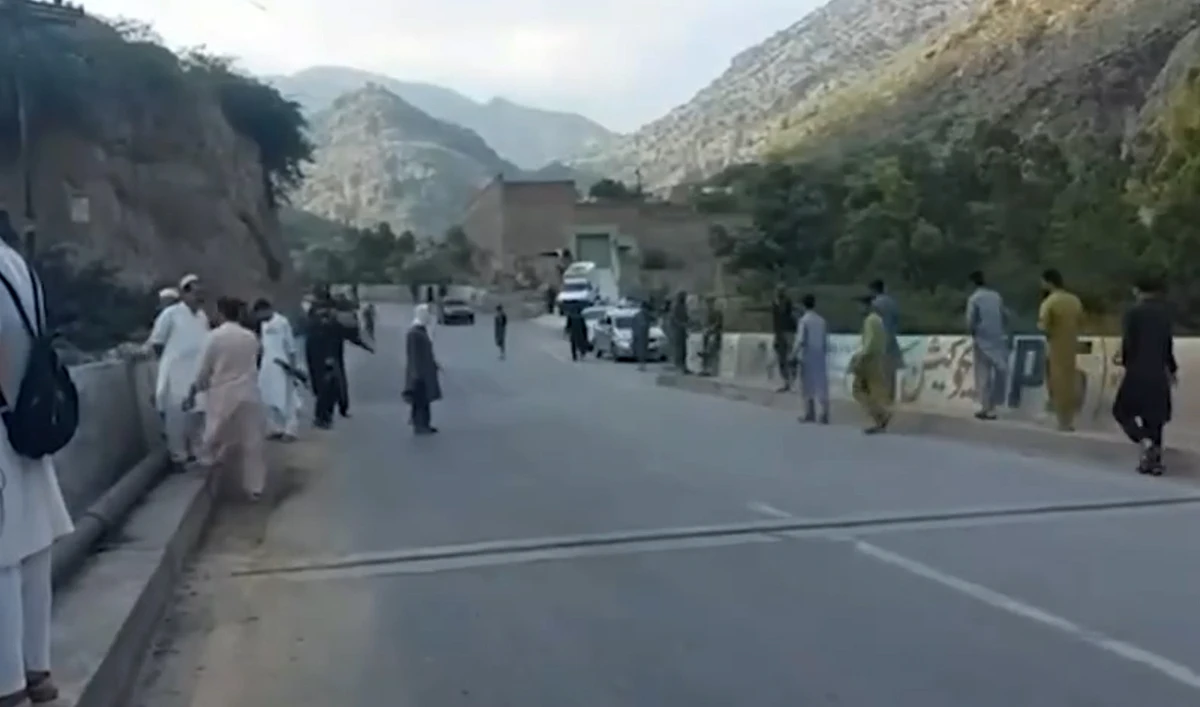
Resident gathers near the mosque targeted during an attack in the Hurmuz village of Mir Ali tehsil, North Waziristan, Pakistan on May 19, 2025. (Photo courtesy: PTV News)
Short Url
Updated 21 May 2025
Follow

Pakistani military blames ‘Indian-sponsored’ militants for children’s death in northwest this week

  • Protests broke out in North Waziristan after a suspected drone strike reportedly led to the killings of four children
  • The military says initial investigations have revealed the incident was carried out by ‘Fitna Al Khwarij’ militants

ISLAMABAD: Pakistan’s military on Wednesday denied responsibility for the death of four children in North Waziristan earlier this week, attributing the incident to a proscribed militant network which it said was operating on “the behest of their Indian masters.”

The incident occurred on May 19 in the Hurmuz village of Mir Ali tehsil, where a suspected drone strike reportedly led to the death of four children from the same family and injuries to five others, including a woman.

The tragedy sparked protests in the area, with locals staging a sit-in and refusing to bury the deceased until authorities provided clarity on the incident and ensured accountability for the loss of innocent lives.

In a statement released on Wednesday, the Inter-Services Public Relations (ISPR), the military’s media wing, dismissed allegations implicating Pakistan’s security forces in the strike, labeling the accusations as “entirely baseless” and part of a “coordinated disinformation campaign” aimed at discrediting the military’s counterterrorism efforts.

“Initial findings have established that this heinous act has been orchestrated and executed by Indian-sponsored Fitna Al Khwarij,” the statement said, using a term commonly employed by Pakistani authorities to describe extremist factions like the Tehreek-i-Taliban Pakistan (TTP).

The term “khwarij” is rooted in early Islamic history and refers to an extremist sect that declared other Muslims apostates.

“It is evident that these elements — acting at the behest of their Indian Masters — continue to exploit civilian areas and vulnerable populations as shields to conduct their reprehensible acts of terrorism,” the statement added. “Such tactics aims to unsuccessfully sow discord between the local population and the security forces, who together remain resolute to uproot the menace of terrorism.”

The military also reaffirmed its commitment to bringing the perpetrators to justice, emphasizing its ongoing efforts to combat militant violence in the region.
Rating firm S&P says it won’t rush Iran war downgrades, sees risks for countries like Pakistan

Updated 12 March 2026
Follow

Rating firm S&P says it won’t rush Iran war downgrades, sees risks for countries like Pakistan

  • Agency says it is monitoring indebted energy importers as higher oil prices strain finances
  • Gulf economies seen better placed to weather shock, though Bahrain flagged as vulnerable

LONDON: S&P Global ‌said it would not make any knee-jerk sovereign rating cuts following the outbreak of war in the ​Middle East, but warned on Thursday that soaring oil and gas prices were putting a number of already cash-strapped countries at risk.

The firm’s top analysts said in a webinar that the conflict, which has involved US and Israeli strikes ‌against Iran and Iranian ‌strikes against Israel, ​US ‌bases ⁠and Gulf ​states, ⁠was now moving from a low- to moderate-risk scenario.

Most Gulf countries had enough fiscal buffers, however, to weather the crisis for a while, with more lowly rated Bahrain the only clear exception.

Qatar’s banking sector could ⁠also struggle if there were significant ‌deposit outflows in ‌reaction to the conflict, although there ​was no evidence ‌of such strains at the moment, they ‌said.

“We don’t want to jump the gun and just say things are bad,” S&P’s head global sovereign analyst, Roberto Sifon-Arevalo, said.

The longer the crisis ‌was prolonged, though, “the more difficult it is going to be,” he ⁠added.

Sifon-Arevalo ⁠said Asia was the second-most exposed region, due to many of its countries being significant Gulf oil and gas importers.

India, Thailand and Indonesia have relatively lower reserves of oil, while the region also had already heavily indebted countries such as Pakistan, Bangladesh and Sri Lanka whose finances would be further hurt by rising energy prices.

“We ​are closely monitoring ​these (countries) to see how the credit stories evolve,” Sifon-Arevalo said.