

Israeli strikes ‘shredding people to pieces’ in Gaza: British surgeon

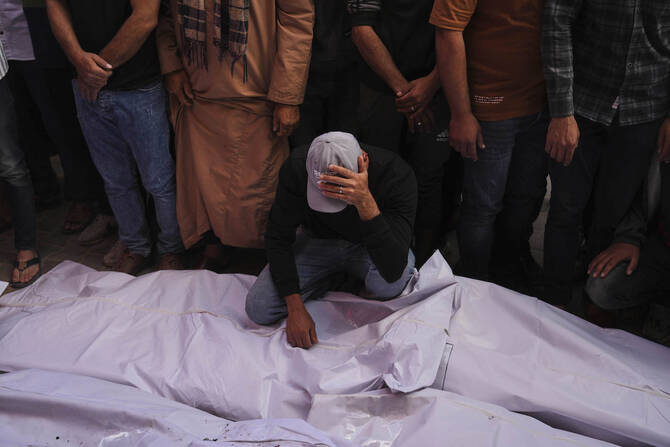
Palestinian mourn relatives who were killed in Israeli army airstrike on the Gaza Strip, at the morgue of Al-Aqsa Hospital in Deir al-Balah, Gaza, May 20, 2025. (AP)
Short Url
Updated 20 May 2025
Follow

Israeli strikes ‘shredding people to pieces’ in Gaza: British surgeon

  • Tom Potokar: ‘It is difficult to imagine how human beings can treat other human beings in this way’
  • ‘This will be a stain on humanity when people look back in years to come’

LONDON: Israeli strikes on Gaza are “shredding people to pieces,” a British surgeon working in hospitals there has told the Daily Telegraph.

Tom Potokar, a plastic surgeon working in southern Gaza, said he was at the European Hospital when it was attacked by Israel.

Its new offensive has been met by international condemnation, with Gaza’s Health Ministry saying hundreds of Palestinians have been killed in recent days.

Potokar, who is now stationed at Al-Amal Hospital in Khan Younis, said: “You have to consider that the Gaza Strip is, geographically, a very small area and yet there are nearly two million people living here.

“So, when you drop ordnance — with the amounts being used and the type of weapons being used in such a small, densely populated area — you are literally shredding people to pieces.”

Potokar was forced to move hospital three times in the past week to avoid Israeli bombing. Describing the attack on the European Hospital, he said: “It is difficult to imagine how human beings can treat other human beings in this way. To see children particularly with horrific injuries and amputations, to see pregnant women requiring major surgery — it’s absolute brutality.”

Israeli attacks on hospitals have drawn widespread condemnation from humanitarian organizations.

The UN Human Rights Office and Human Rights Watch said Israeli bombardment is pushing Gaza’s already-damaged healthcare system to the brink of collapse.

Potokar was also near an airstrike that hit Al-Amal Hospital. “It was around 6 a.m. and a massive strike happened about 400 meters from the hospital, with heavy machine gun fire and helicopters,” he said.

“Thankfully, there were no casualties in the hospital, but a huge piece of shrapnel landed in front of the emergency room.”

He added: “What is the West doing, what is the rest of the world doing? Churning out press statement after press statement but nothing is changing.

“This will be a stain on humanity when people look back in years to come, when we say ‘how did we allow this to happen?’ We’ve been here before, and no lessons are being learned.”

Potokar said: “The killing goes on, the slaughter goes on and these are people like you and me.”


UN rights chief Shocked by ‘unbearable’ Darfur atrocities

Updated 18 January 2026
Follow

UN rights chief Shocked by ‘unbearable’ Darfur atrocities

  • Mediation efforts have failed to produce a ceasefire, even after international outrage intensified last year with reports of mass killings, rape, and abductions during the RSF’s takeover of El-Fasher in Darfur

PORT SUDAN: Nearly three years of war have put the Sudanese people through “hell,” the UN’s rights chief said on Sunday, blasting the vast sums spent on advanced weaponry at the expense of humanitarian aid and the recruitment of child soldiers.
Since April 2023, Sudan has been gripped by a conflict between the army and the paramilitary Rapid Support Forces that has left tens of thousands of people dead and around 11 million displaced.
Speaking in Port Sudan during his first wartime visit, UN Human Rights commissioner Volker Turk said the population had endured “horror and hell,” calling it “despicable” that funds that “should be used to alleviate the suffering of the population” are instead spent on advanced weapons, particularly drones.
More than 21 million people are facing acute food insecurity, and two-thirds of Sudan’s population is in urgent need of humanitarian aid, according to the UN.
In addition to the world’s largest hunger and displacement crisis, Sudan is also facing “the increasing militarization of society by all parties to the conflict, including through the arming of civilians and recruitment and use of children,” Turk added.
He said he had heard testimony of “unbearable” atrocities from survivors of attacks in Darfur, and warned of similar crimes unfolding in the Kordofan region — the current epicenter of the fighting.
Testimony of these atrocities must be heard by “the commanders of this conflict and those who are arming, funding and profiting from this war,” he said.
Mediation efforts have failed to produce a ceasefire, even after international outrage intensified last year with reports of mass killings, rape, and abductions during the RSF’s takeover of El-Fasher in Darfur.
“We must ensure that the perpetrators of these horrific violations face justice regardless of the affiliation,” Turk said on Sunday, adding that repeated attacks on civilian infrastructure could constitute “war crimes.”
He called on both sides to “cease intolerable attacks against civilian objects that are indispensable to the civilian population, including markets, health facilities, schools and shelters.”
Turk again warned on Sunday that crimes similar to those seen in El-Fasher could recur in volatile Kordofan, where the RSF has advanced, besieging and attacking several key cities.
Hundreds of thousands face starvation across the region, where more than 65,000 people have been displaced since October, according to the latest UN figures.