

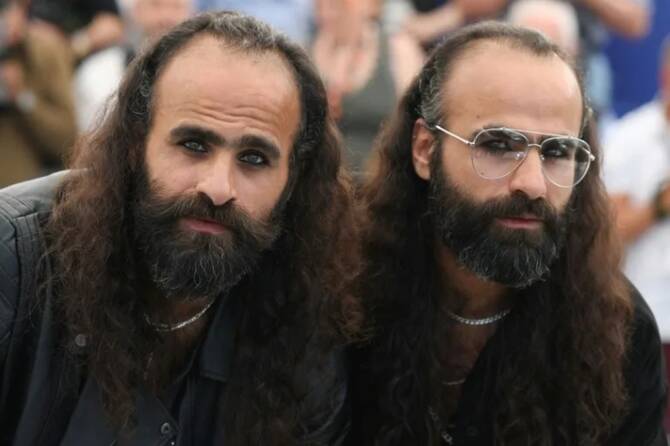
Gazan twins in Cannes warn ‘nothing left’ of homeland

Twin Gazan filmmakers Arab and Tarzan Nasser. (AFP)
Short Url
Updated 20 May 2025
Follow

Gazan twins in Cannes warn ‘nothing left’ of homeland

CANNES: Twin Gazan filmmakers Arab and Tarzan Nasser said they never thought the title of their new film “Once Upon A Time In Gaza” would have such heartbreaking resonance.
“Right now there is nothing left of Gaza,” said Tarzan when it premiered on Monday at the Cannes film festival.
Since militants from Palestinian group Hamas attacked Israel on October 7, 2023, more than 18 months of Israeli bombardment has ravaged large swathes of the Palestinian territory and killed tens of thousands of people.
Israel has vowed to “take control of all” the besieged territory of more than two million inhabitants, where United Nations agencies have warned of famine following Israel’s two-month total blockade.
Israel allowed in several aid trucks on Monday but the UN said it was only “a drop in the ocean” of needs.
The Nasser brothers, who left Gaza in 2012, said their new film set in 2007, when Hamas Islamists seized control of the strip, explains the lead-up to today’s catastrophic war.
“Once Upon A Time In Gaza,” which screened in the festival’s Un Certain Regard section, follows friends Yahia and Osama as they try to make a little extra cash by selling drugs stuffed into falafel sandwiches.
Using a manual meat grinder that does not rely on rare electricity, student Yahia blends up fava beans and fresh herbs to make the patty-shaped fritters in the back of Osama’s small run-down eatery, while dreaming of being able to leave the Israeli-blockaded coastal strip.
Charismatic hustler Osama meanwhile visits pharmacy after pharmacy to amass as many pills as he can with stolen prescriptions, pursued by a corrupt cop.

Israel first imposed a blockade on Gaza in June 2006 after militants there took one of its soldiers, and reinforced it in September 2007 several months after Hamas took power.
“The blockade was gradually tightened, tightened until reaching the genocide we see today,” said Tarzan.
“Until today they are counting the calories that enter,” he added.
An Israeli NGO said in 2012 that documents showed Israeli authorities had calculated that 2,279 calories per person per day was deemed sufficient to prevent malnutrition in Gaza.
The defense ministry however claimed it had “never counted calories” when allowing aid in.
Despite all this, Gazans have always shown a love of life and been incredibly resilient, the directors said.
“My father is until now in northern Gaza,” Tarzan said, explaining the family’s two homes had been destroyed.
But before then, “every time a missile hit, damaging a wall or window, he’d fix it up the next day,” he said.
In films, “the last thing I want to do is talk about Israel and what it’s doing,” he added.
“Human beings are more important — who they are, how they’re living and adapting to this really tough reality.”
In their previous films, the Nasser twins followed an elderly fisherman enamoured with his neighbor in the market in “Gaza Mon Amour” and filmed women trapped at the hairdresser’s in their 2015’s “Degrade.”
Like “Once Upon A Time in Gaza,” they were all shot in Jordan.

As the siege takes its toll in “Once Upon A Time In Gaza,” a desolate Yahia is recruited to star in a Hamas propaganda film.
In Gaza, “we don’t have special effects but we do have live bullets,” the producer says in one scene.
Arab said, long before Gazan tap water became salty and US President Donald Trump sparked controversy by saying he wanted to turn their land into the “Riviera of the Middle East,” the coastal strip was a happy place.
“I remember when I was little, Gaza actually was a riviera. It was the most beautiful place. I can still taste the fresh water on my tongue,” he said.
“Now Trump comes up with this great invention that he wants to turn it into a riviera after Israel completely destroyed it?“
Hamas’s October 2023 attack resulted in the deaths of 1,218 people on the Israeli side, mostly civilians, according to an AFP tally based on official figures.
Militants also took 251 hostages, 57 of whom remain in Gaza including 34 the military says are dead.
Israel’s retaliatory offensive has killed 53,486 people in Gaza, mostly civilians, according to Gaza health authorities, whose figures the United Nations deems reliable.
Gaza health authorities said at least 44 people were killed there in the early hours of Tuesday.


As an uncertain 2026 begins, virtual journeys back to 2016 become a trend

Updated 30 January 2026
Follow

As an uncertain 2026 begins, virtual journeys back to 2016 become a trend

  • Over the past few weeks, millions have been sharing throwback photos to that time on social media, kicking off one of the first viral trends of the year

LONDON: The year is 2016. Somehow it feels carefree, driven by Internet culture. Everyone is wearing over-the-top makeup.
At least, that’s how Maren Nævdal, 27, remembers it — and has seen it on her social feeds in recent days.
For Njeri Allen, also 27, the year was defined by the artists topping the charts that year, from Beyonce to Drake to Rihanna’s last music releases. She also remembers the Snapchat stories and an unforgettable summer with her loved ones. “Everything felt new, different, interesting and fun,” Allen says.
Many people, particularly those in their 20s and 30s, are thinking about 2016 these days. Over the past few weeks, millions have been sharing throwback photos to that time on social media, kicking off one of the first viral trends of the year — the year 2026, that is.
With it have come the memes about how various factors — the sepia hues over Instagram photos, the dog filters on Snapchat and the music — made even 2016’s worst day feel like the best of times.
Part of the look-back trend’s popularity has come from the realization that 2016 was already a decade ago – a time when Nævdal says she felt like people were doing “fun, unserious things” before having to grow up.
But experts point to 2016 as a year when the world was on the edge of the social, political and technological developments that make up our lives today. Those same advances — such as developments under US President Donald Trump and the rise of AI — have increased a yearning for even the recent past, and made it easier to get there.
2016 marked a year of transition
Nostalgia is often driven by a generation coming of age — and its members realizing they miss what childhood and adolescence felt like. That’s certainly true here. But some of those indulging in the online journeys through time say something more is at play as well.
It has to do with the state of the world — then and now.
By the end of 2016, people would be looking ahead to moments like Trump’s first presidential term and repercussions of the United Kingdom leaving the EU after the Brexit referendum. A few years after that, the COVID-19 pandemic would send most of the world into lockdown and upend life for nearly two years.
Janelle Wilson, a professor of sociology at the University of Minnesota-Duluth, says the world was “on the cusp of things, but not fully thrown into the dark days that were to come.”
“The nostalgia being expressed now, for 2016, is due in large part to what has transpired since then,” she says, also referencing the rise of populism and increased polarization. “For there to be nostalgia for 2016 in the present,” she added, “I still think those kinds of transitions are significant.”
For Nævdal, 2016 “was before a lot of the things we’re dealing with now.” She loved seeing “how embarrassing everyone was, not just me,” in the photos people have shared.
“It felt more authentic in some ways,” she says. Today, Nævdal says, “the world is going downhill.”
Nina van Volkinburg, a professor of strategic fashion marketing at University of the Arts, London, says 2016 marked the beginning of “a new world order” and of “fractured trust in institutions and the establishment.” She says it also represented a time of possibility — and, on social media, “the maximalism of it all.”
This was represented in the bohemian fashion popularized in Coachella that year, the “cut crease” makeup Nævdal loved and the dance music Allen remembers.
“People were new to platforms and online trends, so were having fun with their identity,” van Volkinburg says. “There was authenticity around that.”
And 2016 was also the year of the “boss babe” and the popularity of millennial pink, van Volkinburg says, indications of young people coming into adulthood in a year that felt hopeful.
Allen remembers that as the summer she and her friends came of age as high school graduates. She says they all knew then that they would remember 2016 forever.
Ten years on, having moved again to Taiwan, she said “unprecedented things are happening” in the world. “Both of my homes are not safe,” she said of the US and Taiwan, “it’s easier to go back to a time that’s more comfortable and that you felt safe in.”
Feelings of nostalgia are speeding up
In the last few days, Nævdal decided to hide the social media apps on her phone. AI was a big part of that decision. “It freaks me out that you can’t tell what’s real anymore,” she said.
“When I’ve come off of social media, I feel that at least now I know the things I’m seeing are real,” she added, “which is quite terrifying.”
The revival of vinyl record collections, letter writing and a fresh focus on the aesthetics of yesterday point to nostalgia continuing to dominate trends and culture. Wilson says the feeling has increased as technology makes nostalgia more accessible.
“We can so readily access the past or, at least, versions of it,” she said. “We’re to the point where we can say, ‘Remember last week when we were doing XYZ? That was such a good time!’”
Both Nævdal and Allen described themselves as nostalgic people. Nævdal said she enjoys looking back to old photos – especially when they show up as “On This Day” updates on her phone, She sends them to friends and family when their photos come up.
Allen wished that she documented more of her 2016 and younger years overall, to reflect on how much she has evolved and experienced since.
“I didn’t know what life could be,” she said of that time. “I would love to be able to capture my thought process and my feelings, just to know how much I have grown.”