WELLINGTON: The haka, a chanting dance of challenge, is sacred to New Zealand’s Māori people but it’s become a beloved cultural institution among New Zealanders of all races. Spine-tingling performances at sports events, funerals and graduations often go viral online, a non-partisan point of pride for the country abroad.
But one haka performed in protest in New Zealand’s Parliament by three legislators last November has provoked fierce division among lawmakers about whether it was an act of peaceful dissent, or disruptive and even intimidating to their opponents.
A vote to approve unprecedented, lengthy bans from Parliament for the Māori party lawmakers who enacted the protest was unexpectedly suspended on Tuesday. Debate will resume in June, when it threatens to gridlock the legislative agenda until politicians from all parties reach consensus on what the punishment should be.
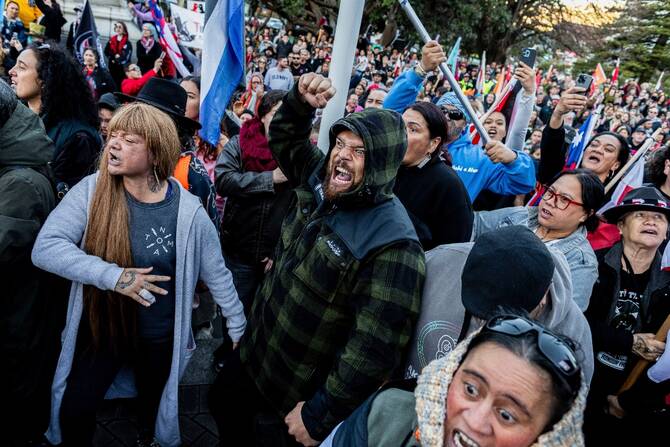
Hundreds of protesters against the sanctions waited outside Parliament’s front doors in New Zealand’s capital, Wellington, on Tuesday to greet the Māori party lawmakers with a haka when they emerged.
What is the haka?
The haka was once viewed as a war dance, but that understanding has changed in New Zealand as it has been embraced in a range of celebratory, somber and ceremonial settings. It’s an expression of Māori identity and while sacred, it can be performed by people of any race who are educated by Māori in the words, movements and cultural protocols.
Emotional haka have generated news headlines in the past year when performed by soldiers farewelling a New Zealander who died fighting in Ukraine, and in Paris by athletes from New Zealand’s Olympic team. While the best-known haka is “ka mate,” the chant often performed by the All Blacks rugby team before games, there are many variants.
Why was this one controversial?
Last November’s protest wasn’t the first time a haka has rung out in Parliament. Performances regularly follow the passage of laws important to Māori.
But some lawmakers decried this one for two reasons: because the legislators from Te Pāti Māori, the Māori Party, left their seats and strode across the floor toward government politicians while performing it, and because it disrupted the vote on a proposed law.
When asked how the Māori party would vote on a bill they said would dismantle Indigenous rights, Hana-Rāwhiti Maipi-Clarke – New Zealand’s youngest parliamentarian, at 22 – tore up a copy of the law and began the haka, joined by two of her colleagues.
The law, an attempt to rewrite New Zealand’s founding treaty between Māori tribal leaders and the British crown, was widely unpopular and has since been defeated. But for six months, a committee of the lawmakers’ peers have fought furiously about how — or whether — their protest of it should be punished.
Why is debate about it still going?
Usually there’s agreement among parliamentarians about penalties for errant behavior. But this episode polarized the committee considering the lawmakers’ actions.
Its report recommended Maipi-Clarke, who the committee said showed contrition in a letter, be suspended for seven days and her colleagues for 21 days. That’s the harshest penalty ever assigned to New Zealand lawmakers; the previous record was three days.
Parliament Speaker Gerry Brownlee this month scheduled a rare, unlimited debate in Parliament until all parties could find consensus on the penalty, citing the severity of the proposed bans. But minutes after the debate began Tuesday, it was adjourned at the government’s behest after they allowed the Māori party lawmakers to stay until after Thursday’s budget was delivered.
It permitted the government their budget week agenda and meant the Māori lawmakers — opponents of the government — wouldn’t miss one of Parliament’s most significant dates. But the debate about the bans will then resume.
Opposition leader Chris Hipkins, the only opponent of the sanctions to speak before debate was suspended, cited episodes where lawmakers have brawled in Parliament and driven a tractor up the building’s steps, but were not suspended, as evidence that the bans weren’t fair.
But Judith Collins, the chair of the committee that produced the sanctions, said the penalties were “not about the haka.” Collins said the lawmakers’ behavior was the most egregious she’d ever witnessed.
What happens next?
The debate will resume on June 5, when it threatens to stall usual government business once more. The government said Tuesday that it would not back down from the punishments suggested and opposition parties said they couldn’t be swayed from disputing them.
Outside Parliament, activist Eru Kapa-Kingi told the assembled crowd that the haka was “a source of fear” in Parliament.
“Even though when the All Blacks do it it’s a good thing,” he added.


![]()

How uproar over a Māori haka, beloved in New Zealand life, sowed chaos and gridlock in Parliament
Short Url
https://arab.news/zc3v5
How uproar over a Māori haka, beloved in New Zealand life, sowed chaos and gridlock in Parliament


Latest updates


© 2026 SAUDI RESEARCH & PUBLISHING COMPANY, All Rights Reserved And subject to Terms of Use Agreement.