

Qatar, Jordan condemn Israeli bombing of Hamad Hospital in Gaza

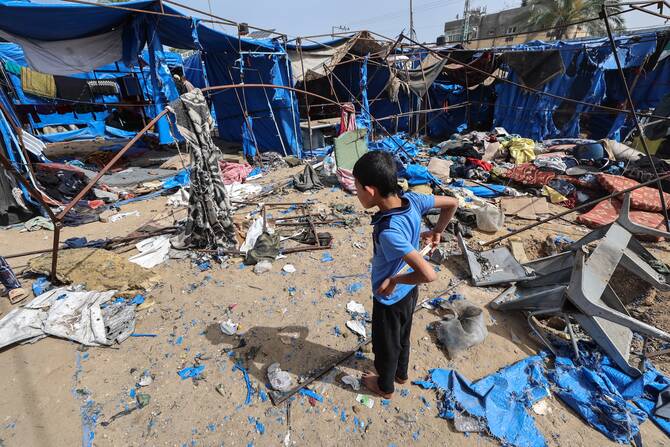
A Palestinian child stands in front of destroyed shelters following overnight Israeli airstrikes that reportedly hit tents for displaced Gazans outside the Al-Aqsa Martyrs hospital in Deir el-Balah in the central Gaza Strip, May 17, 2025. (AFP)
Short Url
Updated 19 May 2025
Follow

Qatar, Jordan condemn Israeli bombing of Hamad Hospital in Gaza

  • The hospital in northern Gaza was established in 2019 following a directive from Qatar’s Sheikh Hamad bin Khalifa Al-Thani
  • Jordan says Israeli violations in Gaza and the occupied West Bank threaten regional security and stability

LONDON: Qatar and Jordan condemned Israel’s bombing of the Hamad Hospital for Prosthetic Limbs in the Gaza Strip on Monday, labeling it a clear violation of international and humanitarian laws.

The Hamad Hospital for Prosthetic Limbs in northern Gaza was established in 2019 following a directive from Sheikh Hamad bin Khalifa Al-Thani, father of Qatari Emir Sheikh Tamim. It is one of the remaining medical facilities functioning in Gaza that offers rehabilitation services for hearing, balance, and prosthetics.

Qatar said that Israel’s bombing of Hamad Hospital and its ongoing targeting of civilians, medical facilities, and shelters for the displaced families in Gaza is “part of the war of genocide against the brotherly Palestinian people.”

Sufian Qudah, spokesperson for the Jordanian Ministry of Foreign Affairs, condemned the Israeli use of starvation and blockade to displace Palestinians. He added that Israeli human rights violations in Gaza and the occupied West Bank threaten regional security and stability.

Jordan and Qatar urged the international community to fulfill its responsibilities and immediately help bring an end to the war in Gaza.

On Sunday, Israel launched extensive military operations in the Gaza Strip aimed at occupying the territory. Several hospitals were targeted in the enclave over the past week, including the Indonesian Hospital, one of the largest partially functioning medical facilities in Beit Lahia. In the south, the Gaza European Hospital in Khan Yunis and the Kuwait Specialized Hospital in Rafah were also affected.


Deal is signed in Beirut to transfer 300 Syrian prisoners in Lebanon to their home country

Updated 4 sec ago
Follow

Deal is signed in Beirut to transfer 300 Syrian prisoners in Lebanon to their home country

  • Lebanon’s Deputy Prime Minister Tarek Mitri and Syria’s Justice Minister Mazhar Al-Wais expressed hope that this step will boost confidence and progress relations
  • Lebanon and Syria have signed an agreement to transfer over 300 Syrian detainees from Lebanese prisons to continue their sentences in Syria
BEIRUT: Lebanon and Syria signed an agreement Friday to transfer more than 300 Syrians from Lebanese prisons to continue serving their sentences in their home country, a step that will likely help improve strained relations between the two neighbors.
The signing came a week after Lebanon’s Cabinet approved a treaty with Syria for the transfer of prisoners. The deal was signed at the government headquarters in the Lebanese capital, Beirut, by Lebanon’s Deputy Prime Minister Tarek Mitri and Syria’s Justice Minister Mazhar Al-Wais.
“This is a very important first step on the road of a comprehensive treatement regarding Syrian prisoners in Lebanese prisons,” Mitri told reporters, adding that the implementation of the agreement would start on Saturday.
“Both countries want to move forward but there are some pending matters,” Al-Wais said. “This step will boost existing confidence and we hope that relations will progress more.”
Mitri said that next, officials from the two neighboring countries, will discuss the transfer of Syrian detainees who are still waiting trial in Lebanon.
Lebanon and Syria have a complicated history, with grievances on both sides. Many Lebanese resent nearly three decades of domination and military presence in their country by Syrian forces that ended in 2005.
Many Syrians resent the role played by the Lebanese militant group Hezbollah when it entered Syria’s civil war that broke out in 2011 in defense of then-President Bashar Assad and his government. Assad was overthrown in December 2024 and fled to Russia where he is now in exile.
After Assad’s fall, relations with Syria’s new Islamist-led authorities remained tense and skirmishes occurred along the unmarked border between the two nations.
Mitri also said Saturday’s signing was “an expression of a joint political will that states that the Lebanese-Syrian relations are based on confidence and mutual respect.”
Asked whether the deal will include Lebanese citizens such as Sunni Muslim cleric Ahmed Al-Assir, Mitri said that it only covers Syrian prisoners.
There are about 2,500 Syrian prisoners in Lebanese prisons and jails, some of whom are held on charges related to their involvement with armed opposition groups that sought to overthrow Assad — in some cases, the same groups that are now ruling Syria.
Earlier this week, Mitri told The Associated Press that most of the detainees who will be transferred to Syria were not convicted of violent crimes. Some of those convicted of violent crimes may be transferred if they have already served seven and a half years of their sentence in Lebanon, he said.