Pakistan explores collaboration opportunities with UAE-based banks for economic growth 

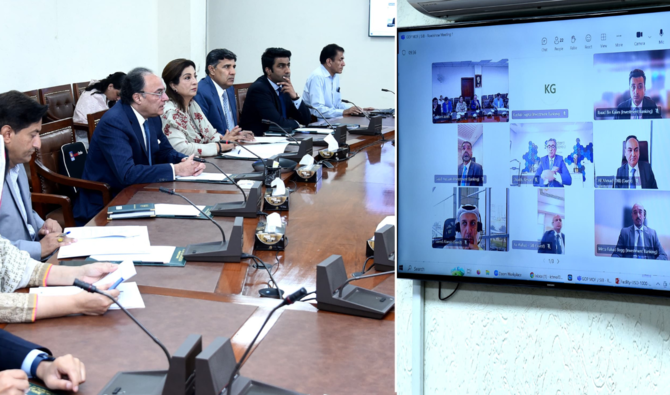
Finance Minister Muhammad Aurangzeb holds meetings with UAE-based banks on May 19, 2025. (Photo courtesy: Ministry of finance)
Short Url
Updated 19 May 2025
Follow

Pakistan explores collaboration opportunities with UAE-based banks for economic growth 

  • Pakistan finmin meets representatives of Sharjah Islamic Bank, Abu Dhabi Islamic Bank, and Ajman Bank
  • Pakistan finance ministry says Islamabad open to commercial partnerships that contribute to economic growth

KARACHI: Finance Minister Muhammad Aurangzeb on Monday held meetings with three UAE-based banks which concluded with both sides expressing their desire to explore potential avenues for collaboration for economic growth, Pakistan’s finance ministry said. 

The ministry held a series of virtual meetings with three UAE-based banks, Sharjah Islamic Bank, Abu Dhabi Islamic Bank, and Ajman Bank. The meeting, chaired by Aurangzeb, focused on the banks’ support for Pakistan’s development and fiscal objectives, the finance ministry said.

“The meeting concluded with mutual interest in continuing the dialogue and exploring potential avenues for collaboration,” the finance ministry said. 

“The finance minister reaffirmed Pakistan’s openness to quality commercial partnerships that contribute to economic growth, development financing, and investor confidence.”

Aurangzeb said Pakistan is on the path to macroeconomic stability. He noted that this year, Pakistan’s forex reserves are approaching the $14 billion mark, which would provide the nation with three months of import cover.

Pakistan has undertaken structural, financial reforms in recent months mandated by the International Monetary Fund (IMF) in exchange for bailout programs from the international lender. 

These include increasing its tax base, introducing reforms in the energy sector and privatizing loss-making public assets. Aurangzeb underscored that the government is “firmly committed” to long-term reforms. 

“We have broken away from the old boom and bust cycle,” the minister said. “The current stability is backed by difficult but necessary reforms— and we are staying the course.”

He shared that Pakistan is set to reach a tax-to-GDP ratio of 10.6 percent by June 2025, with a target of 11 percent in the next fiscal year, the ministry said. 

“During the interactive sessions, senior executives of the three banks acknowledged the progress and shared their comments and views on Pakistan’s economic plans,” the statement said. 

The UAE is Pakistan’s third-largest trading partner after China and the US, and a major source of foreign investment, with over $10 billion invested in the last two decades.

The Gulf country is also home to over a million expatriates from Pakistan, the second-largest overseas Pakistani community globally, and a major source of remittances.


Pakistan launches cashless Ramadan market in Islamabad to promote digital payments

Updated 8 sec ago
Follow

Pakistan launches cashless Ramadan market in Islamabad to promote digital payments

  • Pilot market allows shoppers to buy subsidized food using digital payments
  • Initiative aims to improve transparency and public relief during Ramadan

KARACHI: Pakistan has launched a cashless subsidized Ramadan food market in the capital Islamabad, the interior ministry said on Wednesday, introducing digital payments for essential goods as authorities try to improve transparency and affordability during the Muslim holy month.

The facility in the G-6 Aabpara area allows citizens to purchase vegetables, fruit and staple food items at regulated prices without cash, part of a broader push toward digitizing subsidy delivery.

Ramadan bazaars, which are temporary and often state-supported markets, are set up across Pakistan each year to limit price spikes as demand rises during fasting hours and evening meals.

Ramadan is likely to start on Feb. 19 in Pakistan. 

“The objective is to provide the public affordable and quality items. No negligence in public relief will be tolerated,” the interior ministry said in a statement.

Officials said the market will operate daily from 9 a.m. to 4 p.m. and includes private vendors under monitoring mechanisms to ensure goods are sold according to wholesale market rates.

Authorities also instructed administrators to strengthen cleanliness, security and complaint-handling systems and ensure price lists are prominently displayed.

Pakistan last year launched its first-ever cashless weekly market in Islamabad, but slow Internet speeds and patchy phone connectivity have hampered adoption among vendors and shoppers. 

The government plans to turn Islamabad into Pakistan’s first fully cashless city, using QR-code payments to formalize retail transactions, reduce tax evasion and improve documentation in one of South Asia’s most informally run economies.

Pakistan relies heavily on cash, enabling widespread tax evasion and limiting financial transparency. Economists say expanding digital payments can raise government revenues, curb corruption, and make marketplaces safer for customers and traders.

Pakistan has increasingly experimented with targeted subsidies and digital systems to manage food affordability during Ramadan, when consumption rises sharply and lower-income households face pressure after years of high inflation.

Last week, Prime Minister Shehbaz Sharif launched a Rs38 billion ($136 million) Ramadan relief package, pledging direct digital cash transfers of Rs13,000 ($47) each to 12.1 million low-income families across Pakistan.

The government will distribute the relief package through bank accounts and regulated mobile wallet platforms, fully replacing the previous utility store-based subsidy model with a digital payment mechanism overseen by the State Bank of Pakistan.