ROME: US Secretary of State Marco Rubio said Saturday that the Vatican could be a venue for Russia-Ukraine peace talks, taking up the Holy See’s longstanding offer after Pope Leo XIV vowed to personally make “every effort” to help end the war.
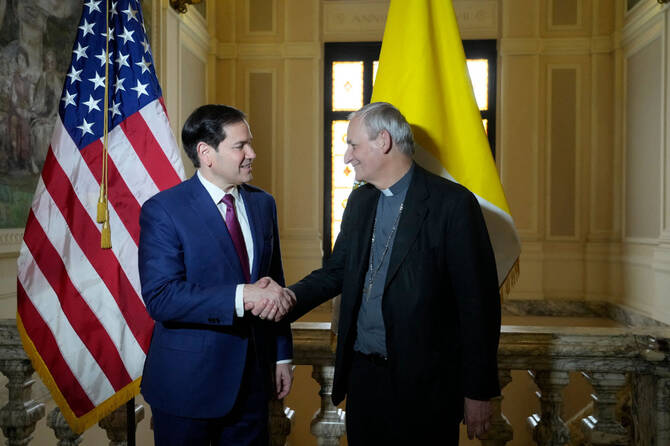
Speaking to reporters in Rome before meeting with Cardinal Matteo Zuppi, the Vatican point man on Ukraine, Rubio said that he would be discussing potential ways the Vatican could help, “the status of the talks, the updates after yesterday (Friday) and the path forward.”
Asked if the Vatican could be a peace broker, Rubio replied: “I wouldn’t call it broker, but it’s certainly — I think it’s a place that both sides would be comfortable going.”
“So we’ll talk about all of that and obviously always grateful to the Vatican for their willingness to play this constructive and positive role,” said Rubio, who also met Saturday with the Vatican secretary of state and foreign minister.
The Vatican has a tradition of diplomatic neutrality and had long offered its services, and venues, to try to help facilitate talks, but found itself sidelined during the all-out war, which began on Feb. 24, 2022.
Pope Francis, who occasionally angered both Kyiv and Moscow with his off-the-cuff comments, had entrusted Zuppi with a mandate to try to find paths of peace. But the mandate seemed to narrow to help facilitate the return of Ukrainian children taken by Russia, and the Holy See also was able to mediate some prisoner exchanges.
During their meeting at the US Embassy in Rome, Rubio thanked Zuppi for the Vatican’s humanitarian role, citing in particular prisoner swaps and the return of Ukrainian children. Rubio “emphasized the importance of continued collaboration under the new leadership of Pope Leo XIV,” US State Department spokesperson Tammy Bruce said.
Leo, who was elected history’s first American pope on May 8, took up Francis’ call for peace in Ukraine in his first Sunday noon blessing as pope. He appealed for all sides to do whatever possible to reach “an authentic, just and lasting peace.”
Leo, who as a bishop in Peru had called Russia’s war an “imperialist invasion,” vowed this week personally to “make every effort so that this peace may prevail.”
In a speech to eastern rite Catholics, including the Greek Catholic Church of Ukraine, Leo begged warring sides to meet and negotiate.
“The Holy See is always ready to help bring enemies together, face to face, to talk to one another, so that peoples everywhere may once more find hope and recover the dignity they deserve, the dignity of peace,” he said.
The Vatican secretary of state, Cardinal Pietro Parolin, repeated the Vatican’s offer to serve as a venue for direct talks, saying the failure of negotiations in Istanbul to reach a ceasefire this week was “tragic.”
“We had hoped it could start a process, slow but positive, toward a peaceful solution to the conflict,” Parolin said on the sidelines of a conference. “But instead we’re back to the beginning.”
Asked concretely what such an offer would entail, Parolin said that the Vatican could serve as a venue for a direct meeting between the two sides.
“One would aim to arrive at this, that at least they talk. We’ll see what happens. It’s an offer of a place,” he said.
“We have always said, repeated to the two sides that we are available to you, with all the discretion needed,” Parolin said.
The Vatican scored what was perhaps its greatest diplomatic achievement of the Francis pontificate when it facilitated the talks between the United States and Cuba in 2014 that resulted in the resumption of diplomatic relations.
The Holy See has also often hosted far less secret diplomatic initiatives, such as when it brought together the rival leaders of South Sudan in 2019. The encounter was made famous by the image of Francis bending down to kiss their feet to beg them to make peace.
Perhaps the Holy See’s most critical diplomatic initiative came during the peak of the Cuban missile crisis when, in the fall of 1962, Soviet Premier Nikita Khrushchev ordered a secret deployment of nuclear missiles in Cuba that were soon detected by US spy planes.
As the Kennedy administration considered its response, with the threat of nuclear war looming, Pope John XXIII pleaded for peace in a public radio address, in a speech to Vatican ambassadors and also wrote privately to Kennedy and Khruschev, appealing to their love of their people to stand down.
Many historians have credited John XXIII’s appeals with helping both sides step back from the brink of nuclear war.


![]()

Vatican could be a venue for Russia-Ukraine talks, Rubio says, after pope renews an offer to help
Short Url
https://arab.news/5yg7z
Vatican could be a venue for Russia-Ukraine talks, Rubio says, after pope renews an offer to help
- In a speech to eastern rite Catholics on May 8, Pope Leo XIV begged Russia and Ukraine to meet and negotiate
- The Vatican has a tradition of diplomatic neutrality and had long offered its services, and venues, to try to help facilitate talks


Latest updates


© 2026 SAUDI RESEARCH & PUBLISHING COMPANY, All Rights Reserved And subject to Terms of Use Agreement.