Libyan police officer killed as protesters attack prime minister’s office

1 / 3
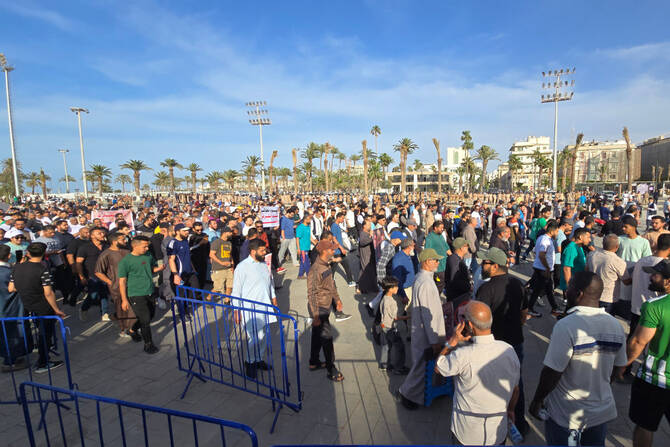
Demonstrators demonstrate at Martyrs' Square in Tripoli on May 16, 2025, demanding that Libya's Government of National Unity headed by Abdulhamid al-Dbeibah steps down. (REUTERS)
2 / 3
Libyan protesters gather in Tripoli's Martyrs Square to call for the resignation of the national unity government on May 16, 2025. (AFP photo)
3 / 3
Libyan protesters gather in Tripoli's Martyrs Square to call for the resignation of the national unity government on May 16, 2025. (AFP photo)
Short Url
Updated 17 May 2025
Follow

Libyan police officer killed as protesters attack prime minister’s office

  • Attack happened as protesters gathered outside to demand PM Dbeibah’s resignation
  • Three cabinet ministers resigned in sympathy with the protesters

TRIPOLI: A police officer was killed in an “attempted assault” on the office of Libya’s internationally recognized premier, the government said Friday, as protesters took to the streets to demand his ouster.
The officer was “targeted while securing the prime minister’s office building,” the Government of National Unity said in a statement.
“He was shot by unknown attackers and succumbed to his injuries,” the statement said.
The government said it had “foiled an attempt to storm the building by a group mixed with protesters” who tried to set it on fire with Molotov cocktails.
Video footage that has not been verified by AFP showed young people running and taking cover behind a low wall near the government headquarters to the sound of automatic gunfire.
Earlier Friday, thousands of protesters had gathered at Martyrs’ Square in Tripoli to demand the resignation of Prime Minister Abdulhamid Dbeibah.

The demonstrators were chanting slogans such as “The nation wants to topple the government” and “We want elections.”

They then marched to the main government building in the city center. “We won’t leave until he leaves,” one protester said.

The marchers carried pictures of Dbeibah, national security adviser Ibrahim Dbeibah and Interior Minister Emad Tarbulsi with their faces crossed out in red.


Libyan protesters gather in Tripoli's Martyrs Square to call for the resignation of the national unity government on May 16, 2025. (AFP photo)

Ahead of the demonstration, the UN Support Mission in Libya, UNSMIL, had underlined “citizens’ right to peaceful protest” and warned against “any escalation of violence.”

Dbeibah, who leads the divided country’s Government of National Unity, came to power through a UN-backed process in 2021. Planned elections failed to proceed that year because of disagreements among rival factions, and he has remained in power.

Calls for Dbeibah to resign increased after two rival armed groups clashed in the capital this week in the heaviest fighting in years. Eight civilians were killed, according to the United Nations.

Violence flared after the prime minister on Tuesday ordered the armed groups to be dismantled. Demonstrators have accused Dbeibah of failing to restore stability and of being complicit in the growing power of armed groups.

After the demonstration, local media reported the resignation of six ministers and deputy ministers from the government, two of whom confirmed their departure in a video.

Those who resigned were Economy and Trade Minister Mohamed Al-Hawij, Local Government Minister Badr Eddin Al-Tumi and Minister of Housing Abu Bakr Al-Ghawi.

Militia leader Abdulghani Kikli, widely known as Ghaniwa, died in the clashes, which calmed on Wednesday after the government announced a ceasefire.

Libya is split between the UN-recognized government in Tripoli, led by Dbeibah, and a rival administration in the east controlled by the family of military strongman Khalifa Haftar.

The country has remained deeply divided since the 2011 NATO-backed revolt that toppled and killed longtime leader Muammar Qaddafi.


Israel’s Supreme Court suspends govt move to shut army radio

Updated 29 December 2025
Follow

Israel’s Supreme Court suspends govt move to shut army radio

  • Israel’s Supreme Court has issued an interim order suspending a government decision to shut down Galei Tsahal, the country’s decades-old and widely listened-to military radio station

JERUSALEM: Israel’s Supreme Court has issued an interim order suspending a government decision to shut down Galei Tsahal, the country’s decades-old and widely listened-to military radio station.
In a ruling issued late Sunday, Supreme Court President Isaac Amit said the suspension was partly because the government “did not provide a clear commitment not to take irreversible steps before the court reaches a final decision.”
He added that Attorney General Gali Baharav-Miara supported the suspension.
The cabinet last week approved the closure of Galei Tsahal, with the shutdown scheduled to take effect before March 1, 2026.
Founded in 1950, Galei Tsahal is widely known for its flagship news programs and has long been followed by both domestic and foreign correspondents.
A government audience survey ranks it as Israel’s third most listened-to radio station, with a market share of 17.7 percent.
Prime Minister Benjamin Netanyahu had urged ministers to back the closure, saying there had been repeated proposals over the years to remove the station from the military, abolish it or privatise it.
But Baharav-Miara, who also serves as the government’s legal adviser and is facing dismissal proceedings initiated by the premier, has warned that closing the station raised “concerns about possible political interference in public broadcasting.”
She added that it “poses questions regarding an infringement on freedom of expression and of the press.”
Defense Minister Israel Katz said last week that Galei Tsahal broadcasts “political and divisive content” that does not align with military values.
He said soldiers, civilians and bereaved families had complained that the station did not represent them and undermined morale and the war effort.
Katz also argued that a military-run radio station serving the general public is an anomaly in democratic countries.
Opposition leader Yair Lapid had condemned the closure decision, calling it part of the government’s effort to suppress freedom of expression ahead of elections.
Israel is due to hold parliamentary elections in 2026, and Netanyahu has said he will seek another term as prime minister.

Grendizer at 50
The anime that conquered Arab hearts and minds
Enter
keywords