

UN says ‘alarmed’ by escalating violence in Libya’s Tripoli

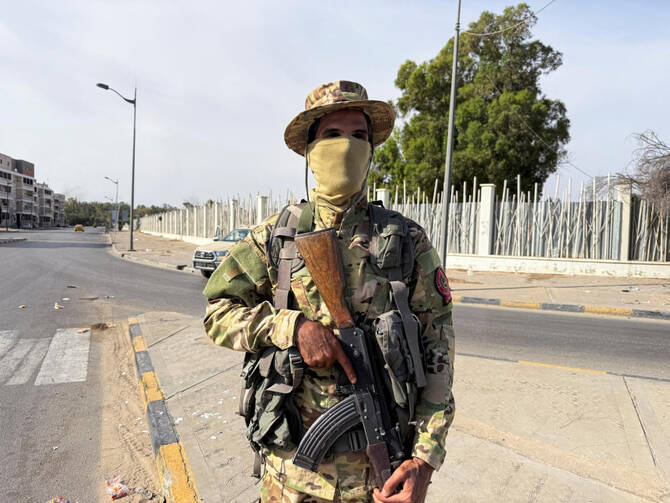
A member of the 444 Brigade of the Libyan Army, a unit serving the Government of National Unity and PM Abdulhamid Al-Dbeibah, stands guard at Abu Salim area, in Tripoli, May 13, 2025. (Reuters)
Short Url
Updated 15 May 2025
Follow

UN says ‘alarmed’ by escalating violence in Libya’s Tripoli

  • IOM called "for an immediate cessation of hostilities to ensure the safety and wellbeing of civilians
  • The IOM said it was "alarmed by the recent escalation of violence in Tripoli"

GENEVA: The United Nations voiced alarm Thursday at escalating violence in Tripoli, warning of a “severe risk of mass displacement and danger to civilians.”

The UN’s International Organization for Migration (IOM) called “for an immediate cessation of hostilities to ensure the safety and wellbeing of civilians in accordance with International Humanitarian Law.”

Their statement came amid fresh unrest in Libya, which has struggled to recover from the NATO-backed 2011 uprising that toppled and killed longtime leader Muammar Qaddafi.

The country remains split between a UN-recognized government in Tripoli, led by Prime Minister Abdulhamid Dbeibah, and a rival administration in the east, controlled by the Haftar family.

Fresh gunbattles erupted Wednesday in the Libyan capital between two powerful armed groups, a security official said, a day after the authorities had declared the fighting over.

The IOM said it was “alarmed by the recent escalation of violence in Tripoli.”

It added: “We are also concerned by the mobilization of armed groups in surrounding regions. There is a severe risk of mass displacement and danger to civilians.”

On Tuesday, the Tripoli-based government said the fighting had been controlled and announced a ceasefire, even as shots were still fired in western parts of Tripoli.

“We welcome reports of a ceasefire and urge that it be fully and unconditionally respected to safeguard the rights and dignity of all those in the affected areas,” the IOM said.

“IOM continues working with partners to support humanitarian access to all vulnerable groups, including migrants,” it added.

“We are monitoring possible displacement trends and stand ready to support should needs arise.”


GCC states ‘face reliance on Saudi Arabia for food imports’

Updated 06 March 2026
Follow

GCC states ‘face reliance on Saudi Arabia for food imports’

  • With 70 percent of food coming through Strait of Hormuz, analysts warn of inevitable shortages

DUBAI: Some Gulf states may have to rely on overland food deliveries from Saudi Arabia if the US-Israel-Iran war continues to disrupt shipping through the Strait of Hormuz and restrict regional airspace, analysts warned on Thursday.
The region is up to 90 percent dependent on food imports, and price surges and scarcity of some goods are expected.
“With over 70 percent of GCC foodstuffs being imported through the Strait of Hormuz, Gulf states face shortages if the war persists,” said Neil ​Quilliam of the Chatham House think tank. 
“While GCC countries have taken steps to diversify suppliers and ensure sufficient stores to withstand disruption, this can only last several months. At this point, price increases ​and longer lead times will start to hit the markets.”
Commodities analyst Ishan Bhanu said: “The biggest immediate effect will be due to the blockade of Jebel Ali in Dubai, serving about 50 million people. Qatar, Kuwait, Bahrain and Iraq effectively become landlocked and will depend on overland routes through Saudi Arabia.”
Bottlenecks are yet to show and the UAE has said its strategic reserves of vital goods cover four to six months of needs. It urged residents to report unjustified price increases through a dedicated hotline.
Supermarket staff ​throughout the Gulf said shelves remain largely stocked, though suppliers are taking longer to replenish certain products. Iran’s strikes on the Gulf since Saturday prompted panic buying in supermarkets, a dry run for what could come. 
“Perception of risk matters, and even if stocks are sufficient now, public runs on supermarkets can spook the public,” Quilliam said.