

Israel blasts UN aid chief over call to prevent Gaza genocide

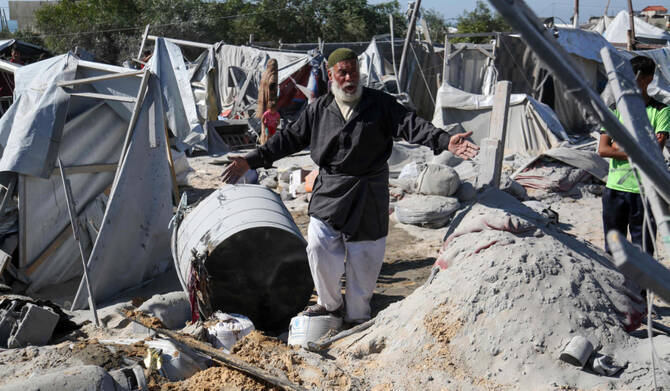
Israel on Friday blasted the United Nations aid chief for asking the UN Security Council if it would act to "prevent genocide" in the Gaza Strip, where experts say famine looms after Israel blocked aid deliveries to the Palestinian enclave 75 days ago. (AFP/File)
Short Url
Updated 16 May 2025
Follow

Israel blasts UN aid chief over call to prevent Gaza genocide

  • Israel’s UN Ambassador Danny Danon accused him of delivering “a political sermon“
  • “It was an utterly inappropriate and deeply irresponsible statement”

UNITED NATIONS: Israel on Friday blasted the United Nations aid chief for asking the UN Security Council if it would act to “prevent genocide” in the Gaza Strip, where experts say famine looms after Israel blocked aid deliveries to the Palestinian enclave 75 days ago.

While briefing the 15-member body earlier this week, UN aid chief Tom Fletcher said: “Will you act – decisively – to prevent genocide and to ensure respect for international humanitarian law?“

In a letter to Fletcher on Friday, Israel’s UN Ambassador Danny Danon accused him of delivering “a political sermon” and weaponizing the word genocide against Israel, questioning under what authority he made what Israel viewed as an accusation.

“You had the audacity, in your capacity as a senior UN official, to stand before the Security Council and invoke the charge of genocide without evidence, mandate, or restraint,” he wrote. “It was an utterly inappropriate and deeply irresponsible statement that shattered any notion of neutrality.”

A spokesperson for Fletcher did not immediately respond to a request for comment on the letter.

Under international law, genocide is an intent to destroy, in whole or part, a national, ethnic, racial or religious group. This includes through killings, serious bodily or mental harm and inflicting conditions calculated to bring about physical destruction.

The war in Gaza was triggered on October 7, 2023, when Palestinian militants Hamas killed 1,200 people in southern Israel and took some 250 hostages, according to Israeli tallies. Since then, Israel’s military campaign has killed more than 53,000 Palestinians, according to Gaza health authorities.

Israel has accused Hamas of stealing aid, which the group denies, and has blocked all aid to Gaza since March 2, demanding Hamas release all remaining hostages.

A global hunger monitor warned on Monday that half a million people face starvation — about a quarter of the population in the enclave.

US President Donald Trump said on Friday that “a lot of people are starving in Gaza.”


Deal is signed in Beirut to transfer 300 Syrian prisoners in Lebanon to their home country

Updated 4 sec ago
Follow

Deal is signed in Beirut to transfer 300 Syrian prisoners in Lebanon to their home country

  • Lebanon’s Deputy Prime Minister Tarek Mitri and Syria’s Justice Minister Mazhar Al-Wais expressed hope that this step will boost confidence and progress relations
  • Lebanon and Syria have signed an agreement to transfer over 300 Syrian detainees from Lebanese prisons to continue their sentences in Syria
BEIRUT: Lebanon and Syria signed an agreement Friday to transfer more than 300 Syrians from Lebanese prisons to continue serving their sentences in their home country, a step that will likely help improve strained relations between the two neighbors.
The signing came a week after Lebanon’s Cabinet approved a treaty with Syria for the transfer of prisoners. The deal was signed at the government headquarters in the Lebanese capital, Beirut, by Lebanon’s Deputy Prime Minister Tarek Mitri and Syria’s Justice Minister Mazhar Al-Wais.
“This is a very important first step on the road of a comprehensive treatement regarding Syrian prisoners in Lebanese prisons,” Mitri told reporters, adding that the implementation of the agreement would start on Saturday.
“Both countries want to move forward but there are some pending matters,” Al-Wais said. “This step will boost existing confidence and we hope that relations will progress more.”
Mitri said that next, officials from the two neighboring countries, will discuss the transfer of Syrian detainees who are still waiting trial in Lebanon.
Lebanon and Syria have a complicated history, with grievances on both sides. Many Lebanese resent nearly three decades of domination and military presence in their country by Syrian forces that ended in 2005.
Many Syrians resent the role played by the Lebanese militant group Hezbollah when it entered Syria’s civil war that broke out in 2011 in defense of then-President Bashar Assad and his government. Assad was overthrown in December 2024 and fled to Russia where he is now in exile.
After Assad’s fall, relations with Syria’s new Islamist-led authorities remained tense and skirmishes occurred along the unmarked border between the two nations.
Mitri also said Saturday’s signing was “an expression of a joint political will that states that the Lebanese-Syrian relations are based on confidence and mutual respect.”
Asked whether the deal will include Lebanese citizens such as Sunni Muslim cleric Ahmed Al-Assir, Mitri said that it only covers Syrian prisoners.
There are about 2,500 Syrian prisoners in Lebanese prisons and jails, some of whom are held on charges related to their involvement with armed opposition groups that sought to overthrow Assad — in some cases, the same groups that are now ruling Syria.
Earlier this week, Mitri told The Associated Press that most of the detainees who will be transferred to Syria were not convicted of violent crimes. Some of those convicted of violent crimes may be transferred if they have already served seven and a half years of their sentence in Lebanon, he said.