Syria’s finance minister says foreign investors welcome after US sanctions move

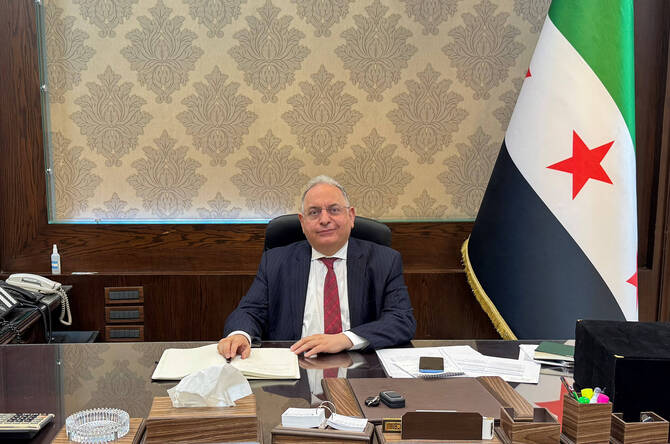
Syrian Finance Minister Yisr Barnieh attends an interview with Reuters at his office at the finance ministry in Damascus, May 14, 2025. REUTERS/Timour Azhari
Short Url
Updated 15 May 2025
Follow

Syria’s finance minister says foreign investors welcome after US sanctions move

  • Syria ‘land of opportunities’ for investors, Barnieh says
  • Sectors include farming, oil, tourism, roads, ports, he says
  • Private sector to have central role in new Syrian state, he says
  • Barnieh says sanctions removal is just first step in Syria’s recovery

DAMASCUS: Syrian Finance Minister Yisr Barnieh made a call to global investors on Wednesday to come do business with Syria after US President Donald Trump’s surprise announcement that he would lift all of Washington’s sanctions on the country.

“Syria today is a land of opportunities, with immense potential across every sector — from agriculture to oil, tourism, infrastructure, and transportation,” Barnieh said in an interview with Reuters at the Finance Ministry in Damascus.

“We envision a central role for the private sector in the new Syrian economy. The finance ministry’s role is not to spend indiscriminately or act as a regulatory enforcer over businesses, but rather to enable and support growth.”

A wall outside his office still bore the discolored outline of one of the many posters of former strongman Bashar Assad that used to hang in Syria’s public buildings before his ousting by Islamist rebels Hayat Tahrir Al-Sham last year.

Changes in Syria have been swift since Assad fled to Russia in December of last year.

Former rebel commander Ahmed Sharaa was appointed president, formed a government and had quick success garnering Gulf Arab support and getting most European sanctions lifted.

The stunning turn of events was capped by a meeting between Sharaa and Trump in Riyadh on Wednesday after Trump’s pledge to cease US sanctions imposed on Syria under Assad-family rule, measures widely seen as the biggest external obstacles to the country’s economic recovery.

Trump has not set out a timeline for removal.

“One of the most critical outcomes of lifting sanctions would be Syria’s reintegration into the global financial system,” Barnieh said.

“This would allow us to restore financial flows and attract investments, which are urgently needed across all sectors,” he said, adding that Syrian authorities have already seen strong interest from Saudi Arabia, the UAE, Kuwait, Qatar, and several EU countries, among others.

He noted that the government is undertaking a comprehensive overhaul of public financial management, including reforms to the tax system, customs, and banking — part of a broader effort to modernize an economy long burdened by an oversized public sector.

He also struck a cautioning tone, saying that the removal of sanctions would be just the first step in a years-long recovery for a country ruined by 14 years of war.

“The lifting of sanctions is not the final chapter,” he said.

“We cannot afford to become complacent. We are entering a new phase that demands real results and visible progress on the ground.” 


Oman launches 2026–2030 SME plan as fiscal recovery strengthens 

Updated 18 sec ago
Follow

Oman launches 2026–2030 SME plan as fiscal recovery strengthens 

RIYADH: Oman has launched a five-year plan to expand its small and medium-sized enterprise sector, seeking to deepen private-sector growth as the sultanate consolidates recent fiscal gains and returns to investment-grade status.  

The 2026–2030 SME Sector Implementation Plan, unveiled by the Small and Medium Enterprises Development Authority, or Riyada, aims to improve market access, boost SME competitiveness and raise the sector’s contribution to the economy, according to the Oman News Agency. 

The plan supports innovation and entrepreneurship while promoting the transition to a knowledge-based economy, the Oman News Agency reported. 

The initiative forms part of Oman Vision 2040 and the Eleventh Five-Year Development Plan, which prioritize private-sector expansion, diversification and job creation. 

The launch follows Fitch Ratings’ decision earlier this month to upgrade Oman to investment-grade status, raising the country’s long-term foreign-currency rating to BBB- from BB+. Fitch cited stronger public finances, a sharper reduction in government debt and an improved external position. 

“The implementation plan is based on several key strategic pillars, most notably: market access and value chains, financing and investment, enhancing local content, and developing a culture of entrepreneurship, skills, and innovation,” the ONA report stated. 

It added: “These pillars were developed through a participatory approach with contributions from several government and private entities supporting the SME sector, and are based on studies, benchmarking, and international best practices.”  

The plan also includes a package of specialized programs and initiatives targeting different stages of SME growth. These include measures to improve readiness for expansion and exports, integrated financing programs, initiatives supporting handicrafts and the creative economy, and the development of a network of entrepreneurship centers across Oman’s governorates.

Riyada said implementation of the plan would help strengthen the sustainability of SMEs, create quality job opportunities and empower entrepreneurs to build viable and scalable businesses, enhancing the competitiveness of the national economy. 

Oman has made significant progress in strengthening fiscal discipline, reducing government debt to around 36 percent of GDP in 2025, down from about 68 percent in 2020. 

With the outlook remaining stable, Fitch expects the budget deficit to remain at a manageable level of around 1 percent of GDP in 2026 and 2027, assuming an average Brent crude price of $63 per barrel. The fiscal breakeven oil price is estimated at around $67 per barrel over the same period.