Pakistan says willing to work with India, global partners to counter ‘terrorism’

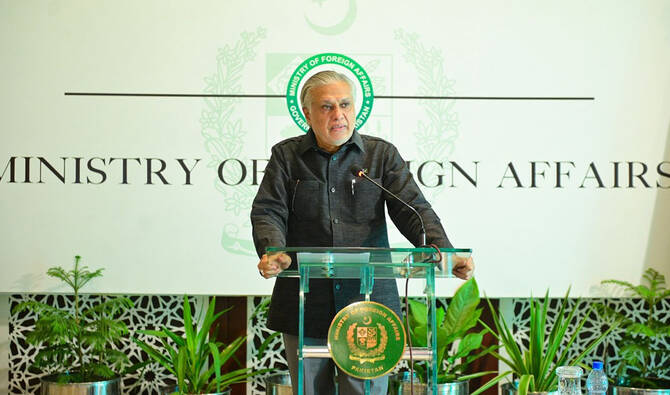
Pakistan Deputy Prime Minister and Foreign Minister Ishaq Dar speaks during a meeting with the foreign ministry officials at the Ministry of Foreign Affairs in Islamabad on May 14, 2025. (Photo courtesy: Handout/MOFA)
Short Url
Updated 15 May 2025
Follow

Pakistan says willing to work with India, global partners to counter ‘terrorism’

  • Islamabad has always denied New Delhi's allegations it supports militants who launch attacks against it
  • Disputed Kashmir territory has been the root cause of conflict between India and Pakistan since 1947

ISLAMABAD: Pakistan's Foreign Minister Ishaq Dar on Wednesday said Islamabad was willing to work with New Delhi and global partners to counter "terrorism," as his country's fragile ceasefire with India continues to hold after last week's armed conflict.

India fired missiles into what it says were "terrorist" camps in Pakistan last Wednesday, stoking tensions between the two neighbors. India targeted Pakistani cities in Azad Kashmir and Punjab after weeks of tensions over an attack in Indian-administered Kashmir on April 22. New Delhi blamed the attack on Pakistan, while Islamabad denied involvement.

Pakistan said it downed five Indian fighter jets last Wednesday and conducted retaliatory strikes on Saturday. Hours later, US President Donald Trump announced both sides had agreed to a ceasefire brokered by Washington.

India accuses Pakistan of sheltering militants that launch attacks on its soil, especially in the part of the disputed Kashmir territory that New Delhi administers. Pakistan denies the allegations and urges Delhi to give Kashmiris the right to self-determination.

"I think we can work together because if they [Indian authorities] are so allergic not to work together against this [terrorism] menace, we can have two, three more partners," Dar, who also serves as Pakistan's deputy prime minister, told BBC News Hindi.

Dar did not elaborate on which countries he meant when he said "partners."

"Global partners to deal with it," the minister added.

He pointed out that Pakistan had suffered from militant attacks and was a "frontline ally" in the so-called War on Terror.

"We have lost 90,000 people but then it takes two to tango," he continued. "We have to work together to eliminate the menace of terrorism."

Kashmir has been the root cause of conflicts between India and Pakistan since both countries gained independence from British rule in 1947.

India and Pakistan have fought two out of three wars over Kashmir. Both countries claim the Himalayan region in full but administer only parts of it.

India accuses Pakistan of arming and funding separatist militants in Kashmir. Islamabad denies the allegations and says it only provides moral and diplomatic support to Kashmiris.



Pakistan joins OIC, Islamic nations to reject Israel’s recognition of Somaliland

Updated 28 December 2025
Follow

Pakistan joins OIC, Islamic nations to reject Israel’s recognition of Somaliland

  • Foreign ministers of 21 Islamic nations, OIC issue joint statement to condemn Israel’s move to recognize breakaway African region
  • Joint statement describes Israel’s move as a “grave violation of the principles of international law and the United Nations Charter“

ISLAMABAD: Pakistan on Sunday joined the Organization of Islamic Cooperation (OIC) and other Arab and Islamic nations in condemning Israel’s recognition of Somaliland, a breakaway African region, calling it a violation of international law and reaffirming its support for the sovereignty and territorial integrity of Somalia. 

Israel this week announced it had recognized Somaliland — a self-declared region that broke away from Somalia in 1991 but has not previously been recognized by any United Nations member state — triggering condemnation from Somalia and criticism from regional bodies.

The joint statement shared by Pakistan’s foreign ministry on Sunday was endorsed by the foreign ministers of 20 other Muslim countries including Jordan, Egypt, Saudi Arabia, Palestine, Qatar, Libya, Iran, Iraq, Türkiye, Yemen and others as well as the OIC. 

“Their unequivocal rejection of Israel’s recognition of the ‘Somaliland’ region of the Federal Republic of Somalia on 26 December 2025, given the serious repercussions of such unprecedented measure on peace and security in the Horn of Africa, the Red Sea, and its serious effects on international peace and security as a whole, which also reflects Israel’s full and blatant disregard to international law,” the joint statement said. 

The statement said Israel’s recognition constitutes a “grave violation of the principles of international law and the United Nations Charter,” pointing out that it reflects Tel Aviv’s expansionist agenda.

The Muslim states said they reject any measures that undermine Somalia’s unity, territorial integrity or sovereignty over its entire territory.

“The full rejection of any potential link between such a measure and any attempts to forcibly expel the Palestinian people out of their land, which is unequivocally rejected in any form as a matter of principle,” the statement said.

The statement was referencing international media reports earlier this year that said Israel and the US had reached out to East African states, including Somaliland, to take in Palestinians from Gaza.

Pakistan’s foreign office on Saturday issued a separate statement condemning Israel’s recognition of Somaliland. 

“Pakistan strongly condemns any attempts to undermine the sovereignty, unity, and territorial integrity of Somalia, and rejects, in this regard, the announcement made by Israel recognizing the independence of the so-called Somaliland region of the Federal Republic of Somalia,” the foreign office had said. 

Somalia’s government has said Israel’s recognition of Somaliland violates its sovereignty, while the African Union has opposed unilateral recognition of breakaway regions on the continent.

Israeli Prime Minister Benjamin Netanyahu said on Friday his country had recognized Somaliland “in the spirit of the Abraham Accords,” referring to US-brokered deals that helped establish ties between Israel and Arab states.