

Fully automated robotic cleaners improve efficiency of Saudi solar farms

1 / 2
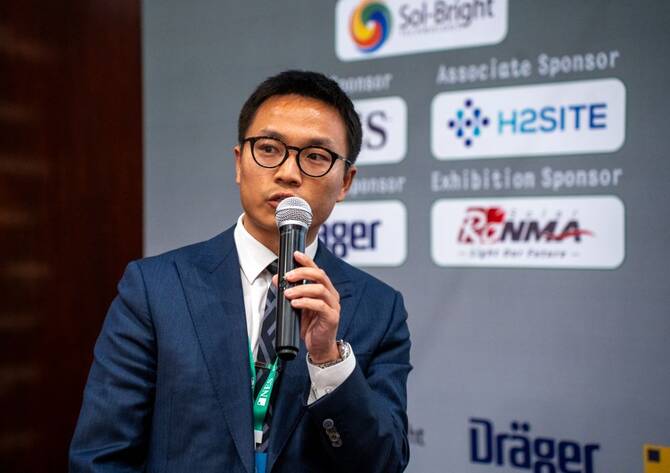
In the MENA region, majority projects are constructed in the desert, making the utilization of robotic machines significantly useful, said Sol-Bright’s sales director, Chao Kaik. (AN Photo/Loai Elkelawy)
2 / 2
Fully-automated robotic cleaning devices are being used in Saudi solar farms, improving the efficiency of panels and reducing the need for manual labor. (Supplied)
Short Url
Updated 14 May 2025
Follow

Fully automated robotic cleaners improve efficiency of Saudi solar farms

  • Proper cleaning can improve solar panel efficiency by up to 70%
  • Automated systems keep panels free of dust and other debris

RIYADH: Harsh, dry and hot weather conditions in Saudi Arabia increase the chances for solar photovoltaic cells to get damaged by sand and dust storms, bird droppings, and the “hot spot effect”, which can overheat the panels and cause fires.

“Without proper cleaning, the power reduction can reach 70 percent in one month, according to some professional statistics on the market,” said Chao Kaik, a representative of the robotic cleaner producer Sol-Bright, at the Saudi Arabia Green Energy Week 2025 event in Riyadh on Wednesday.

On the other hand, having the PV cells cleaned greatly increases the amount of energy generated by these panels, according to Kaik.

The cleaning robots complete a fully automated cycle every day, reducing the need for workers to enter PV panel areas.

“It is fully automated and highly efficient … this is why robots are very popular in the MENA region right now,” Kaik said.

Saudi Arabia is increasingly taking a greener approach to energy production, with major projects including the 2.6 gigawatt Shuaibah and 1.5GW Sudair projects among the largest of their kind in the world.

Most of the projects in the region suffer from the effects of the harsh climate, making the robotic cleaners essential.

Saudi Arabia Green Energy Week 2025 kicked off on Wednesday with discussions on green energy in the Kingdom, the sustainable goals of Vision 2030 and the work of Chinese technology companies in Saudi Arabia.

“From the future of solar power to the impact of hydrogen and renewables projects in KSA and MENA, the Saudi Arabia Green Energy Week 2025 has provided a platform for meaningful dialogue and collaboration,” said Mohammed Al-Ghazal, chairman of Saudi Arabia Green Energy Week 2025, at the opening session of the conference.

Al-Ghazal added: “Investments in green energy and technology are charting the course to make climate neutrality a reality.”


Shaping future society: How intellectual forums contribute to cultural development

Updated 7 sec ago
Follow

Shaping future society: How intellectual forums contribute to cultural development

RIYADH: Modern nations do not transform on technological progress alone, but evolve through various factors such as values, religion, culture and assumptions that guide how societies interpret development.

Philosophy is one aspect of understanding civilization. Although it is often seen as abstract or far from reality, it plays an essential role in shaping a nation’s understanding of modernization.

It impacts how people see progress and discuss cultural identity, along with measuring the ethical implications of joining the global mindset.

Yet, by examining the philosophical thoughts that shape national narratives, people gain a deeper understanding of why societies adopt certain ideologies for development, resist others, and struggle to balance tradition with innovation.

Saudi Arabia, for example, defines its place on the global stage and navigates the complex tensions between heritage, aspiration and global responsibility through its own philosophy.

The Philosophy Forum, organized in Riyadh this week for the fifth year, witnessed the attendance of both local and international thinkers. During the conference, some Arab philosophers shared their beliefs in the idea that there is no absolute truth; while other philosophers differed, considering the Arab view on truth, culture and relativism.

“We must distinguish between the existence of relativity in science — the world is changing because it is relative — and our belief in absolute truths within our culture. For example, the only truly absolute thing in the world is death, which is mentioned in the Holy Qur’an,” Essam Gameil, professor of logic and critical thinking at Cairo University, told Arab News on the sidelines of the forum.

He added: “Our morals are unchanging; ethical principles are fixed. For example, respecting others is a fundamental principle; how can it be altered?

“Some concepts can be changed within the framework of science, but not in the humanities, not in religion, not in ethics. There are constants.

“It is the moral principles and rules that drive me forward,” Gameil said, adding that philosophy was created to solve issues that occurred in society during the time of Aristotle and Plato.

“It appeared to solve social problems … it was created to address lying, deception and more. Socrates was a moral philosopher and nothing else,” he said.

Gameil described Saudi Arabia as an example of “an extraordinary leap” in the Arab world in terms of development and philosophy.

He said that the Kingdom’s interest in philosophy and its organization of a major conference in the field stems from a crucial concept discovered by the Saudi leadership, which is that humanity has two aspects: A spiritual aspect and a material aspect, represented by the body.

“Studies typically focus on the body — artificial intelligence, engineering, and so on — but have often neglected the spiritual dimension. Philosophy is a human science; the more you emphasize it, the more certain concepts become firmly established and ingrained,” said Gameil.

Eman Al-Mulhem, a researcher in the philosophy of science at King Faisal University in Al-Ahsa, believes that the Kingdom’s situation presents three very promising paths: The philosophy and ethics of artificial intelligence, science and technology studies, and a re-reading of the Arab philosophical heritage using contemporary methodologies.

“This field is no longer a luxury, but a necessity. The question is no longer: What can a machine do? Rather, it has become: How do we preserve our humanity in a world where we share the power of decision-making with machines?” she said, highlighting the philosophy and ethics of AI.

She added: “We have a rich heritage, but we need modern tools to understand and reconstruct it, not just explain it. These fields are not only promising, but they are also capable of reshaping the role of philosophy in the Arab world.”

Al-Mulhem also works to connect Arab philosophical heritage to questions of contemporary science. She believes that philosophy is not detached from reality, but rather helps to reevaluate our relationship with science, humanity and the world.

On the question of whether Arab philosophical heritage is still suffering from global misconceptions, she said: “(It) still suffers some global misconceptions, such as being reduced to a mere extension of Greek philosophy or a stagnant tradition.”

However, the Riyadh International Philosophy Conference, which hosts philosophical minds from around the world, is helping to correct this image, she added.

“They present Arab heritage in a dynamic context, through the voices of its own scholars. At this conference, the world encounters Arab thoughts that engage in dialogue, produce ideas and critique — not as a static heritage, but as an integral part of contemporary global philosophy,” said Al-Mulhem.

“Philosophy is not far removed from humanity; it is closer than we imagine. Every question we ask, every attempt to understand the world, is a philosophical step,” she said.

“I believe that the Arab region today has a great opportunity to reclaim its role in producing knowledge, not just consuming it. And the Arab researcher is capable — given the right environment — of making a lasting impact that transcends geographical boundaries,” she added.