ACWA Power secures $2.6bn financing for 3 Saudi solar projects

ACWA Power is key in driving the Kingdom’s green energy initiatives and is expanding globally. ACWA Power
Short Url
Updated 11 June 2025
Follow

ACWA Power secures $2.6bn financing for 3 Saudi solar projects

  • ACWA Power owns a 35.1% stake, while Badeel holds a 34.9% stake in each project company
  • Financing alliance includes a mix of local, regional, and international banks

RIYADH: Saudi utility developer ACWA Power has signed financing agreements valued at SR9.7 billion ($2.58 billion) with a consortium of banks to develop three large-scale solar projects in the Kingdom. 

In a statement to Saudi stock exchange Tadawul, the Public Investment Fund-backed firm said that these projects, located in Haden, Muwyah, and Al-Khushaybi in the Makkah and Qassim provinces, will have capacities of 2,000 megawatts, 2,000MW, and 1,500MW, respectively. 

The financing agreements were signed by Buraiq Renewable Energy Co., Moya Renewable Energy Co., and Nabah Renewable Energy Co. These firms will be owned by ACWA Power, Badeel — a subsidiary of PIF, and Saudi Aramco Power Co. 

ACWA Power owns a 35.1 percent stake, while Badeel holds a 34.9 percent stake in each project company. 

The development underscores Saudi Arabia’s growing role in the renewable energy sector, with the Kingdom aiming to produce 130 gigawatts of green energy by the end of the decade. 

The Kingdom has heavily invested in diversifying its energy mix toward renewable sources to meet its pledge to cut carbon emissions and promote sustainable development. By 2030, the country aims to source at least 50 percent of its electricity from renewables. 

The financing alliance includes a mix of local, regional, and international banks such as Banque Saudi Fransi, Emirates NBD, and First Abu Dhabi Bank, as well as HSBC, Mizuho Bank, and Riyad Bank, Saudi National Bank and Standard Chartered Bank. 

According to the statement, the funding duration is 27.3 years, with ACWA Power’s guarantee limited to its equity bridge loan and standby equity. 

ACWA Power, listed on Saudi Arabia’s main market, is key in driving the Kingdom’s green energy initiatives and is expanding globally, targeting high-growth economies. 

In a separate disclosure, ACWA Power announced it has engaged Citigroup Saudi Arabia, SNB Capital, and J.P. Morgan Saudi Arabia as financial advisers for a planned $7.12 billion capital raise. 

The capital hike will support the company’s new growth strategy, approved in 2023, aiming to triple operations by 2030. 

In August, ACWA Power reported a net profit of SR926.79 million for the first half of the year, a 35.46 percent increase compared to the same period in 2023. 

The company attributed the profit rise to higher revenues, increased profit share from equity-accounted investees, and higher finance income. 


Saudi POS transactions see 20% surge to hit $4bn: SAMA

Updated 05 December 2025
Follow

Saudi POS transactions see 20% surge to hit $4bn: SAMA

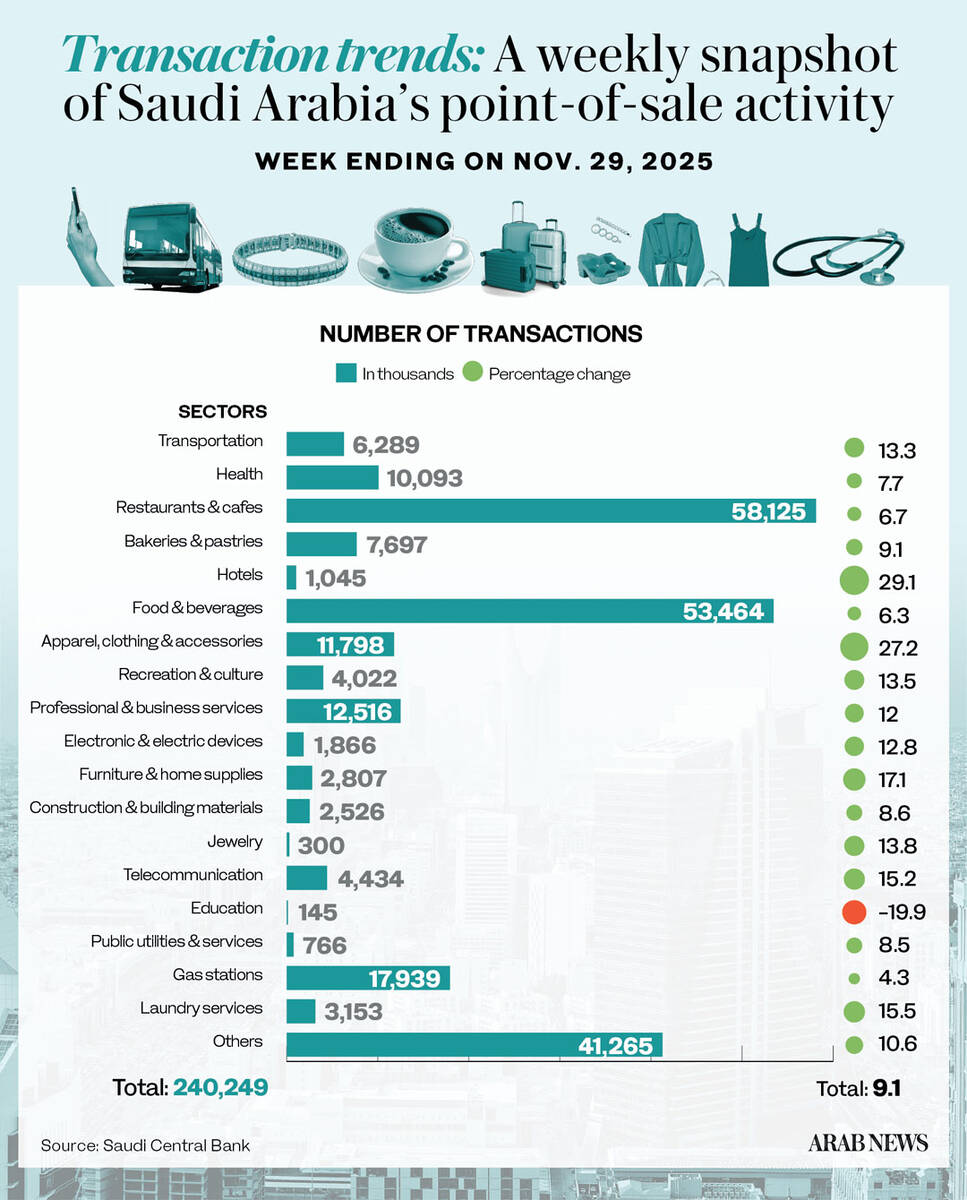
RIYADH: Saudi Arabia’s total point-of-sale transactions surged by 20.4 percent in the week ending Nov. 29, to reach SR15.1 billion ($4 billion).

According to the latest data from the Saudi Central Bank, the number of POS transactions represented a 9.1 percent week-on-week increase to 240.25 million compared to 220.15 million the week before.

Most categories saw positive change across the period, with spending on laundry services registering the biggest uptick at 36 percent to SR65.1 million. Recreation followed, with a 35.3 percent increase to SR255.99 million. 

Expenditure on apparel and clothing saw an increase of 34.6 percent, followed by a 27.8 percent increase in spending on telecommunication. Jewelry outlays rose 5.6 percent to SR354.45 million.

Data revealed decreases across only three sectors, led by education, which saw the largest dip at 40.4 percent to reach SR62.26 million. 

Spending on airlines in Saudi Arabia fell by 25.2 percent, coinciding with major global flight disruptions. This followed an urgent Airbus recall of 6,000 A320-family aircraft after solar radiation was linked to potential flight-control data corruption. Saudi carriers moved swiftly to implement the mandatory fixes.

Flyadeal completed all updates and rebooked affected passengers, while flynas updated 20 aircraft with no schedule impact. Their rapid response contained the disruption, allowing operations to return to normal quickly.

Expenditure on food and beverages saw a 28.4 percent increase to SR2.31 billion, claiming the largest share of the POS. Spending on restaurants and cafes followed with an uptick of 22.3 percent to SR1.90 billion.

The Kingdom’s key urban centers mirrored the national decline. Riyadh, which accounted for the largest share of total POS spending, saw a 14.1 percent surge to SR5.08 billion, up from SR4.46 billion the previous week. The number of transactions in the capital reached 75.2 million, up 4.4 percent week-on-week.

In Jeddah, transaction values increased by 18.1 percent to SR2.03 billion, while Dammam reported a 14 percent surge to SR708.08 million.

POS data, tracked weekly by SAMA, provides an indicator of consumer spending trends and the ongoing growth of digital payments in Saudi Arabia. 

The data also highlights the expanding reach of POS infrastructure, extending beyond major retail hubs to smaller cities and service sectors, supporting broader digital inclusion initiatives. 

The growth of digital payment technologies aligns with the Kingdom’s Vision 2030 objectives, promoting electronic transactions and contributing to the nation’s broader digital economy.