

Oil Updates — prices dip as traders watch for jump in US crude stockpiles

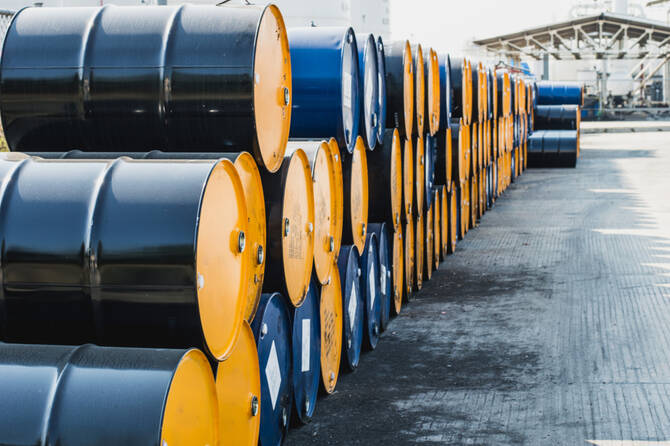
Brent crude futures fell 32 cents, or 0.5 percent, to $66.31 a barrel by 10:00 a.m. Saudi time. Shutterstock
Short Url
Updated 14 May 2025
Follow

Oil Updates — prices dip as traders watch for jump in US crude stockpiles

SINGAPORE: Oil prices retreated on Wednesday as traders eyed a potential jump in US crude inventories, though prices held near two-week highs amid relief after the United States and China agreed to temporarily lower their reciprocal tariffs.

Brent crude futures fell 32 cents, or 0.5 percent, to $66.31 a barrel by 10:00 a.m. Saudi time. US West Texas Intermediate crude slipped 32 cents, or 0.5 percent, to $63.35. Both benchmarks had climbed more than 2.5 percent in the previous session.

The two largest economies agreed on Monday to pause their trade war for at least 90 days, with the US cutting tariffs to 30 percent from 145 percent and China slashing duties on US imports to 10 percent from 125 percent.

“The US-China economic pause might have crafted a narrative that could invigorate demand amidst a backdrop of cautious optimism,” said Priyanka Sachdeva, senior market analyst at Phillip Nova.

However, expectations of a staggering jump in US oil inventories capped optimism for now, Sachdeva added.

“This sharp contrast to last week’s substantial draw signals that the demand side is still grappling with significant challenges, leaving market watchers on edge and wondering where the next twist will come from,” she said.

Crude stocks were up by 4.3 million barrels in the week ended May 9, market sources said, citing American Petroleum Institute figures on Tuesday.

Official weekly inventory data from the US Energy Information Administration is due on Wednesday at 5:30 p.m. Saudi time.

Investors remain watchful of demand signals. Rystad energy analysts said in a note the agreement had “eroded some demand side pessimism,” while cautioning against any lingering impact of the tariffs despite the rollbacks.

The market is also watching US President Donald Trump’s Gulf trip, begun on Tuesday with an appearance at an investment forum in Riyadh, where he said the US would lift longstanding sanctions on Syria and secured a $600-billion pledge of Saudi investment.

Rystad Energy’s global head of commodity markets Mukesh Sahdev said preventing oil price spikes over the summer travel season will be a key part of the president’s agenda on the trip.

The US could take advantage of lower prices to buy more Middle East crude for its Strategic Petroleum Reserve, he added.

“The big unknown for the market is how US actions related to Iran, Russia and Venezuela will result in supply disruptions or additions,” Sahdev said.

On Tuesday, the US slapped fresh sanctions on about 20 companies it said were helping Iran’s Armed Forces General Staff and its front company, Sepehr Energy, send Iranian oil to China.

The sanctions follow a fourth round of US-Iran talks in Oman to tackle disputes over Iran’s nuclear program. 


UAE adds 250k companies in 2025, says minister

Updated 44 min 12 sec ago
Follow

UAE adds 250k companies in 2025, says minister

RIYADH: The UAE saw 250,000 new companies in 2025, bringing the total number of businesses operating in the Emirates to 1.4 million, said Abdulla bin Touq Al-Marri, the country’s minister of economy and tourism. 

Speaking during a media briefing, Al-Marri said that the number of small businesses in the Emirates has grown by 63 percent over the past five years. 

The minister added that the UAE has attracted around 760,000 companies since the introduction of full foreign ownership for commercial businesses in September 2021. 

Until the end of 2025, the number of firms operating in the country increased by 118.7 percent compared to the end of the first half of 2021. 

Discussing new amendments to the Commercial Companies Law, Al-Marri said that they provide a comprehensive and clear legal framework that supports the growth of the companies and their long-term sustainability. 

“The amendments grant multiple quotas and share classes in limited liability companies and public and private joint stock companies as a legal right, compared to the previous system where this right was limited to public joint stock companies through a Cabinet decision,” said the minister. 

The amendments also facilitate access to financing and investment opportunities, and are expected to strengthen companies’ ability to continue operations and expand geographically across free zones and financial free zones. 

The minister further highlighted that the law enhances the ease of doing business and ensures smoother entry to the markets by allowing the transfer of a company’s registration between Emirates, free zones and financial free zones, while maintaining the company’s original legal terms. 

“The UAE is among the first countries in the Middle East to allow multiple quota classes for LLCs, while many countries restrict this to joint stock companies, particularly public joint stock companies. It enhances flexibility in ownership structures and better regulates the relationship among shareholders,” said Al-Marri. 

The minister added that the total number of business registrations and licenses in the UAE is expected to increase by 10 to 15 percent within the first year of implementing the new amendments.

Al-Marri revealed that the UAE witnessed the registration of approximately 37,794 national and international trademarks in 2025. 

The number of registered trademarks also rose by 74 percent over four years, underscoring the Emirates’ business-friendly environment. 

In terms of intellectual property, 3,595 works were registered in 2025, representing a 124 percent growth rate over four years. 

The minister said that the contribution of the tourism sector to the country’s gross domestic product reached 291 billion dirhams ($79.24 billion) by the end of 2025. 

Currently, tourism contributes 15 percent to the country’s GDP compared to 6 percent in 2021. 

Al-Marri added that the UAE economy is projected to grow by 5 percent in 2025, driven by the continued expansion of non-oil sectors, whose contribution reached 77.5 percent to the nation’s GDP by the end of the first half of 2025.