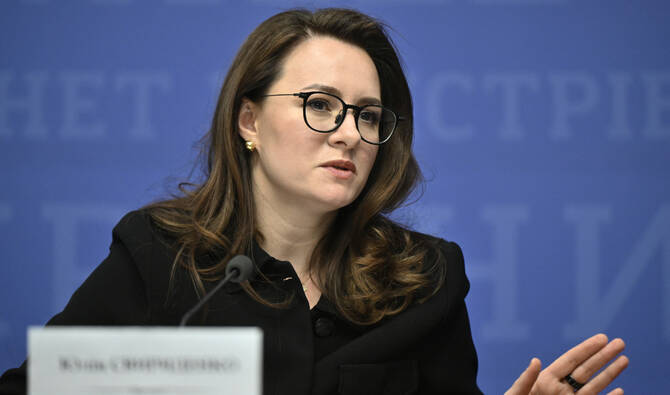
Ukraine has concluded procedures for implementation of a deal with the United States on exploiting minerals, including the operation of an investment fund, the country’s first deputy prime minister said on Tuesday.
Yulia Svyrydenko gave few details of the latest step in securing approval of the accord, promoted by US President Donald Trump, but it was known that two additional documents were drawn up as part of its implementation.
“Another milestone on the path to launching the United States-Ukraine Reconstruction Investment Fund: Ukraine has completed all necessary procedures on schedule,” Svyrydenko wrote in English on social media.
She said a note certifying completion of the process had been handed to interim US Charge d’Affaires Julie Davis.
“These are equal agreements — forward-looking, aligned with Ukraine’s national interests, and structured to ensure investment flows exclusively into Ukraine’s recovery and growth,” Svyrydenko wrote.
After weeks of tough negotiations following a shouting match between President Volodymyr Zelensky and Trump in the Oval Office, Svyrydenko signed the minerals agreement in Washington and it was ratified last week by the Ukrainian parliament.
After that vote, Svyrydenko described the accord as “not merely a legal construct — it is the foundation of a new model of interaction with a key strategic partner.”
The minerals agreement hands the United States preferential access to new Ukrainian minerals deals and sets up the investment fund, which could be used for the reconstruction of Ukraine for the first 10 years.
Ukraine also sees the deal as a way to unlock supplies of new US weapons, especially additional Patriot air defense systems it sees as vital to protect against Russian air attacks.
Zelensky hailed the reworked draft of the agreement as a marked improvement over earlier versions that some critics in Ukraine had denounced as “colonial.” The accord also acknowledges Ukraine’s bid to join the European Union.


![]()


Ukraine completes steps for minerals deal with US, deputy prime minister says
Short Url
https://arab.news/pvp4v
Ukraine completes steps for minerals deal with US, deputy prime minister says


South Korea calls for resuming dialogue with North
- President Lee Jae Myung has sought to mend ties with the nuclear-armed North since taking office in June
- North Korean leader Kim Jong Un last week dashed hopes of a diplomatic thaw with Seoul
SEOUL: South Korean President Lee Jae Myung called on Sunday for dialogue with North Korea to resume, after Pyongyang last week shunned the prospect of diplomacy with its neighbor.
Since taking office in June, a dovish Lee has sought to mend ties with the nuclear-armed North, which reaffirmed its anti-Seoul approach during a party meeting last week.
“As my administration has repeatedly made clear, we respect the North’s system and will neither engage in any type of hostile acts, nor pursue any form of unification by absorption,” Lee said in a speech marking the anniversary of a historical campaign against Japan’s colonial rule.
“We will also continue our efforts to resume dialogue with the North,” he said.
North Korean leader Kim Jong Un last week dashed hopes of a diplomatic thaw with Seoul, describing its overtures as “clumsy, deceptive farce and a poor work.”
Speaking at the party congress in Pyongyang, Kim said North Korea has “absolutely no business dealing with South Korea, its most hostile entity, and will permanently exclude South Korea from the category of compatriots.”
But he also said the North could “get along well” with the United States if Washington acknowledges its nuclear status.
Speculation has mounted over whether US President Donald Trump will seek a meeting with Kim during planned travels to China.
Last year, Trump said he was “100 percent” open to a meeting.
Previous Trump-Kim summits during the US president’s first term fell apart after the pair failed to agree over sanctions relief — and what nuclear concessions North Korea might make in return.
Since taking office in June, a dovish Lee has sought to mend ties with the nuclear-armed North, which reaffirmed its anti-Seoul approach during a party meeting last week.
“As my administration has repeatedly made clear, we respect the North’s system and will neither engage in any type of hostile acts, nor pursue any form of unification by absorption,” Lee said in a speech marking the anniversary of a historical campaign against Japan’s colonial rule.
“We will also continue our efforts to resume dialogue with the North,” he said.
North Korean leader Kim Jong Un last week dashed hopes of a diplomatic thaw with Seoul, describing its overtures as “clumsy, deceptive farce and a poor work.”
Speaking at the party congress in Pyongyang, Kim said North Korea has “absolutely no business dealing with South Korea, its most hostile entity, and will permanently exclude South Korea from the category of compatriots.”
But he also said the North could “get along well” with the United States if Washington acknowledges its nuclear status.
Speculation has mounted over whether US President Donald Trump will seek a meeting with Kim during planned travels to China.
Last year, Trump said he was “100 percent” open to a meeting.
Previous Trump-Kim summits during the US president’s first term fell apart after the pair failed to agree over sanctions relief — and what nuclear concessions North Korea might make in return.
Latest updates




© 2026 SAUDI RESEARCH & PUBLISHING COMPANY, All Rights Reserved And subject to Terms of Use Agreement.