Germany’s Merz: EU to tighten sanctions on Russia if no progress on Ukraine this week

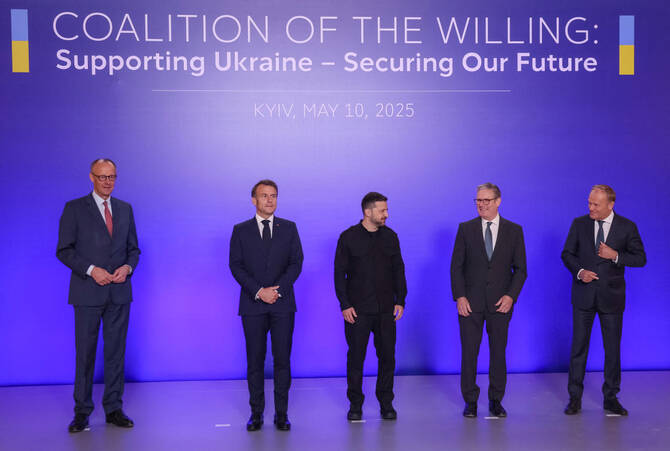
Ukraine’s President Volodymyr Zelensky, Britain’s Prime Minister Keir Starmer, French President Emmanuel Macron, German Chancellor Friedrich Merz and Poland’s Prime Minister Donald Tusk pose for a picture before their meting in Kyiv, on May 10, 2025. (Reuters)
Short Url
Updated 13 May 2025
Follow

Germany’s Merz: EU to tighten sanctions on Russia if no progress on Ukraine this week

  • Merz said EU leaders had agreed with Zelensky that he could take part in talks with Russia
  • “I believe more compromise and more concessions are no longer reasonable“

BERLIN: The European Union is ready to impose tougher sanctions on Russia if progress on ending the war in Ukraine is not made this week, German Chancellor Friedrich Merz said on Tuesday, adding a new package of sanctions was prepared.

“We are waiting for (Russian President Vladimir) Putin’s agreement and we agree that if there is no real progress this week, we want to work together at European level for a significant tightening of sanctions,” Merz said at a news conference with his Greek counterpart.

“We will be looking at other areas, such as the energy sector and also the financial market,” he said.

Merz said EU leaders had agreed with Ukrainian President Volodymyr Zelensky that he could take part in talks with Russia in Istanbul this week on the condition that Russian bombardment and attacks on civilians in Ukraine must stop.

While saying he admired Zelensky’s willingness to compromise if it could help a ceasefire, Merz added:

“I believe more compromise and more concessions are no longer reasonable,” said Merz.

Greek Prime Minister Kyriakos Mitsotakis said the EU must be at the center of any peace settlement.


EU leaders agree on 90 billion euro loan to Ukraine

Updated 5 sec ago
Follow

EU leaders agree on 90 billion euro loan to Ukraine

BRUSSELS: European Union leaders agreed on Friday to provide a massive interest-free loan to Ukraine to meet its military and economic needs for the next two years, EU Council President Antonio Costa said.
“We have a deal. Decision to provide 90 billion euros  of support to Ukraine for 2026-27 approved. We committed, we delivered,” Costa said in a post on social media, without providing details about how the money would be raised.
The EU leaders worked deep into Thursday night to reassure Belgium that they would provide guarantees to protect it from Russian retaliation if it backed the loan for Ukraine.