Afghan women’s radio station Radio Begum to resume broadcasts after Taliban lifts suspension

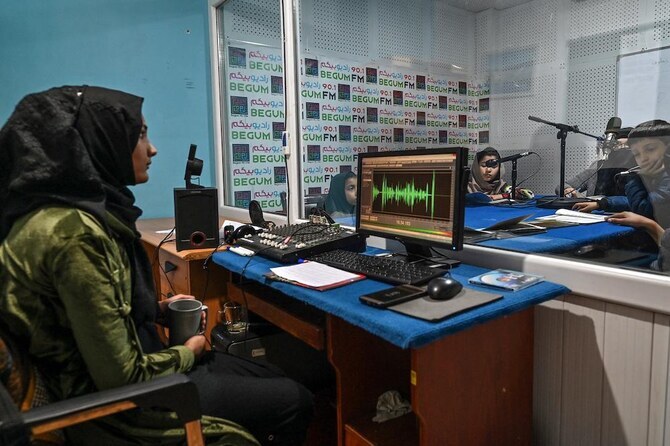
Students attend a class on-air at Radio Begum in Kabul on Nov. 28, 2021. (AFP)
Short Url
Updated 23 February 2025
Follow

Afghan women’s radio station Radio Begum to resume broadcasts after Taliban lifts suspension

  • Radio Begum was launched on International Women’s Day in March 2021 months before Taliban takeover
  • Taliban information ministry says suspension lifted after station made commitments to Afghan authorities

An Afghan women’s radio station will resume broadcasts after the Taliban suspended its operations, citing “unauthorized provision” of content to an overseas TV channel and improperly using its license.
Radio Begum launched on International Women’s Day in March 2021, five months before the Taliban seized power amid the chaotic withdrawal of US and NATO troops.
The station’s content is produced entirely by Afghan women. Its sister satellite channel, Begum TV, operates from France and broadcasts programs that cover the Afghan school curriculum from seventh to 12th grade. The Taliban have banned education for women and girls in the country beyond grade six.
In a statement issued Saturday night, the Taliban’s Information and Culture Ministry said Radio Begum had “repeatedly requested” to restart operations and that the suspension was lifted after the station made commitments to authorities.
The station pledged to conduct broadcasts “in accordance with the principles of journalism and the regulations of the Islamic Emirate of Afghanistan, and to avoid any violations in the future,” it added.
The ministry did not elaborate what those principles and regulations were. Radio Begum was not immediately available for comment.
Since their takeover, the Taliban have excluded women from education, many kinds of work, and public spaces. Journalists, especially women, have lost their jobs as the Taliban tighten their grip on the media.
In the 2024 press freedom index from Reporters without Borders, Afghanistan ranks 178 out of 180 countries. The year before that it ranked 152.
The Information Ministry did not initially identify the TV channel it alleged Radio Begum had been working with. But the Saturday statement mentioned collaboration with “foreign sanctioned media outlets.”


With Saudi businessman’s support, Singapore university maps overlooked Arabia-Asia links

Updated 13 sec ago
Follow

With Saudi businessman’s support, Singapore university maps overlooked Arabia-Asia links

  • Muhammad Alagil Chair in Arabia–Asia Studies was established at National University of Singapore in 2014
  • It is dedicated to research in the social, cultural, historical and contemporary Arabia-Asia relations

DUBAI: Moving beyond the usual “Middle East vs. West” frameworks, research at Singapore’s top university examines Arabia–Asia connections, shedding new light on centuries of trade, political and cultural ties that were long obscured by European colonial scholarship.

It all began with an endowment from Muhammad Alagil, a Saudi philanthropist and chairman of Jarir Group — one of the Kingdom’s leading retailers.

Located at the Asia Research Institute of the National University of Singapore, the Muhammad Alagil Chair in Arabia–Asia Studies was established in 2014 to promote research on the contemporary and historical links between the two regions.

“This history has never been put together, and it’s been there for over a thousand years — and I thought this was missing,” Alagil told Arab News from the sidelines of the “Exploring the Sacred,” hosted by the chair in Singapore on Dec. 4-5.

“Considering that Asia is also rising, ascending, it would also be very good for Saudi and the Arabian Peninsula.”

Arabia and Asia have been linked for centuries through trade, religion, culture, food and kinship, with the connections spanning the Indian Ocean and overland routes between West and East Asia.

“Our research covers a wide range of topics — from economic, political, social and cultural interactions — because we are opening up a new geographical area of focus about which there is sparse knowledge and whose scope is huge, going from Arabia to China,” said Prof. Sumit Mandal, who holds the Muhammad Alagil Chair.

“To my knowledge, there is no comparable program of study anywhere else in the world.”

The research spans multiple regions at the same time — from the spread of Islamic spiritual and legal ideas across the Indian Ocean and its coastal areas, through the formation and survival of Arab diasporas in Asia, as well as trade and political networks created by Arab, Indian, Swahili, and Baloch merchants, lawyers, soldiers, preachers and seamen.

“By opening up scholarly analysis to a transregional scope rather than limiting it to national or regional boundaries, the research opens our eyes to the many and longstanding connections that have existed between Arabia and Asia but were erased with the rise of European colonial expansion,” Prof. Mandal said.

“Hadramis from Yemen, for instance, emerge as significant traders, diplomats, scholars and political leaders across the Indian Ocean, from East Africa to Southeast Asia. Where they were once understood purely through their roles within Indonesia, for instance, we can now see the significance of their connections to Yemen as well. The picture that emerges is broader geographically and deeper horizontally.”

Besides research, the endowment also promotes academics working in the field and aims to empower the growth of new generations of scholars, especially from its focus regions.

It made it possible to bring together a network of scholars, including Engseng Ho — a leading scholar of transnational anthropology, history and Muslim societies, who was the first to hold the Muhammad Alagil Chair.

Another initiative is a project to document the history of Arab communities by digitizing and preserving their manuscripts, especially those at risk of being lost or destroyed.

“They are part of a long tradition of local writing across the Indian Ocean that is disappearing because of neglect and lack of proper conservation,” he said.

“When they disappear, we will no longer be able to tell the story of a big part of centuries of trade, politics and cultural exchange between Arabia and Asia before the 20th century.”

The current focus is on three geographical regions: Malabar in India, Makassar in Indonesia and Hadramout in Yemen.

Mandal sees them as offering a completely new understanding of the worlds of Arabia, Asia and the Indian Ocean, because they are written in the local languages and “represent voices of the region,” he said.

“The emerging Arabia Asia Archives will change how we see Arabia, Asia and the world in the present and the past.”