

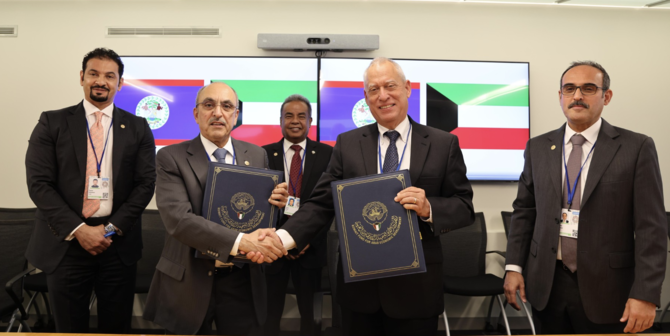
Kuwait Fund signs $26m loan agreements with Belize and Saint Lucia 

Acting Director General Waleed Al-Bahar signed the deals. KUNA
Short Url
Updated 14 October 2025
Follow

Kuwait Fund signs $26m loan agreements with Belize and Saint Lucia 

RIYADH: Major road infrastructure projects in Belize and Saint Lucia will get a boost after the Kuwait Fund for Arab Economic Development signed two concessional loans totaling 8 million Kuwaiti dinars ($25.6 million).

The agreements, each valued at 4 million dinars ($12.8 million), were signed on the sidelines of the World Bank and IMF Annual Meetings in Washington and will co-finance key highways in both countries, the Kuwait News Agency reported. 

The Belize project forms part of a broader national infrastructure program with a total cost of approximately $42.7 million.  

“Under the first agreement, KFAED will provide the government of Belize with a loan of KD4 million ($12.8 million) to contribute to financing the George Price Highway (Belmopan-La Democracia Section) project,” KFAED said in a statement. 

The 4-million-dinar loan will finance the government’s contribution to the project, with implementation expected to be completed by 2028. The project aims to enhance road safety, reduce congestion, and improve climate resilience.  

Christopher Coye, minister of state in Belize’s Ministry of Finance, Economic Development and Investment, signed the agreement with Acting Director General Waleed Al-Bahar.

Coye noted that the highway is one of the most important transport arteries in the country, and the project will improve access, reduce travel time, and support commerce. 

In Saint Lucia, the loan will support the Millennium Highway and West Coast Road Project, which links the capital Castries with the southern city of Soufriere, and is frequently affected by flooding and traffic delays.  

The project’s total estimated cost is approximately $47 million. The 4-million-dinar loan from Kuwait complements other financing provided by the Saudi Fund for Development and the OPEC Fund. 

The upgrade will reduce vehicle operating costs, improve traffic flow, and increase resilience to environmental conditions. 

KFAED stated that both loans are structured over a 21-year term, including a five-year grace period. They carry an annual interest rate of 1.5 percent and a 0.5 percent service fee.  

The Belize project supports Sustainable Development Goals 11 and 17, while the Saint Lucia project contributes to SDGs 9, 11, and 13. 

The recent agreements with Belize and Saint Lucia are part of a broader push by the KFAED to expand its development financing portfolio across multiple sectors and regions.  

In September, the fund signed a $20 million loan agreement with Liberia to rehabilitate a 65-km stretch of road between Konia and Voinjama, aimed at enhancing regional connectivity. 

In the same period, Jordan secured a $38.3 million loan from KFAED to construct 12 new public schools across several governorates. 


Education spending surges 251% as students return from autumn break: SAMA

Updated 12 December 2025
Follow

Education spending surges 251% as students return from autumn break: SAMA

RIYADH: Education spending in Saudi Arabia surged 251.3 percent in the week ending Dec. 6, reflecting the sharp uptick in purchases as students returned from the autumn break.

According to the latest data from the Saudi Central Bank, expenditure in the sector reached SR218.73 million ($58.2 million), with the number of transactions increasing by 61 percent to 233,000.

Despite this surge, overall point-of-sale spending fell 4.3 percent to SR14.45 billion, while the number of transactions dipped 1.7 percent to 236.18 million week on week.

The week saw mixed changes between the sectors. Spending on freight transport, postal and courier services saw the second-biggest uptick at 33.3 percent to SR60.93 million, followed by medical services, which saw an 8.1 percent increase to SR505.35 million.

Expenditure on apparel and clothing saw a decrease of 16.3 percent, followed by a 2 percent reduction in spending on telecommunication.

Jewelry outlays witnessed an 8.1 percent decline to reach SR325.90 million. Data revealed decreases across many other sectors, led by hotels, which saw the largest dip at 24.5 percent to reach SR335.98 million. 

Spending on car rentals in the Kingdom fell by 12.6 percent, while airlines saw a 3.7 percent increase to SR46.28 million.

Expenditure on food and beverages saw a 1.7 percent increase to SR2.35 billion, claiming the largest share of the POS. Restaurants and cafes retained the second position despite a 12.6 percent dip to SR1.66 billion.

Saudi Arabia’s key urban centers mirrored the national decline. Riyadh, which accounted for the largest share of total POS spending, saw a 3.9 percent dip to SR4.89 billion, down from SR5.08 billion the previous week.

The number of transactions in the capital settled at 74.16 million, down 1.4 percent week on week.

In Jeddah, transaction values decreased by 5.9 percent to SR1.91 billion, while Dammam reported a 0.8 percent surge to SR713.71 million.

POS data, tracked weekly by SAMA, provides an indicator of consumer spending trends and the ongoing growth of digital payments in Saudi Arabia. 

The data also highlights the expanding reach of POS infrastructure, extending beyond major retail hubs to smaller cities and service sectors, supporting broader digital inclusion initiatives. 

The growth of digital payment technologies aligns with the Kingdom’s Vision 2030 objectives, promoting electronic transactions and contributing to the nation’s broader digital economy.