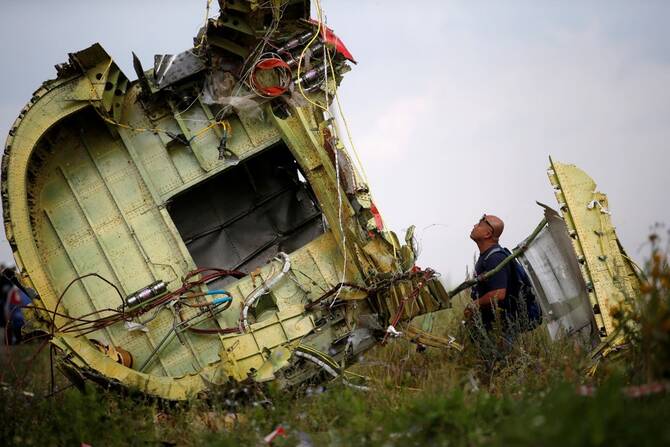
MONTREAL: The United Nations aviation agency said Monday that Russia was responsible for the downing of a Malaysia Airlines jetliner over Ukraine in 2014, leading to the deaths of 298 people.
The International Civil Aviation Organization , based in Montreal, said claims brought by Australia and the Netherlands over the shooting down of Flight MH17 on July 17 of that year were “well founded in fact and in law.”
“The Russian Federation failed to uphold its obligations under international air law in the 2014 downing of Malaysia Airlines Flight MH17,” the agency said in a statement issued Monday evening.
The OCAO said this was the first time in its history that its council has made a determination on the merits of a dispute between member states.
On July 17, 2014 the Malaysia Airlines Boeing 777 — en route from Amsterdam to Kuala Lumpur — crashed in eastern Ukraine’s Donetsk region where pro-Russian separatist rebels were battling Ukrainian forces.
The plane was hit by a Russian-made BUK surface-to-air missile.
Dutch nationals accounted for two-thirds of the dead, along with 38 Australians and about 30 Malaysians, with many victims having dual nationalities.
Then-Ukrainian President Petro Poroshenko called it a “terrorist act.”
Pro-Russian rebels in the area claimed the airliner was shot down by a Ukrainian military jet. Russian President Vladimir Putin says Ukraine “bears responsibility.”
The following day, then US president Barack Obama said a missile fired from separatist-held territory was to blame and the rebels would not have been able to hit the airliner without Russian support.
In 2022 a Dutch court sentenced three men to life in prison over the downing, among them two Russians, but Russia refused to extradite them.
Russia has consistently denied any involvement in the tragedy.
The governments of Australia and the Netherlands welcomed the UN agency’s decision Monday night.
“This is a historic moment in the pursuit of truth, justice and accountability for the victims of the downing of Flight MH17, and their families and loved ones,” the Australian government said in a statement.
It called on the agency to “move swiftly to determine remedies” for Russia’s violation of international law.
“We call upon Russia to finally face up to its responsibility for this horrific act of violence and make reparations for its egregious conduct, as required under international law,” the statement added.
International investigators suspended their probe of the downing last year, saying there was not enough evidence to identify more suspects.


UN aviation agency finds Russia responsible for 2014 downing of airliner over Ukraine
https://arab.news/jqk2s
UN aviation agency finds Russia responsible for 2014 downing of airliner over Ukraine


Bangladesh halts controversial relocation of Rohingya refugees to remote island
- Administration of ousted PM Sheikh Hasina spent about $350m on the project
- Rohingya refuse to move to island and 10,000 have fled, top refugee official says
DHAKA: When Bangladesh launched a multi-million-dollar project to relocate Rohingya refugees to a remote island, it promised a better life. Five years on, the controversial plan has stalled, as authorities find it is unsustainable and refugees flee back to overcrowded mainland camps.
The Bhasan Char island emerged naturally from river sediments some 20 years ago. It lies in the Bay of Bengal, over 60 km from Bangladesh’s mainland.
Never inhabited, the 40 sq. km area was developed to accommodate 100,000 Rohingya refugees from the cramped camps of the coastal Cox’s Bazar district.
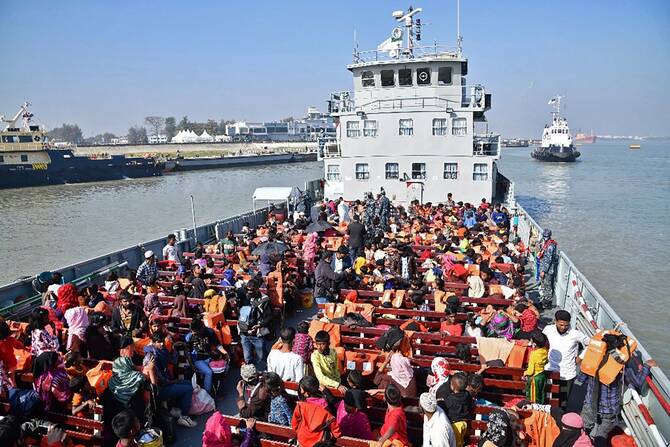
Relocation to the island started in early December 2020, despite protests from the UN and humanitarian organizations, which warned that it was vulnerable to cyclones and flooding, and that its isolation restricted access to emergency services.
Over 1,600 people were then moved to Bhasan Char by the Bangladesh Navy, followed by another 1,800 the same month. During 25 such transfers, more than 38,000 refugees were resettled on the island by October 2024.
The relocation project was spearheaded by the government of former Prime Minister Sheikh Hasina, who was ousted last year. The new administration has since suspended it indefinitely.
“The Bangladesh government will not conduct any further relocation of the Rohingya to Bhasan Char island. The main reason is that the country’s present government considers the project not viable,” Mizanur Rahman, refugee relief and repatriation commissioner in Cox’s Bazar, told Arab News on Sunday.
The government’s decision was prompted by data from UN agencies, which showed that operations on Bhasan Char involved 30 percent higher costs compared with the mainland camps in Cox’s Bazar, Rahman said.
“On the other hand, the Rohingya are not voluntarily coming forward for relocation to the island. Many of those previously relocated have fled ... Around 29,000 are currently living on the island, while about 10,000 have returned to Cox’s Bazar on their own.”
A mostly Muslim ethnic minority, the Rohingya have lived for centuries in Myanmar’s western Rakhine state but were stripped of their citizenship in the 1980s and have faced systemic persecution ever since.
In 2017 alone, some 750,000 of them crossed to neighboring Bangladesh, fleeing a deadly crackdown by Myanmar’s military. Today, about 1.3 million of them shelter in 33 camps in the coastal Cox’s Bazar district, making it the world’s largest refugee settlement.
Bhasan Char, where the Bangladeshi government spent an estimated $350 million to construct concrete residential buildings, cyclone shelters, roads, freshwater systems, and other infrastructure, offered better living conditions than the squalid camps.
But there was no regular transport service to the island, its inhabitants were not allowed to travel freely, and livelihood opportunities were few and dependent on aid coming from the mainland.
Rahman said: “Considering all aspects, we can say that Rohingya relocation to Bhasan Char is currently halted. Following the fall of Sheikh Hasina’s regime, only one batch of Rohingya was relocated to the island.
“The relocation was conducted with government funding, but the government is no longer allowing any funds for this purpose.”
“The Bangladeshi government has spent around $350 million on it from its own funds ... It seems the project has not turned out to be successful.”


