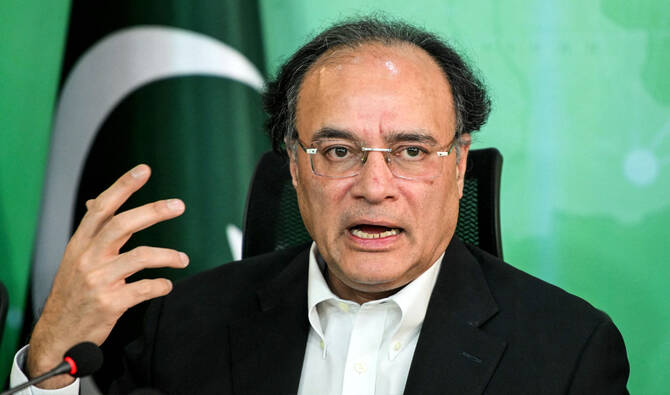
KARACHI/ISLAMABAD: The recent military escalation with arch-rival India won’t have a large fiscal impact on Pakistan and can be managed within the current fiscal space, with no need for a new economic assessment, Pakistan’s Finance Minister said in an interview with Reuters on Monday.
Trade talks with the United States – which had played a key role mediating a ceasefire between the two countries – would likely have progress in “short order” and that Pakistan could import more high-quality cotton, more soy beans and was also exploring other asset classes, including hydrocarbons, Finance Minister Muhammad Aurangzeb said in the online interview.
On Monday, US President Donald Trump said the US is ready to help India and Pakistan after a ceasefire agreement, claiming trade was a big reason they “stopped fighting.”
Pakistan faces a 29 percent tariff on exports to the US due to an approximate $3 billion trade surplus, but this is currently under a 90-day pause announced in April.
The International Monetary Fund (IMF) on Friday approved a $1 billion loan disbursement to Pakistan as part of a larger $7 billion bailout agreement.
Aurangzeb said Islamabad would receive the tranche disbursement on Tuesday.
The IMF executive board also approved a fresh $1.4 billion loan to Pakistan under its climate resilience facility.
The federal budget for the next fiscal year, starting July, will be finalized within the next three to four weeks, with scheduled budget talks with the IMF to take place from May 14-23, he said.
Regarding the India-Pakistan conflict, Aurangzeb described it as a “short duration escalation” with minimal fiscal impact, stating it can be “accommodated within the fiscal space which is available to the government of Pakistan.”
When questioned about potential increased military spending in the upcoming budget, Aurangzeb deferred comment, saying it was premature to discuss specific plans. However, he said: “Whatever we need to do in terms of ensuring that our defense requirements are met will be met.”
Aurangzeb said he expects the Indus Water Treaty, which India unilaterally suspended, to be reinstated and rolled back to where it was.
He said there is not going to be any immediate impact from India’s suspension and Pakistan does not “even want to consider any scenario which does not take into account the reinstatement of this treaty.”
Tensions between India and Pakistan began mounting after the April 22 attack in Indian-administered Kashmir on Hindu tourists that killed 26 people, sparking the worst clashes between the nuclear-armed neighbors in more than two decades.
On Saturday, a ceasefire in the Himalayan region was announced by Trump, following four days of fighting and diplomacy and pressure from Washington.


![]()

Pakistan finance minister says conflict with India won’t have large fiscal impact
Short Url
https://arab.news/49gng
Pakistan finance minister says conflict with India won’t have large fiscal impact
- On Monday, US President Donald Trump said the US is ready to help India and Pakistan after a ceasefire agreement
- Pakistan faces a 29 percent tariff on exports to the US due to a $3 billion trade surplus, currently under a 90-day pause
Latest updates


© 2026 SAUDI RESEARCH & PUBLISHING COMPANY, All Rights Reserved And subject to Terms of Use Agreement.