

Pakistan to get export boost after US slashed tariffs in new trade deal — deputy finance chief

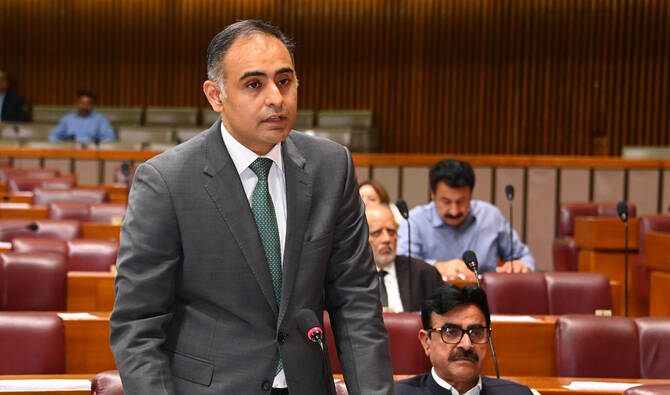
State Minister for Finance and Revenue Bilal Azhar Kayani speaks on the floor of the National Assembly of Pakistan in Islamabad on August 7, 2025. (Hanout/National Assembly)
Short Url
Updated 07 August 2025
Follow

Pakistan to get export boost after US slashed tariffs in new trade deal — deputy finance chief

  • The 19% tariff is lower than what the US imposed on regional competitors, including Vietnam and India
  • Pakistan exported $6 billion worth of goods to the US last fiscal year, making it its largest export market

ISLAMABAD: State Minister for Finance and Revenue Bilal Azhar Kayani said on Thursday Pakistan expected a significant boost in exports to the United States following successful trade negotiations that convinced President Donald Trump’s administration to lower tariffs on Pakistani products to 19%.

Pakistan and the United States finalized a trade agreement last week under which 19% tariff was imposed on a wide range of Pakistani goods. The new rate marked a considerable reduction from the initially proposed 29% under a sweeping executive order signed by Trump.

Islamabad had pushed for a lower tariff than its regional competitors, including Vietnam, which now faces a 20% tariff, and India, whose exports were hit with an additional 25% levy a day earlier over continued imports of Russian oil.

“The trade deal that has just been finalized with America has resulted in us getting a 19% tariff, the lowest tariff in the South Asia region,” Kayani told lawmakers in the National Assembly. “This, God willing, will certainly lead to an increase in our exports.”

He emphasized the US was already Pakistan’s largest export destination.

“In the last fiscal year, out of $32 billion in exports, $6 billion went to America. So this is definitely a tried and tested market, our biggest export market, and the relative reduction in this tariff will certainly benefit us.”

Kayani said the trade breakthrough reflected a broader improvement in US-Pakistan relations, contrasting the current diplomatic engagement with a period of strained ties under the government led by the opposition Pakistan Tehreek-e-Insaf party.

“No one could have imagined that we would have this kind of relationship with America today, or that we would be signing a trade deal like this, one that would give Pakistan the lowest tariff in the South Asia region,” he said, urging the opposition to acknowledge the government’s achievement.

He also linked the ongoing momentum in the bilateral relations to what he called “diplomatic victories” after Pakistan’s recent four-day military standoff with India, which ended with a US-brokered ceasefire on May 10.

The minister noted that bilateral cooperation with Washington had expanded since then, adding that Pakistan’s army chief, Field Marshal Asim Munir, was invited to the White House for a meeting with President Trump in the aftermath of the same conflict.

Kayani’s remarks come at a time when Pakistan and the United States strengthen ties in key sectors including security, trade and investment.

President Trump announced earlier this month his administration would assist Pakistan in developing its oil reserves.

Washington and Islamabad are also collaborating in cryptocurrency, with Pakistan eyeing US investment in mining, rare earths and information technology.


Pakistan says multilateralism in peril, urges global powers to prioritize diplomacy over confrontation

Updated 8 sec ago
Follow

Pakistan says multilateralism in peril, urges global powers to prioritize diplomacy over confrontation

  • The country tells the UN international security system is eroding, asks rival blocs to return to dialogue
  • It emphasizes lowering of international tensions, rebuilding of channels of communication among states

ISLAMABAD: Pakistan warned the world community on Monday that multilateralism was “in peril” amid rising global tensions, urging major powers to revive diplomacy and dialogue to prevent a further breakdown in international security.

Speaking at a UN Security Council briefing, Pakistan’s ambassador to the UN, Asim Iftikhar Ahmad, said the world was drifting toward confrontation at a time when cooperative mechanisms were weakening.

His comments came during a session addressed by Finland’s foreign minister Elina Valtonen, chairing the Organization for Security and Co-operation in Europe (OSCE), the world’s largest regional security body.

Formed out of the 1975 Helsinki Final Act, the OSCE was designed during the Cold War to reduce tensions, uphold principles of sovereignty and human rights and promote mechanisms for peaceful dispute resolution.

“Today, the foundational ethos of international relations, multilateralism, cooperation and indivisible security, as envisaged in the preamble of Helsinki Final Act, is perhaps facing its biggest challenge in decades,” Ahmed said. “The OSCE, too, is navigating a difficult geopolitical landscape, with conflict raging in the heart of Europe for nearly four years, depletion of trust and unprecedented strains on peaceful co-existence.”

He said a return to the “Helsinki spirit” of dialogue, confidence-building and cooperative security was urgently needed, not only in Europe but globally.

“This is not a matter of choice but a strategic imperative to lower tensions, rebuild essential channels of communication, and demonstrate that comprehensive security is best preserved through cooperative instruments, and not by the pursuit of hegemony and domination through military means,” he said. “Objective, inclusive, impartial, and principle-based approaches are indispensable for success.”

Ahmed’s statement came in a year when Pakistan itself fought a brief but intense war after India launched missile strikes at its city in May following a militant attack in Indian-administered Kashmir. New Delhi blamed Pakistan for the assault, an allegation Islamabad denied while calling for a transparent international investigation.

The Pakistani diplomat said the international system was increasingly defined by bloc politics, mistrust and militarization, warning that such trends undermine both regional stability and the authority of multilateral institutions, including the UN itself.

He urged member states to invest more in preventive diplomacy and the peaceful settlement of disputes as reaffirmed by the Council in Resolution 2788.

Ahmad said Pakistan hoped the OSCE would continue reinforcing models of cooperative security and that the Security Council would back partnerships that strengthen international law and the credibility of multilateral frameworks.

The path forward, he added, required “choosing cooperation over confrontation, dialogue over division, and inclusive security over bloc-based divides.”