


DOHA: A young Sudanese man sits in a chair dressed in an elegant off-white three-piece suit. He holds a small shotgun in one hand which he eyes solemnly while resting against the wall behind him on a crimson red tapestry is a rifle. The photograph is titled “Life Won’t Stop” and is one of several images by Sudanese photographer Mosab Abushama documenting his friend’s wedding in Omdurman, Sudan, a city constantly targeted by airstrikes.
The photograph is on view as part of the show “Tadween,” referring to the concept of recording of news and emotions through writing, photography, audio or video, and is one of several exhibitions in the third edition of Doha’s Tasweer Photo Festival, which runs until June 20.

“Life Won’t Stop” is one of several images by Sudanese photographer Mosab Abushama documenting his friend’s wedding in Omdurman, Sudan. (Supplied)
“Despite the clashes and random shelling in the city, the wedding was a simple but joyous occasion with family and friends,” wrote in the caption for the work. “The war in Sudan, which began in April 2023, brought horrors and displacement, forcing me to leave my childhood home and move to another part of the city. It was a time none of us ever expected to live through. Yet, this wedding was a reminder of the joy of everyday life still possible amidst the tragedy and despair.”
Abushama’s photograph earned recognition at the 2025 World Press Photo Awards in the Singles Africa category.
Abushama’s poignant image is one of many on show this year in the Tasweer Photo Festival that prompt deep reflection and compassion.
One of the numerous exhibitions on view is “Obliteration — Surviving The Inferno: Gaza’s Battle for Existence.” The images are displayed outside in Doha’s Katara Cultural Village unfolding in five stages to capture each chapter thus far of the war on Gaza. Each image, such as Abdulrahman Zaqout’s “When Food and Water Become Weapons,” has been shot by a Gazan photographer on the ground to witness and experience the catastrophe. From children extending bowls for food to mothers comforting terrified children, each image recounts the tales of horror that continue to unfold as the war in Gaza continues.

One of the numerous exhibitions on view is “Obliteration — Surviving The Inferno: Gaza’s Battle for Existence.” (Supplied)
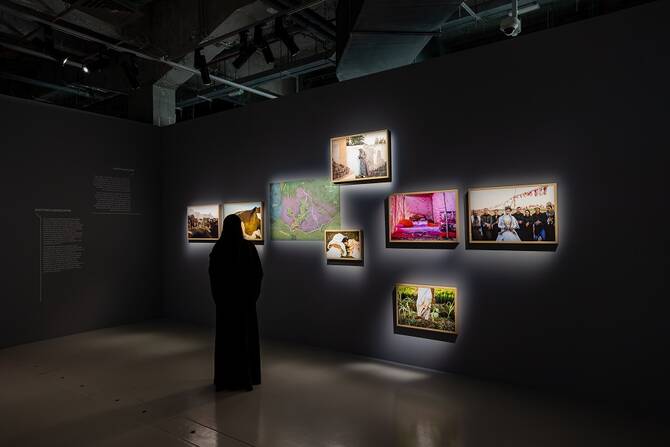
“As I Lay Between Two Seas,” another exhibition in the festival, is at the Doha Fire Station. Curated by Meriem Berrada, an independent curator and artistic director of the Museum of Contemporary African Art Al Maaden in Marrakech, the exhibition is a poignant and poetic display of 25 photographers from the Arab world and its diasporas grappling and coming to terms with ideas of identity, belonging and home.
“(The exhibition) approaches belonging not as a fixed state, but as a fluid, evolving condition shaped by memory, distance, rupture, and imagination,” Berrada told Arab News. “The exhibition unfolds through a non-linear narrative that invites diverse temporalities and perspectives to coexist.”

“As I Lay Between Two Seas,” another exhibition in the festival, is at the Doha Fire Station. (Supplied)
The title of the exhibition is drawn from a photographic series by Ali Al-Shehabi that conjures up a metaphor that speaks to the fluid, ever changing idea of understanding the self.
“Guided by the metaphor of the sea — shifting, unstable, and expansive — it draws inspiration from poets of the region whose writings on exile and longing offer a conceptual and emotional foundation,” Berrada said. “The selected works span a wide spectrum from documentary to conceptual and abstract practices. These works examine family and community dynamics, spiritual and philosophical relationships, and the sociopolitical structures that influence selfhood. They explore the symbolic ties to one’s roots, often shaped by personal memory and collective histories.”
From Lebanese artist Ziad Antar’s dreamy and edgy photographs of abandoned and unfinished buildings in Beirut and on the Lebanese coast and Saudi artist Moath Alofi’s series of desolated mosques along the winding road to Madinah, Saudi Arabia, to Palestinian Taysir Batniji’s “Just in Case #2” (2024), portraying images of a series of keys representative of feelings of loss and exile, the photographic works on show oscillate between feelings of pride, belonging, loss and longing.

The "Al Mihrab" exhibition at Doha Fire Station. (Supplied)
A poem by Palestinian poet and author Mahmoud Darwish titled “I Belong There,” appears on one wall between the display of several photographs reflecting through words many of the feelings expressed in the images on display. “I belong there. I have many memories. I was born as everyone is born […] I have lived on the land long before swords turned man into prey. I belong there.”
Elsewhere in Tasweer, a solo exhibition at Mathaf: Arab Museum of Modern Art on the works of Moroccan photographer and filmmaker Daoud Aoulad-Syad titled “Territories of the Instant” presents the essence of Moroccan popular culture and remote regions in the country. Another exhibition, “Threads of Light: Stories from the Tasweer Single Image Awards,” presents 31 captivating images from 2023 and 2024 awards highlighting the extraordinary in daily life, including sacred traditions in Oman, dynamic street scenes in Yemen and moments of contemporary change in Iraq and picturesque marine views of traditional boats in Doha.
As Berrada said of the festival, which can arguably apply to numerous works and shows in Tasweer this year: “It also reflects on the photographic medium itself — how image-making can question fixed and often deterministic categories of belonging and become a powerful tool for reimagining identity in a deeply interconnected world.”


