



MANILA: In political rallies, Senate hearings, and voter surveys ahead of Monday’s midterm elections in the Philippines, China has been an overwhelming — and unusual — presence.
The shadow of its giant maritime neighbor has loomed over the Philippines for years.
However, as the country’s two most prominent political clans flex their muscles in the usually low-key process to pick senators and local government leaders, relations with China have emerged as a political lightning rod.
The outcome could shape the country’s strategic positioning over the remaining half of President Ferdinand Marcos Jr.’s six-year term, which began in 2022.

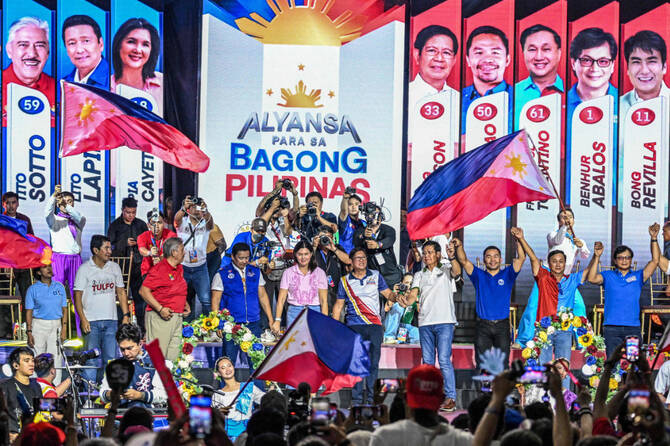
Philippine President Ferdinand Marcos Jr. attends a campaign rally of senatorial candidates under his party in Mandaluyong, Metro Manila, on May 9, 2025, ahead of the midterm elections. (AFP)
“Will we allow ourselves to return to the time when our leaders wanted us to become a province of China?” Marcos asked voters at a rally in February, in a dig at predecessor Rodrigo Duterte and his daughter Sara, who is currently vice president and a key Marcos rival.
During his 2016 to 2022 term, Duterte shifted foreign policy on China, adopting conciliatory rhetoric and downplaying disputes in the South China Sea.
The strategy drew concern from Washington and raised questions about the Philippines’ longstanding security alliance with the US.
In contrast, Marcos has moved to rekindle and deepen ties with Washington.
“These are hot-button issues that many Filipino voters can relate to, particularly on the issue of China. There was a time in the past when foreign policy did not matter that much during elections,” said Ederson Tapia, professor of public administration at the University of Makati.
“But now it does.”
An April survey found that most voters in the country of 110 million prefer candidates who assert Philippine sovereignty in the South China Sea, where the Marcos-led administration has taken a more assertive stance in its maritime confrontations with Beijing, which continue unabated.
It is a sentiment that Marcos has tapped into since he started his campaign for the slate of Senate candidates that he is backing.
In the February rally, Marcos pointed to his candidates, saying: “None of them were applauding China when our coast guard was being bombed with water, when our fishermen were being blocked, when their catch was stolen, and our islands seized to become part of another country.”
The Duterte camp enjoyed a surge of sympathy when he was arrested by the International Criminal Court in March and taken to The Hague, but Marcos’ candidates remain ahead in polls and appear poised to dominate the Senate race.
A Duterte spokesperson did not respond to a request for comment.
Through a months-long campaign, Marcos has kept up the pressure and focused on China as a key election issue, while his allies have aimed at Sara Duterte for her silence on China’s actions.
Sara, a likely future presidential candidate, was once a Marcos ally but now faces an impeachment trial on charges including a threat to assassinate the president if she were harmed.
In the Philippines, the 24-member Senate acts as the jury in any impeachment trial, making the midterms even more consequential in determining Sara Duterte’s political future.
Sara, who denied wrongdoing, responded to her impeachment with defiance, asking the Supreme Court to nullify the complaint against her.
A strong mandate for Marcos would not only define his ability to govern decisively in the remaining three years of his term but would also shape the 2028 presidential race, said Victor Andres “Dindo” Manhit, a political analyst and founder of Stratbase Group, a research and advisory firm.
Marcos is limited to a single term under the Constitution and is expected to anoint a successor. Sara Duterte would also be eligible to run in 2028 if she survives impeachment.
“Those who will run need to be tested on consistency about these issues,” Manhit said, referring to protecting the Philippines’ maritime rights and sovereignty.
“And one of them is the current vice president. She has not spoken against this coercion by China.”
A spokesperson for Sara Duterte did not respond to a request for comment.
The midterm election comes amid a proliferation of disinformation in the Philippines. Inauthentic accounts have driven up to 45 percent of discussions about the elections on social media, Reuters reported last month.
The use of fake accounts and paid influencers for political operations is widespread in the Philippines, but a top security official and a senator alleged last month that Chinese state-sponsored groups might be attempting to influence Filipinos.
China’s foreign ministry and its embassy in Manila have rejected the accusations.


