Not Italy’s Devil’s Island: Sardinia bristles at mafia inmate plan

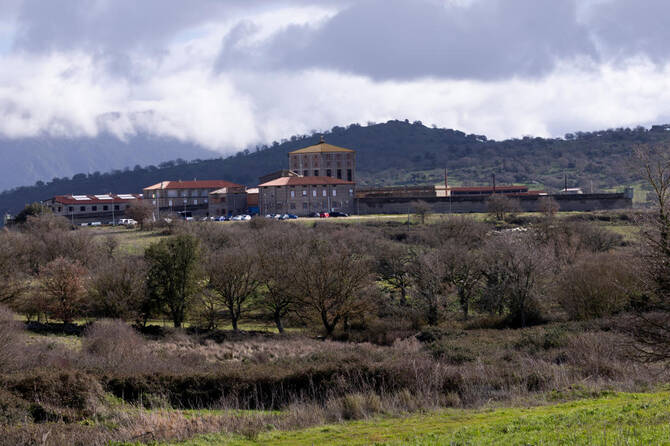
Above, Clouds move over the Badu’e Carros prison in Nuoro on Feb. 1, 2026. Sardinia is no longer seen as a dumping ground for criminals, instead building an international reputation around tourism, but that could change soon. (Reuters)
Short Url
Updated 07 February 2026
Follow

Not Italy’s Devil’s Island: Sardinia bristles at mafia inmate plan

  • A third of top-risk mafia prisoners could go to Sardinia
  • Officials say clans may follow relatives and infiltrate economy

NUORO: In Nuoro, a remote city on the Italian island of Sardinia, a high stone wall rings the local prison, a fortress-like complex once renowned for holding high-profile mobsters and convicted terrorists far from the mainland.

Only a handful of top mafiosi remain detained there and Sardinia is no longer seen as a dumping ground for criminals, instead building an international reputation around tourism.

But that could change under a plan of Prime Minister Giorgia Meloni’s government which has alarmed residents. In December, a justice undersecretary said about 750 prisoners held under the rigid “41bis” regime would be concentrated in just a few dedicated facilities across Italy, overseen by special guard units to improve security.

Sardinia has been told it may get nearly a third of them, split between Sassari in the north, already housing about 90, the capital Cagliari, where around 90 are due to arrive this month, and Nuoro — reviving old stigma concerns.

“Sardinia does not deserve to be seen as Italy’s Cayenne,” said Governor Alessandra Todde, invoking the notorious former French Guiana penal colony on Devil’s Island.

Worries of Mafia infiltration

Italy’s 41bis regime, named after the law that regulates it, is among the most restrictive in Europe. Introduced in 1992 after the murder of anti-mafia ‌judge Giovanni Falcone, ‌it imposes near-total isolation on prisoners and was designed to stop bosses running their operations from behind ‌bars.

The ⁠law says it should “preferably” ‌be enforced on Italy’s islands. The late boss of the Sicilian mafia, Salvatore “Toto” Riina, was among those once held in Sardinia.

Locals and authorities fear the government plan could prompt mafia clans to move from mainland Italy to be near jailed relatives, creating opportunities to launder illicit money and infiltrate business, particularly in less developed areas, such as Nuoro, a city of 30,000 people.

Silvio Lai, a Sardinian lawmaker with the opposition Democratic Party, visited the city prison last month and said renovation work was already ongoing, potentially making room for at least 30 new maximum-security inmates.

“Weak economies can be infiltrated easily, and Nuoro is about an hour’s drive from the Costa Smeralda,” Lai said, suggesting a mafia foothold in the city could swiftly spread to the island’s luxurious tourist resort.

The Justice Ministry did not respond to a request to comment on the work.

Improving ⁠national security

Autonomous mafia groups have never emerged in sparsely populated Sardinia, but magistrates say investigations have been opened into alleged clan penetration in the north of the island, possibly encouraged by the presence of detained ‌mobsters.

“Prosecutors are keeping a close watch on the phenomenon of Camorra (a mafia group based around Naples) ‍investments... especially in the tourism, hospitality and restaurant sectors,” said Cagliari chief prosecutor ‍Luigi Patronaggio.

At a December meeting with regional officials, Justice Undersecretary Andrea Delmastro Delle Vedove downplayed the risk of a mass move to Sardinia, minutes show, ‍arguing that families of 41bis detainees do not typically leave clan-controlled areas.

“This (plan) will ensure greater national security... will make individual prisons safer because only specialized prison guard units will be deployed,” Delmastro said.

However, Maria Cristina Ornano, head of the sentence enforcement tribunal in Cagliari, said police and the judiciary will need increased security resources if more mobsters arrive.

“Once organized crime takes root here, we will not be able to get rid of it. We can see it in parts of southern Italy, which are among the most


59-kilogram monster fish catches eyes at Nigerian fishing festival

Updated 15 February 2026
Follow

59-kilogram monster fish catches eyes at Nigerian fishing festival

  • Over the decades, the festival grew into one of Nigeria’s biggest cultural events, drawing international visitors, before insecurity and funding shortages reduced it to an occasional celebration

ARGUNGU: Local fisherman Abubakar Usman’s 59-kilogram monster catch was the major highlight of the UNESCO-listed Argungu fishing festival, which returned after a six-year hiatus because of the insecurity in northwestern Nigeria’s Kebbi state.
Thousands of people, including a handful of women and children, defied the blistering 39-degree heat to take part. Fishermen from Nigeria’s West African neighbors Niger, Chad, and Togo also came to compete.
The fishing festival was first staged in 1934 by the then traditional ruler of Argungu, Mohammed Sama. It was held to mark an end to a century-old history of hostility and distrust between his people and the region’s most powerful ruler, the Sultan of Sokoto, then Hassan Dan-Mu’azu.

FASTFACT

The festival has grown into one of Nigeria’s biggest cultural events, drawing international visitors, before insecurity and funding shortages reduced it to an occasional celebration.

Over the decades, the festival grew into one of Nigeria’s biggest cultural events, drawing international visitors, before insecurity and funding shortages reduced it to an occasional celebration. The last full edition was held six years ago, say organizers.
On Saturday, fishermen floated on brown, round gourds as they hunted for the biggest catch in Matan Fada river, using only their hands and nets in the river’s murky waters.
Thousands of spectators lined the riverbank cheering loudly.
For the Emir of Argungu, Al-Hajji Samaila Mohammed Mera, hosting the festival this year was a victory of some sort.
Parts of Kebbi state have seen sporadic militant attacks in recent years, with analysts blaming the Lakurawa terror group for the deadly violence.
“I came back to have a fuller experience,” said Adeniyi Olugbemii, 56, who is attending the festival a second time from neighboring Sokoto state.
Outside the arena that sits on the edge of the Matan Fada, chants, drumbeats, and cultural displays added to the atmosphere, highlighting the heritage that has turned Argungu into a global tourism draw.
Rukaya Ismaila, 23, said she had traveled from Kogi state, some 850 kilometers away, to attend the festival for the first time.
“The famous Argungu that we’ve been told about since primary school,” she said.
“It is worth all the excitement,” she added, praising the way the competing fishermen helped each other out.
Days of activities preceded the fishing competition, including a motor rally from Nigeria’s capital city, Abuja, a Durbar procession, and a variety of cultural events.
Abubakar Usman’s hefty catch earned him two new saloon cars and 1-million-naira cash prize (about $739).
Hundreds of much smaller catches ended up at a makeshift market set up on the adjoining streets to the arena.
The event was overshadowed by a prominent political campaign for the re-election of President Tinubu and Kebbi Gov. Mohammed Nasir Idris.
Billboards and posters of both men lined the streets leading to the river arena.
Supporters in blue t-shirts emblazoned with their images drummed and danced, drawing crowds of their own, while songs eulogising the visiting president blared through speakers inside the main arena.
Earlier in the day, a false start around midday had forced the already anxious contestants to plunge into the river. They had defied the scorching sun to wait for the arrival of President Bola Tinubu.
The president arrived more than two hours later, after which the contest was restarted.